How to Outbound ZoomInfo EMEA Data Under GDPR Article 14
ZoomInfo gives the Article 14 notice for its own processing. The moment you outbound an EEA contact you become a separate controller - here is the legal basis, notice, balancing test, and opt-out you owe.
If you buy a ZoomInfo seat to prospect into Germany, France, or the UK, the first legal question is not "is the data accurate" but "am I allowed to email this person at all." I looked at the coverage side of that question when I compared Cognism Diamond Data against ZoomInfo's EMEA records; this post is about the other half - what GDPR actually asks of you the moment you press send on a contact you never collected yourself. (Beauhurst's UK and Germany funding data, now wired into Clay, is another EMEA source worth running through the same check.)
The short version: ZoomInfo collected the record under its own lawful basis and gave its own notice, but the instant you load that contact into a sequence you become a separate controller with separate obligations. ZoomInfo says as much in its privacy policy, which as of mid-2026 states it processes EEA, UK, and Swiss data "as necessary for the legitimate interests of ZoomInfo and ZoomInfo's customers and partners to engage in direct marketing, sales" and that it "provides notice to all data subjects as required by GDPR Article 13 or 14, as appropriate." That covers ZoomInfo's processing. It does not cover yours.
ZoomInfo provides notice to all data subjects as required by GDPR Article 13 or 14, as appropriate [...] as necessary for the legitimate interests of ZoomInfo and ZoomInfo's customers and partners to engage in direct marketing, sales.
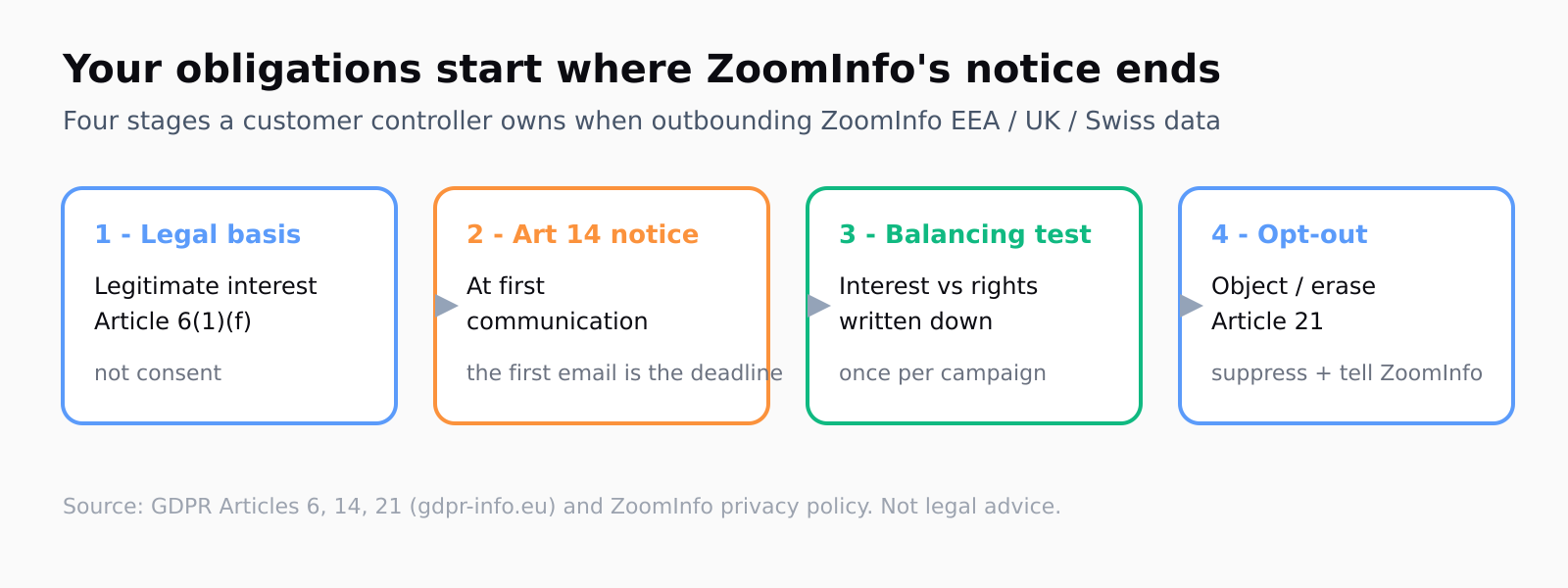
So here is the practitioner's read of what you owe, in the order you should handle it. None of this is legal advice (I am not your lawyer), but every claim below links to either the GDPR text or ZoomInfo's own policy so you can check the wording yourself.
How to confirm your legal basis for ZoomInfo EMEA data
You did not get consent from these people - nobody clicked a box to be in ZoomInfo's database - so consent is off the table. The basis you are relying on is legitimate interest, Article 6(1)(f), the same basis ZoomInfo names for itself. B2B direct marketing is a recognised legitimate interest; recital 47 of the GDPR says so in as many words. But "recognised" is not "automatic." Legitimate interest is a three-part test - a real interest, processing that is necessary for it, and a balancing exercise against the person's rights - and you have to be able to show your work, not ZoomInfo's.
The practical move is to write down, before you send anything, which interest you are pursuing (selling a specific product to a specific role at a specific company type) and why email to a work address is a proportionate way to pursue it. That document is your legitimate-interest assessment. You will need it twice: once for your own Article 30 records, and once if a data subject or a regulator asks you to justify the contact.
What to put in the Article 14 first-contact notice
This is the part most teams skip and the part that bites. Because you obtained the data from a third party rather than from the person directly, the notice rules you fall under are Article 14, not Article 13. Article 14 has a hard deadline that is easy to miss: if the data "are to be used for communication with the data subject," the notice is due "at the latest at the time of the first communication to that data subject." In plain terms, your first cold email is the deadline. There is no grace period after it.
The other timing branch matters too - even if you sit on the record without contacting anyone, Article 14(3)(a) gives you "within a reasonable period after obtaining the personal data, but at the latest within one month" to provide the notice. Whichever comes first wins, and for outbound the first email almost always comes first.
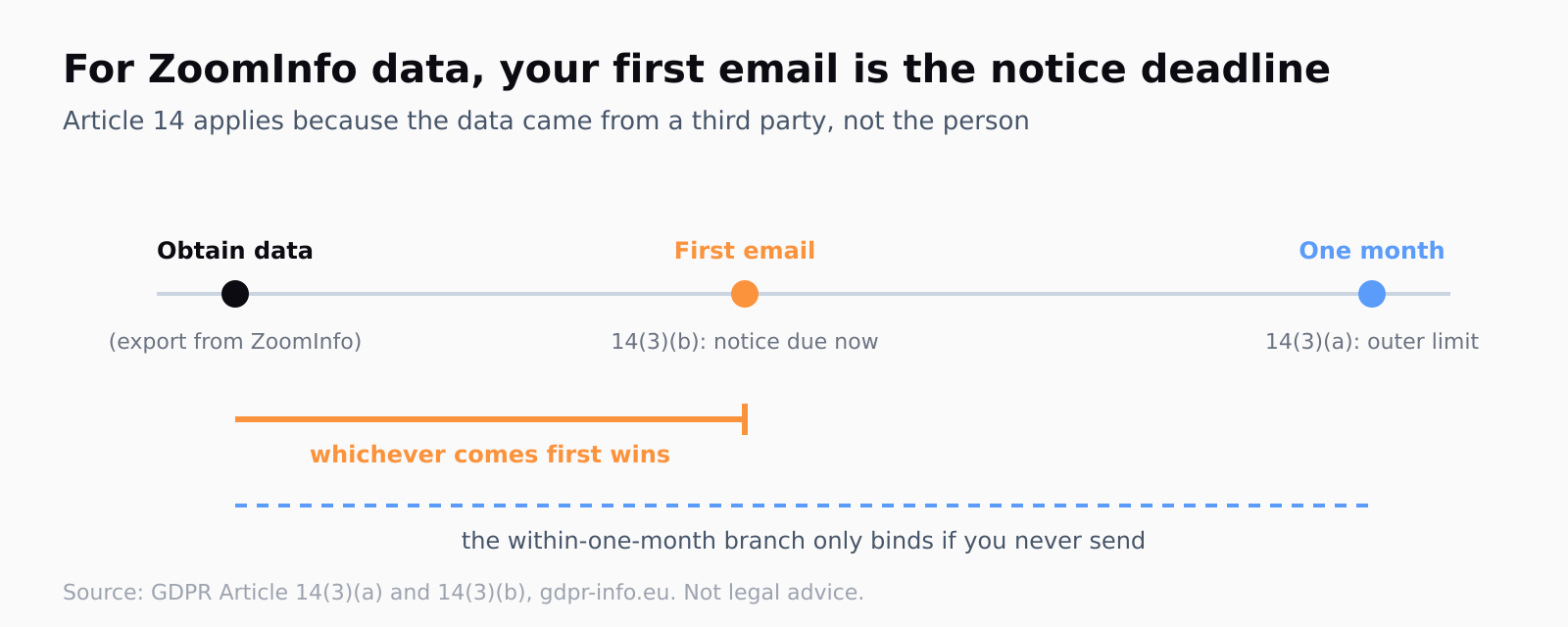
[...] if the personal data are to be used for communication with the data subject, at the latest at the time of the first communication to that data subject.
What goes in the notice is enumerated, not vibes: who you are and your contact details, the purposes and the legal basis (legitimate interest), the categories of data you hold, who you might share it with, the storage period, and the rights the person has - including, under Article 14(2)(c), the right "to object to processing." Two items trip people up specifically. Article 14(2)(b) wants you to spell out "the legitimate interests pursued by the controller or by a third party" - not just name the basis but say what the interest is. And Article 14(2)(f) wants "from which source the personal data originate," which means you have to be willing to tell the recipient you got their details from ZoomInfo. Most teams write a two-sentence footer in the first email that does all of this and links to a fuller privacy page. That is enough, as long as it is genuinely at first contact.
How to run the legitimate-interest balancing test before you send
The balancing test is where the basis lives or dies, and it is genuinely fact-specific. The question is whether your commercial interest is overridden by "the interests or fundamental rights and freedoms of the data subject." A few things tilt it in your favour: the data is a work email at a business, the offer is plausibly relevant to that person's job, the volume is targeted rather than spray-and-pray, and you make opting out trivial. A few things tilt it against you: scraping personal Gmail addresses, contacting roles with no conceivable interest in your product, or ignoring an earlier objection.
(To be fair, this is the step that feels most like paperwork for no reward - right up until a complaint lands and the regulator asks to see it.) Write it once per campaign type, not once per contact. If your ICP is "RevOps leaders at Series B SaaS in the DACH region," one assessment covers the whole list. The freshness of the underlying data matters here too, because emailing someone who left the company eighteen months ago is both useless and a small Article 5 accuracy problem - I wrote separately about auditing ZoomInfo data freshness before renewal, and the same stale-record risk that wastes sends also weakens your compliance posture.
How to wire opt-out and erasure back to ZoomInfo
An objection or an erasure request is not just a "remove from list" click. Under Article 21, a person can object to direct-marketing processing at any time, and once they do you must stop - there is no balancing test left to run at that point. So your sequencing tool needs a real suppression list, and a request to one of your sending domains has to suppress across all of them; I went through the multi-domain version of this when writing about honouring opt-outs across multiple sending domains. The wrinkle with ZoomInfo data is that the suppression should also flow back upstream: ZoomInfo's policy says "EU, UK, and Swiss citizens may choose to opt out of such disclosures" and directs requests to its Trust Center or privacy@zoominfo.com, and it "honors the rights of data subjects provided in Articles 12-23, including the right to be forgotten." If the person told you to delete them, the clean move is to suppress locally and point them at ZoomInfo's process so the record does not just reappear in your next export.
This is the seam Leadex sits on, and it is why we attach a source URL and a timestamp to every row the agent returns. Article 14(2)(f) asks you to disclose "from which source the personal data originate," and Article 30 asks you to keep records - both are trivial to answer when every contact already carries its provenance, and miserable when your list is a CSV with no memory of where each line came from. If you want to see the shape of that, the plan-preview step shows you the exact sources before the agent fetches anything, so the provenance is decided up front rather than reconstructed under a deadline.
None of this makes ZoomInfo EMEA data unusable - it makes it usable on purpose rather than by accident. The legal basis is real, the notice is a footer and a linked page, the balancing test is a paragraph you write once per campaign, and the opt-out is a suppression list you were going to need anyway. The teams that get into trouble are the ones who treated "ZoomInfo gave notice" as the end of the sentence rather than the start of theirs.
FAQ
Can European companies legally use ZoomInfo data for outreach?
Yes, in principle, if you can stand on legitimate interest under Article 6(1)(f), give the Article 14 notice at first contact, and honour objections. The data being legally collected by ZoomInfo does not by itself make your use of it lawful - you are a separate controller with your own basis to justify.
What notice do I have to give when cold-emailing ZoomInfo EU contacts?
An Article 14 notice, because you got the data from a third party rather than the person. It must identify you, state legitimate interest as the basis, describe the data and its source, give the storage period, and explain the right to object. Article 14(3)(b) makes it due "at the latest at the time of the first communication," so it belongs in the first email.
Is legitimate interest enough on its own, or do I need consent?
For B2B email to work addresses, legitimate interest is the usual basis and consent is generally not required under the GDPR itself. National rules layered on top (such as ePrivacy implementations) can be stricter in some countries, so a real legitimate-interest assessment plus the Article 14 notice is the floor, not a guarantee for every member state.
Do I have to tell the recipient I got their details from ZoomInfo?
Effectively yes. Article 14(2)(f) requires disclosing "from which source the personal data originate," so your notice has to name the data provider or category of source. Naming ZoomInfo directly is the simplest way to satisfy it.