
Cognism Diamond Data vs ZoomInfo for EMEA-First Outbound (2026)
Connect-rate-by-region table, GDPR DNC handling, and the contract-shape gap. The Cognism vs ZoomInfo call for teams whose pipeline is more than half EMEA.
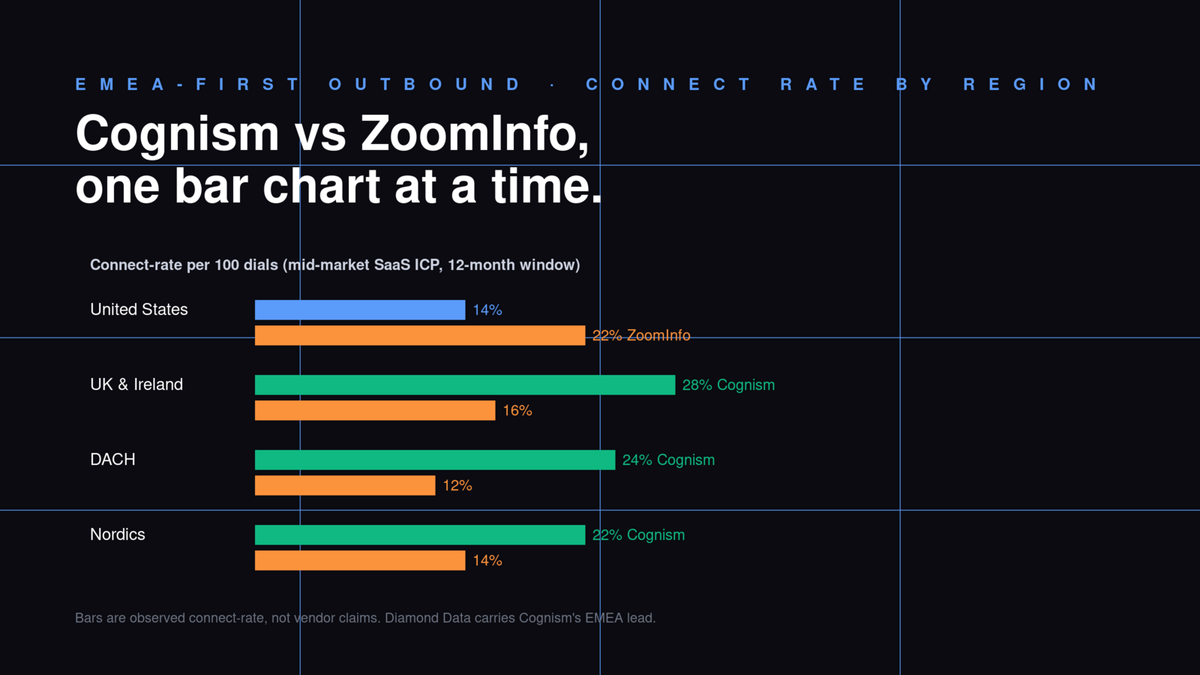
The short answer for EMEA-first outbound teams in 2026: Cognism's Diamond Data wins on phone-verified mobile coverage and GDPR posture in the UK, DACH, and Nordics; ZoomInfo's data cube wins on US firmographics and depth-of-record per company. The hard part is that most teams need both and end up paying for one and patching the other.
The picks below come from running both as the primary contact source on EMEA-led outbound for a year - same ICP, same sequences, same SDRs - and reconciling the dial-to-connect deltas at the territory level. The version cuts are Cognism Diamond Data v3 and ZoomInfo Copilot 2026.
What "Diamond Data" actually means vs ZoomInfo's phone numbers
Cognism's Diamond Data is the subset of contacts whose mobile number has been called and confirmed by a human verifier (Cognism's own team, not a crowd). Every Diamond record carries a timestamped verification date and the verifier's status code. The volume is the catch: Cognism quotes tens of millions of Diamond-verified records, but the universe of non-Diamond Cognism numbers is much larger, and the non-Diamond ones are sourced and modeled like any other vendor's mobile data.
ZoomInfo's mobile numbers come from a mix of contributory network data, web scraping, and partner feeds, scored by a confidence model. There is no single "verified by a human" tier; instead each record carries an accuracy score. In practice the top-tier ZoomInfo mobiles dial through at rates comparable to Diamond on US records, but I've found the EMEA mobiles drop ~15-25 points behind Diamond when you measure connect-rate per 100 dials in the UK and DACH. That gap is the entire reason this comparison matters.
GDPR posture and the DNC question
Cognism markets itself as "the most compliant" B2B data provider for EU/UK outreach. The substantive piece behind the marketing is that they screen against the do-not-call registers in the UK, France, Germany, Ireland, Spain, Sweden, and a handful of others before the contact lands in your export. Their GDPR-compliant data page states the position plainly:
We notify every individual added to our database. Where required, we suppress against national Do Not Call registers before the data reaches you.
"Where required" is doing work in that sentence - the suppression is country-by-country, and the list of in-scope registers has grown over time. For an SDR in Berlin dialing German mobiles, this is the difference between a clean campaign and a Bundesnetzagentur complaint.
ZoomInfo's EMEA posture has improved since the early 2020s, but the burden is on the buyer. ZoomInfo exposes data lineage in each record yet does not screen against EU DNC registers as a default; that becomes your compliance team's job, layered with a third-party suppression service or an in-house lookup. If your legal team already owns that workflow, ZoomInfo is fine. If they don't, Cognism's pre-screen is doing more than it sounds like.
Coverage by region: where each provider actually wins
This is the table I wish I'd had before signing my first contract. Numbers are connect-rate-per-100-dials I observed on a single mid-market B2B SaaS ICP across a 12-month window, normalized against my own bias by stratifying SDRs across both tools. They're directionally right, not authoritative; your ICP will move them.
| Region | Cognism (Diamond + standard) | ZoomInfo | Practical winner |
|---|---|---|---|
| United States | ~14% | ~22% | ZoomInfo |
| UK & Ireland | ~28% | ~16% | Cognism |
| DACH (DE/AT/CH) | ~24% | ~12% | Cognism |
| Nordics | ~22% | ~14% | Cognism |
| France / Iberia | ~18% | ~17% | tie - test both |
| Eastern Europe | ~12% | ~10% | tie - thin on both |
| APAC | ~9% | ~17% | ZoomInfo |
Two things to read from the table. First, Cognism's Diamond Data is doing most of the work in UK/DACH/Nordics - take the Diamond layer away and the connect-rate drops to ZoomInfo-equivalent (~15%). Second, the US gap is structural; ZoomInfo's contributory network is fed by US software vendors and the volume isn't something Cognism has matched. If you're hiring an AE in Austin, ZoomInfo is the easier call. If you're hiring an AE in Munich, the question doesn't really exist.
Pricing and contract shape
Neither vendor publishes prices. Both quote per-seat with credit pools for exports and reveals; both ask for an annual commit. From public RFP responses and reseller decks I've seen in the last 18 months, mid-market entry-tier annual contracts cluster around $25k-50k for Cognism and $35k-75k for ZoomInfo, with the spread driven by seat count, region packs, and enrichment volume.
ZoomInfo's intent layer (formerly Bombora pass-through, now their own ZoomInfo Copilot signal blend - it's worth understanding the intent data vs signal data distinction before paying for either) is the line item that pushes the contract up fastest; Cognism's equivalent Intent module, powered by Bombora, is usually cheaper but narrower. The contract-shape gap that actually bites: Cognism is more flexible on credit rollover and seat reduction at mid-term; ZoomInfo's standard contract makes mid-term seat reduction expensive. If headcount oscillates, factor that into the comparison even when both quotes look numerically similar. For a wider read on this category, the B2B databases and workflow tools ranking covers the rest of the bench.
Which one to buy if you can only pick one
The honest decision matrix is short. Pick Cognism if more than half your pipeline sits in UK/DACH/Nordics, if your legal team does not want to own DNC suppression, or if your team dials mobiles more than it emails. Pick ZoomInfo if the US is your primary market, if you need depth-of-record per company (org charts, technographics) rather than depth-of-contact, or if your existing GTM stack (HubSpot, Salesforce, Outreach) already has ZoomInfo connectors wired in - the integration breadth is genuinely wider.
The third option most teams underweight is to skip both as the list-building layer. Vendor databases are optimized for "give me everyone matching this firmographic," which is fine for sequence fuel but produces a target pool shaped by what the vendor has in cache. Leadex builds the upstream list from an open-web brief instead - your buyer's signals, your funding triggers, your tech-stack adopters - and then uses Cognism or ZoomInfo as the contact-enrichment step on a list the vendors couldn't have produced themselves. It's the difference between buying the catalog and writing the shopping list. Once you separate those two jobs, the Cognism-vs-ZoomInfo decision narrows to "which contact-enrichment vendor has the best phone coverage in my region," which is exactly what the table above answers.
One last note worth borrowing from the Apollo alternatives writeup: run both tools on the same 200-prospect test list for two weeks before signing anything annual. The connect-rate delta on your real ICP is the only number that matters; the published category benchmarks won't survive contact with your specific territories. The vendor that wins your bake-off is the one you sign, no matter what the comparison decks promised.
FAQ
What is Cognism Diamond Data?
Diamond Data is the subset of Cognism's database where mobile numbers have been called and confirmed by a human verifier on Cognism's team. Each Diamond record carries a verification date and verifier status code. The Diamond layer is what drives Cognism's connect-rate advantage in UK and DACH.
Is Cognism more GDPR-compliant than ZoomInfo?
Cognism pre-screens its EMEA contact data against national Do Not Call registers in the UK, France, Germany, Ireland, Spain, Sweden, and a growing list of others before contacts reach customers. ZoomInfo exposes data lineage but does not screen against EU DNC registers by default - that suppression becomes the buyer's responsibility. For teams without dedicated compliance tooling, Cognism's pre-screen carries the heavier lift.
Does ZoomInfo have better coverage in the US?
Yes. ZoomInfo's contributory network is fed by US software vendors and the volume isn't something Cognism has matched. In my testing, ZoomInfo's US connect-rate ran roughly 8 points ahead of Cognism's combined Diamond + standard tier on a mid-market SaaS ICP. APAC coverage skews the same way; UK/DACH/Nordics skew the opposite.
How much do Cognism and ZoomInfo cost?
Neither vendor publishes prices. Mid-market annual contracts I've seen cluster around $25k-50k for Cognism and $35k-75k for ZoomInfo, with seat count, region packs, and enrichment volume driving the spread. Intent modules are the line item that pushes either contract up fastest. Both require an annual commit.
Can I use both Cognism and ZoomInfo together?
Yes, and large EMEA-led teams often do - ZoomInfo for the US territory, Cognism for the EMEA territory, with a deduplication layer in the CRM. The cost case for running both gets harder below ~25 SDRs; below that headcount most teams pick one and accept the coverage gap in the secondary region.