Apollo Alternatives: 10 Tools Compared by Use Case (2026)
Apollo at $49-119/user is the default for a reason: 275M contacts, free tier, sequencer in the box. Here's an honest look at the ten tools people compare it against in 2026 - ZoomInfo, Cognism, LeadIQ, Hunter, Lusha, Seamless, RocketReach, Clay, Leadex - clustered by use case, not feature checkbox.
"Apollo alternatives" is one of the more honest searches in B2B sales: people don't run it because Apollo is bad - they run it because Apollo is the default and they want to know what they're missing. Apollo in 2026 sells four tiers (Free, Basic at $49, Professional at $79, Organization at $119 per user per month on annual billing), claims 275M+ contacts and 73M companies, and ships a sequencer and dialer in the same box. For a founder doing founder-led sales next Tuesday, that is a defensible first choice.
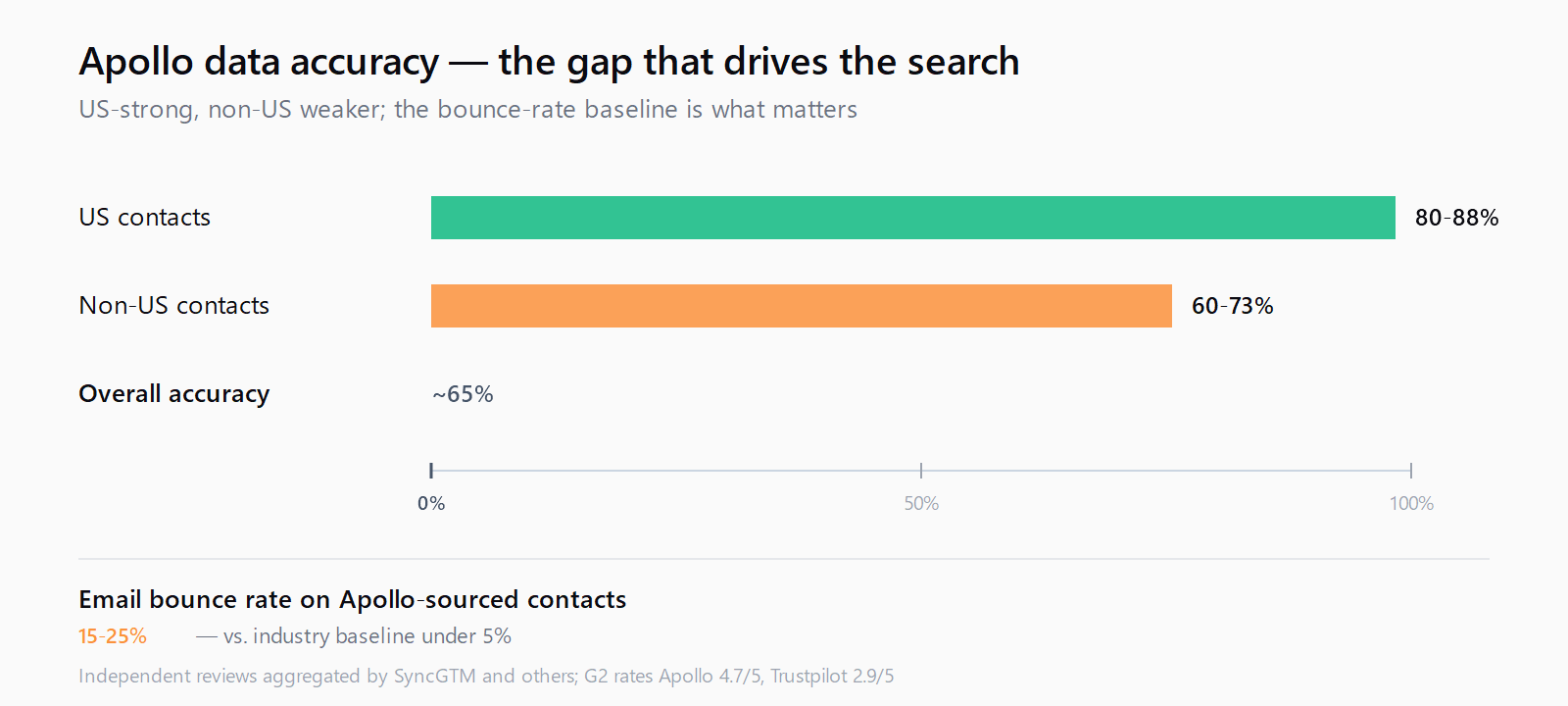
The reason the search exists is what happens after Tuesday. Independent reviews put Apollo's data accuracy around 65% overall - 80-88% in the US, dropping to 60-73% outside it - and report email bounce rates of 15-25% on Apollo-sourced contacts (the industry baseline is under 5%). The credit system rewards careful use and punishes everything else: monthly expiry, no rollover, phone reveals at 8x the cost of email, $0.20 per overage credit with a 250-credit minimum. G2 sits at 4.7/5 across 9,400+ reviews; Trustpilot sits at 2.9/5 and the gap is mostly billing disputes and account-suspension threads. Both numbers are true.
The ten tools people compare against Apollo cluster into four groups. Quick directory, then prose:
- Apollo - 275M-record DB, sequencer, dialer, free tier.
- ZoomInfo - enterprise DB, US-strongest, quote-only.
- Cognism - GDPR-first, phone-verified EU mobiles, platform fee + per-seat.
- LeadIQ - lighter prospecting layer, unified credits from $15/user.
- Hunter - domain search + email finder, $34-149/mo.
- Lusha - browser-extension contact reveal, free tier + $37+/mo.
- Seamless.AI - $79/mo headline, daily credit expiry.
- RocketReach - email + phone lookups, $33-175/mo annual-only.
- Clay - spreadsheet-first enrichment orchestrator, 100+ data sources.
- Leadex - chat-native open-web research agent, BYOK enrichment.
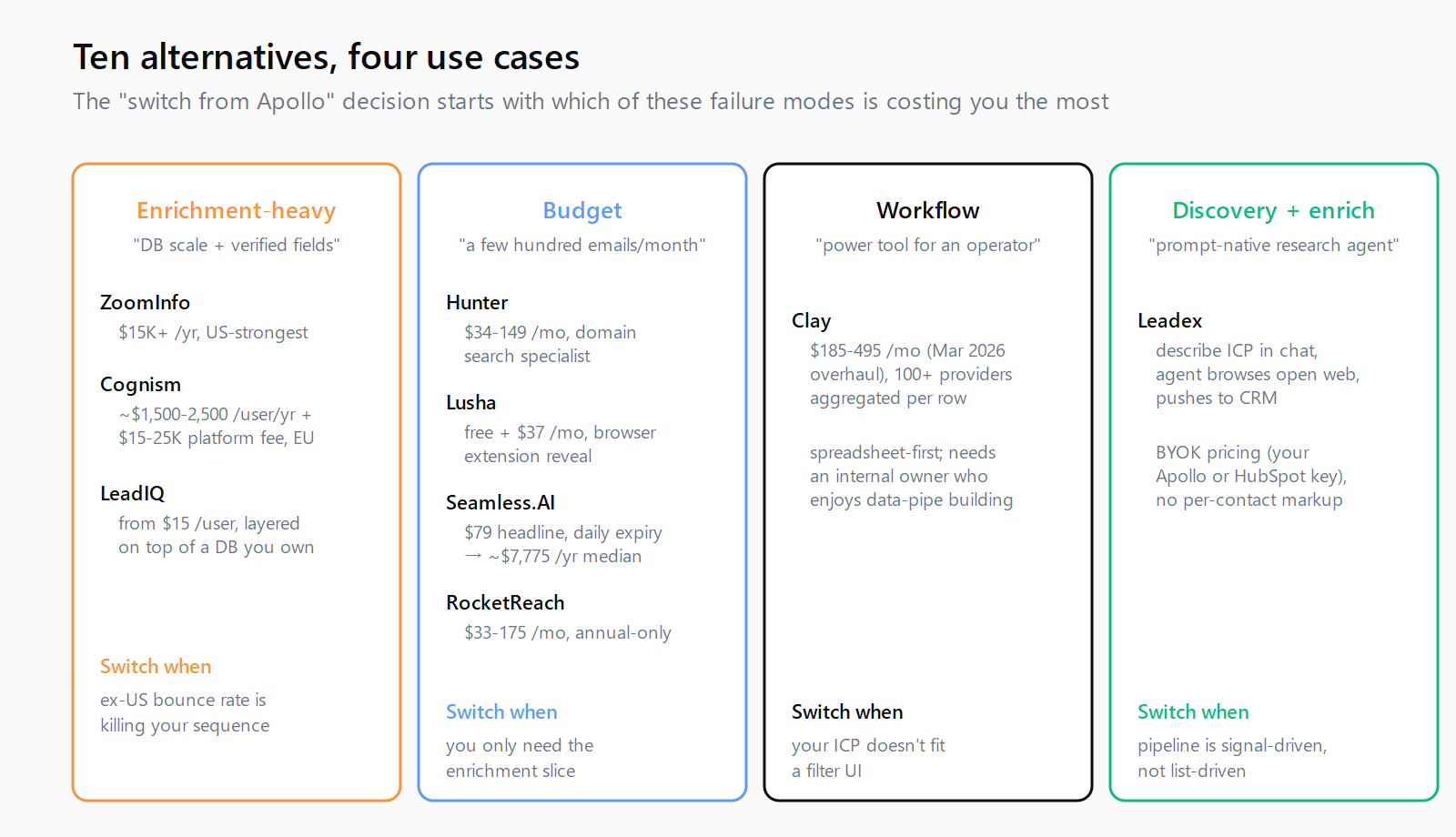
The honest version of "switch from Apollo" almost never starts with feature checkboxes. It starts with one of: my ex-US bounce rate is too high, my ICP doesn't fit a filter UI, or my pipeline is now driven by signals instead of static lists. Each cluster below answers a different one of those.
The enrichment-heavy cluster - ZoomInfo, Cognism, LeadIQ - competes on database scale and verified fields, not on workflow. ZoomInfo is the procurement-friendly enterprise default: best US coverage, intent data, vendor-verified records, and a quote-only model with $15K+ annual minimums that most analysts cite. Cognism is the EU answer - phone-verified mobiles, GDPR/DNC screening, and quote pricing that Salesmotion's 2026 breakdown pegs around $1,500-$2,500/user/year on top of a $15-25K platform fee. Here is the named practitioner quote that crystallises why this cluster exists at all:
We trialled Apollo, which didn't produce adequate results. We evaluated ZoomInfo but found the data to be too US-centric, which is why we went with Cognism.
- Marc Parsons, SDR Manager, OneUp Sales (quoted on Cognism's competitor blog, so read with the source bias in mind - but the geographic complaint matches independent reviews). LeadIQ is the third option in this cluster and the one most people forget: it doesn't try to be the database, it tries to be the lightweight prospecting surface on top of one, with unified credits from $15/user and no daily expiration. If your team is already paying for a DB elsewhere, LeadIQ is the cheaper Chrome-extension layer; if you're starting from zero, it isn't enough on its own.
The budget cluster - Hunter, Lusha, Seamless.AI, RocketReach - is where most "I just need a few hundred verified emails this month" searches end up. Hunter migrated to Unified Credits in July 2025 and runs $34-149/month for the self-serve tiers; it is genuinely good at one thing - "find emails at this domain" - and weak at everything else. Lusha is the browser-extension reveal tool, $37.45/mo for 4,800 credits/year on the Starter plan, with a free tier that is plenty for hand-rolled prospecting. Seamless.AI lists $79/user/month and then does the credit-expires-daily move that LeadIQ's analysis argues pushes the median buyer to $7,775/year (!) - read the contract before signing. RocketReach is the workhorse for $33-175/month annual-only plans with phone lookups locked behind the Pro tier; not exciting, but the lookup volume is honest. None of these four tools tries to replace Apollo wholesale; they replace the *enrichment* slice of Apollo for a tenth the spend, and you give up the sequencer.
The workflow-heavy cluster has exactly one entrant worth naming, which is Clay. Clay does not own a database; it is a spreadsheet that aggregates 100+ providers (including Apollo) per row, runs templates across columns, and turns prospecting into a maintained data pipeline. After the March 2026 pricing overhaul the entry plan is Launch at $185/month (2,500 Data Credits, 15,000 Actions) and Growth at $495/month - a serious step up from Apollo's $79 and a serious step down from ZoomInfo's quote. The right way to think about Clay is that it is a *power tool for an operator who already knows what they want to build*. The wrong way is to treat it as a turnkey product. If your team has someone who genuinely enjoys spreadsheet engineering, Clay is the strongest non-database option in the category. If they don't, the tool sits unused and the bill keeps coming.
The fourth cluster is the one this site cares about, so I'll be careful here. Leadex sits at the seam between discovery and enrichment: you describe an ICP in plain English ("Series A fintechs in France whose Head of Eng posted about hiring in the last 90 days"), the agent drafts a research plan, browses the open web, enriches via your own Apollo or HubSpot key, dedupes, and pushes to your CRM. Where Leadex actually wins against Apollo is on three axes - prompt-based briefs that filter UIs cannot express, signal stacking across multiple sources in one run, and a BYOK pricing model with no per-contact markup. Where Apollo wins is everywhere else: the 275M-record database, the per-user price, the dialer, the sequencer. Leadex isn't a static contact graph and never tries to be. If your bottleneck is "Apollo's filters can't describe what we need" or "we want signals + research as one motion," that's the switch worth making; if your bottleneck is "we need a million emails next quarter and a dialer," stay where you are. The honest version is in our compare page, including what Apollo does that we do not.
The counter-take is straightforward enough that it should be said out loud: for most teams under 10 reps doing US-centric outbound at moderate volume, Apollo at $49-79/user with the free tier and the built-in sequencer is the right call. The bounce rates are real, the credit system is irritating, and the support stories on Trustpilot are bad - but the shortest path from "we need to send cold email tomorrow" to "we are sending cold email tomorrow" still runs through Apollo. The reason to leave is rarely Apollo itself; it's that one of those three failure modes (ex-US data, unstructured ICPs, signal-driven motion) starts costing you more than the migration would. Until then, the alternative tools above are mostly *additions* to Apollo, not replacements. Cognism for EU coverage, Clay for enrichment templates, Hunter for domain searches, Leadex for prompts the filter UI can't hold - these layer on top.
One useful next thought, since the directory above only ranks tools by category. If you're trying to decide which cluster to look at first, the AI lead-generation tools roundup walks through the buying criteria, and the prompt-based AI SDR tools follow-up covers the chat-native end of the market specifically. If you've already picked a tool and are stuck on what to actually ask it, the prospecting prompts notebook has the briefs that survive contact with reality. None of those will tell you whether to switch from Apollo. They will tell you whether you're solving the right problem. (See also: audit your ZoomInfo data freshness before you renew.)