Clay Alternatives for Teams Without a RevOps Engineer
Clay is the most powerful tool in its category, and the category is 'spreadsheet for GTM engineers.' This post is for teams that want signal-based prospecting without hiring one - with an honest look at Common Room, Pocus, Persana, HG Insights, and Leadex.
Clay is the most powerful tool in its category, and the category it's in is "spreadsheet for GTM engineers." That second clause is doing more work than most teams realise when they swipe the credit card. Clay's table-and-formula UX is genuinely flexible - waterfall enrichment, AI prompts per row, 150+ providers wired together - and it is also the reason a non-trivial share of Clay seats sit half-used three months after purchase, while someone on the team tries to find a half-day to "really learn it this quarter."
This post is for the teams who looked at Clay, ran the math, and realised they don't have - and don't want to hire - a full-time RevOps or GTM engineer to operate it. There are honest alternatives. There is also a counter-take, because for some teams Clay is the correct purchase and you should buy it tomorrow.
First, the facts. After Clay's March 11, 2026 pricing overhaul, the self-serve plans collapsed from three tiers to two: Launch at $185/month (or $167 on annual) for 2,500 Data Credits and 15,000 Actions, and Growth at $495/month for 6,000 Data Credits and 40,000 Actions. Enterprise is custom and lands somewhere between $30k and $154k a year based on contract data leaked into review sites. The same overhaul split the credit system into Data Credits (for marketplace enrichment) and Actions (for platform operations), and top-up credits are billed at 50% above your plan's standard rate when you blow through your monthly allocation - which on the Launch plan is the most common surprise on the invoice. There is no public "agency tier"; agencies route through Enterprise like everyone else.
None of that is the actual problem. The actual problem is what Clay's own Head of GTM Engineering will tell you on the record:
If we were starting from scratch today, the first GTM hire would be a GTM Engineer. Before the first AE.
- Everett Berry, Head of GTM Engineering, Clay
Read that twice. The team that builds Clay is telling you that the operating model assumes an engineering-shaped person in the loop before a salesperson. That isn't a critique - it's an org-chart honest description of how the tool is meant to be driven. A 2026 review aggregation across 500+ GTM professionals, summarised on Hakulabs, found that 28% of negative Clay reviews cite the learning curve as the primary issue, and Reddit threads in r/coldemail and r/sales hover around "amazing once it's working, but getting there took me a week" (and that's from a technical user). Multiple G2 reviewers peg the time to build a sophisticated trigger-based, multi-source enrichment workflow at two to four weeks, which is fine if your team has those weeks and not fine if your team is three people, one of whom is also the founder selling. If your team doesn't already have someone whose job is "build and maintain workflows," Clay is going to underperform its sticker price for you - not because the tool is bad, but because nobody is going to drive it past the demo.
The alternatives split along the axis of where the signal lives. Common Room ("Pipeline powered by buyer intelligence") leans into community and usage signals - Slack, Discord, GitHub, docs visits - which is the right pick if you sell a developer tool or a community-led product and your highest-signal events happen outside a CRM. Pocus ("Make outbound feel like inbound - with AI") leans into product-usage data and is built for PLG companies whose best leads are the ones already poking at the free tier. HG Insights ("Fuel Your GTM Strategy with Actionable Revenue Growth Intelligence") is the closer standalone analog to what Clearbit used to be - technographic and IT-spend intelligence - now that Clearbit itself has been folded into HubSpot's Breeze suite post-acquisition. Persana ("10x Your Sales Prospecting with AI") is the closest in shape to Clay's table model, with AI agents acting on rows and a noticeably softer ramp; if you like the spreadsheet metaphor but bounced off Clay's formula bar, this is the one to test next.
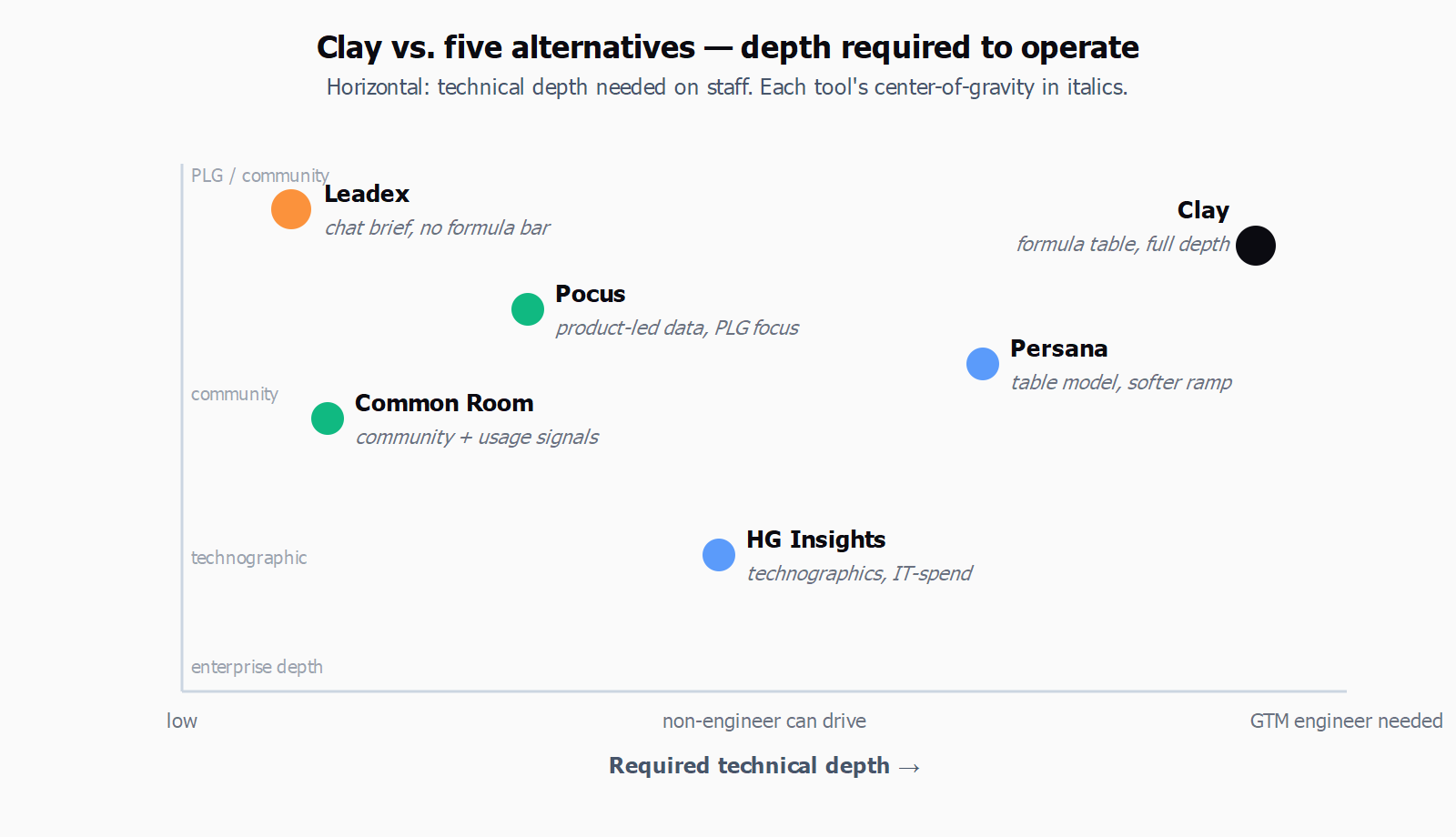
The fifth shape is the one we work on. Leadex is a prompt-driven research agent: you describe the ICP in plain English ("Series A fintechs in France whose Head of Eng posted about hiring in the last 90 days, exclude anyone already in our HubSpot"), the agent drafts a research plan you approve, browses the open web, enriches via your own Apollo or HubSpot key, dedupes, and lands a CSV in your CRM. There is no table to maintain and no formula bar. The honest caveat: Clay's enrichment graph - 150+ providers, custom waterfalls, per-row AI prompts as reusable templates - is enormous, and Leadex does not try to match that surface area. Leadex wins for "I want a list this afternoon and I'll describe what I want in plain English"; Clay wins for "we have a library of 40 enrichment templates we re-run across hundreds of lists a month." Different tool, different team shape.
Worth noting that "no formulas" doesn't mean "no signals." The same trigger-based moves that make Clay valuable - new funding rounds, exec hires, hiring spikes, tech-stack switches - are buildable in any of these tools, including Leadex. We wrote up the underlying pattern in no-code signal-based workflow, and a broader survey of the prompt-driven layer above the data sits in AI SDR and prompt-based tools. The signal layer is portable; the question is which UX you want to express it in.
Now the counter-take, because the strong version of "Clay is hard" is wrong. Clay is genuinely the best buy on the market if three things are simultaneously true. One: someone on staff already has GTM-engineer or technical-RevOps reps - they read API docs for fun and they're going to be there in twelve months. Two: outbound volume is north of roughly 10,000 contacts a month, so the credit math amortises across enough rows to matter. Three: you're going to reuse the workflows you build - waterfall enrichment templates that fire across many lists, not one-off ICPs that get built once and never run again. If you tick all three, nothing else has Clay's depth, and the alternatives above will feel like they've capped you. If you tick one or zero, you're going to spend $5k-$50k a year on a tool you barely operate, and the right answer is one of the lighter shapes - or, if you're cross-shopping a chat-native option, ours. The same analysis applies if you're also weighing Apollo alternatives: the question isn't which tool is "best," it's which one your team will still be using in six months.
The honest read on the category is that Clay solved the hard problem (composable enrichment with provenance) and left the easy one (a non-engineer can drive it) for everyone else to chase. Common Room, Pocus, Persana, HG Insights, and the prompt-driven cohort are not Clay-killers; they are Clay-for-the-team-that-doesn't-have-an-engineer. Pick the one whose centre of gravity matches yours - community signals, product usage, technographics, table-with-softer-ramp, or chat - and run a 14-day test on a real list before you commit. If the test takes longer than the trial, you've already learned which alternative is wrong for you.