What 11x.ai's Alice Actually Automates (And What Setup Costs)
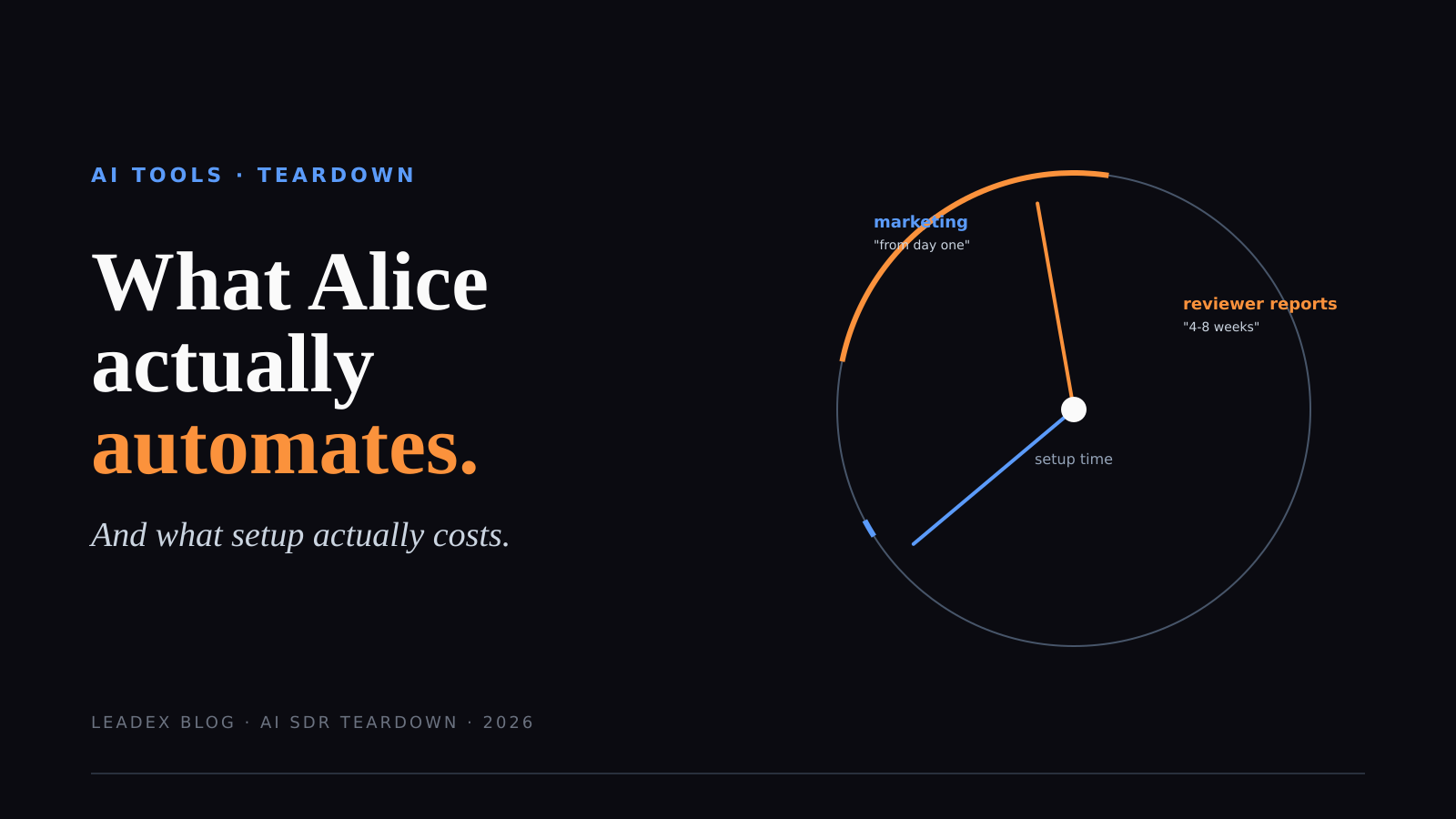
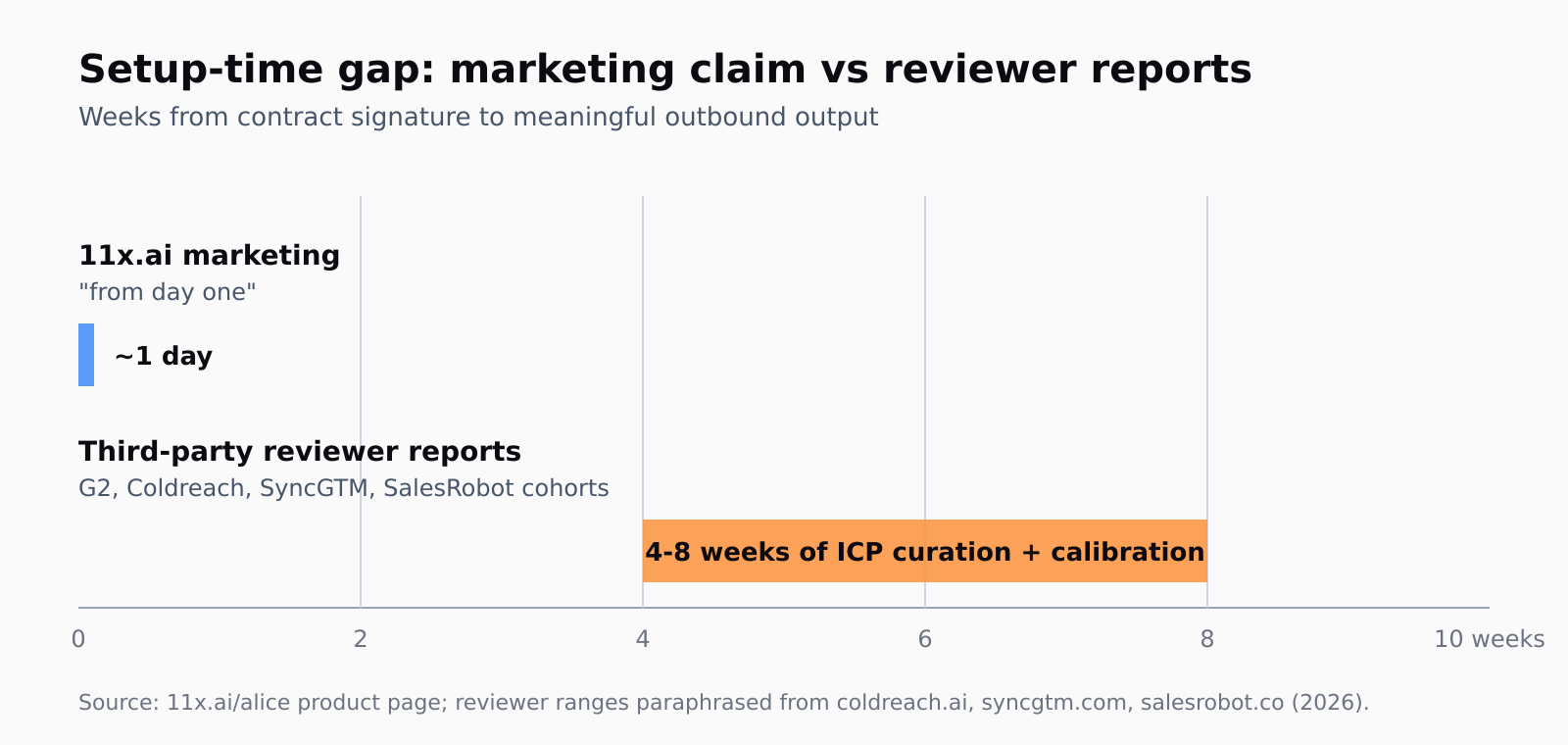
11x.ai sells Alice as an autonomous AI SDR who works from day one. Buyers report 4-8 weeks of ICP curation, sequence approval, and data tuning before the bot is worth flipping on - the same surface area as onboarding a junior human SDR.
The pitch from 11x.ai's Alice is one of the cleanest in the AI-SDR category: "Hi, I'm Alice. The world's best SDR." She prospects, researches, sequences, books meetings, runs 24/7, never quits, never asks for stock. The company has raised over $70M from a16z and Benchmark on a "digital workforce" narrative that flattens the difference between an AI tool and a headcount line. It is the most quotable promise in the AI SDR roundup we ran earlier this year (covered in our six AI SDR and prompt-based tools post) and it is, in practice, also the most quietly oversold.
The thing buyers underestimate isn't whether Alice can send email - she can, and the emails are usually grammatical. It's how much human work has to happen before the autopilot is worth flipping on. A few weeks of ICP curation, sequence approval cycles, data-source vetting, blacklist building, deliverability tuning. The same surface area you'd use to onboard a junior human SDR, just rearranged. The marketing copy says "from day one"; the buyer reports say "after weeks, maybe."
What Alice actually automates
The mechanical loop is real and it does work. Alice ingests an ICP definition, queries 11x's own contact database plus live web search, scores leads, drafts personalised emails based on profile-level research, runs multi-touch sequences over email and LinkedIn (the phone-agent sibling, Jordan, handles voice), processes replies, and books meetings into a calendar via the Salesforce or HubSpot integration. Customer-facing claims on the Alice page list "+30% meetings per AE", "+80% meeting-to-qualified opportunity", and "-50% cost per lead". They are averages from named customer testimonials (Checkr, Canibuild, MMB Networks), not third-party benchmarks; treat them as the high end of a wide distribution, not a forecast for your account.
What gets compressed into "the mechanical loop" is the part Alice is best at: the repetitive list-building, the per-prospect research bullet, the draft-edit-send cadence, the calendar handshake at the bottom. Anyone who has employed an SDR knows that's the bulk of the time that human spends in a workday, and removing it is genuinely useful. The output is not the problem. The input - the configuration that makes the output relevant - is where the autopilot framing breaks down.
What setup actually costs you
The reviews are consistent on this point even when they disagree on everything else. Coldreach calls the setup overhead "meaningful, requiring configuration time for targeting, messaging, workflows, reply logic, and reporting." SyncGTM lists "onboarding time of weeks for setup and ICP calibration" as a hidden cost. SalesRobot calls out a "potentially high learning curve" and notes that training the digital worker to understand your business context "likely requires significant upfront investment."
Translate that into the work a buyer actually has to do. Define the ICP precisely enough that the bot can filter on it without operator review of every batch. Decide which of 11x's data sources to trust for which fields. Build the blacklist - existing customers, churned accounts, partners, competitors, the CEO's brother-in-law. Approve the first few sequence templates and the variants the system generates after that. Tune deliverability per mailbox, warm the sending domains, monitor reply rates, decide what counts as a positive reply vs. a polite no, define the handoff rule from Alice to a human AE. None of that is optional, and none of it is something the bot can do for you. It's the same scope as onboarding a junior human - the difference is that the bot can be ramped to thousands of prospects a week the moment the configuration is right, which is exactly when it gets expensive if the configuration is wrong.
The pricing makes the early-stage configuration error worse. 11x doesn't publish a price list. G2 reviewer reports cited by SyncGTM put the range at $5,000 to $15,000+ per month, annual contracts only, no self-serve, no documented monthly option. A junior SDR in the US costs roughly $4-6K fully loaded per month and ramps in the same six to eight weeks. The economic case for Alice depends on her being more than 2-3x as productive as that SDR by month three. She might be. She might not. The annual contract structure means you find out either way.
Where the autopilot story breaks: signals
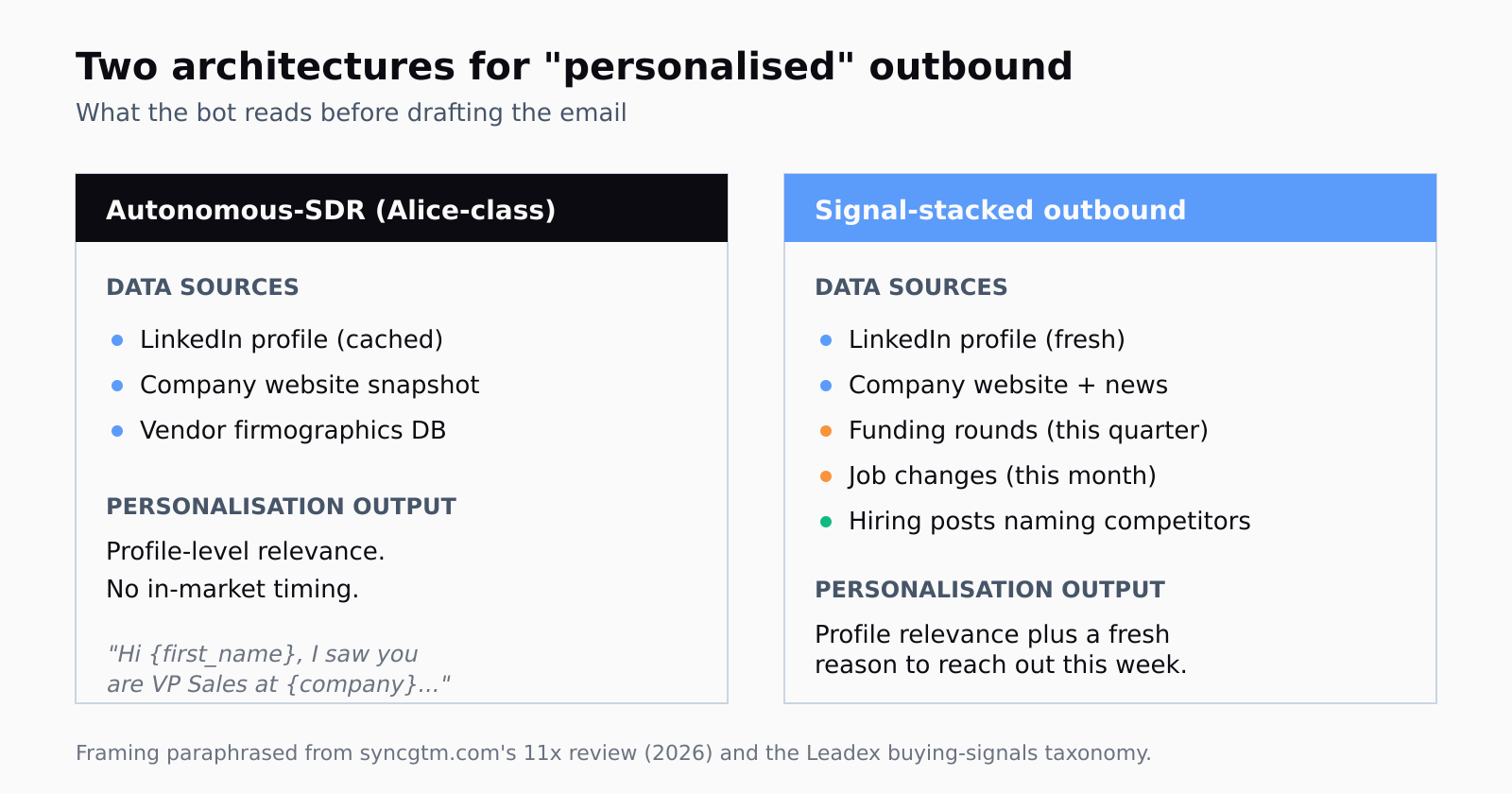
The structural gap that nobody on the 11x page talks about, and that every third-party review eventually arrives at, is the absence of a real-time buying signals layer. Alice writes well-personalised emails based on what's on someone's LinkedIn profile and company website. She doesn't know who hired a new VP of Sales last Tuesday, who raised a Series B yesterday, who's actively interviewing for an SRE role this week, or who just published a job spec that names the competitor you displace. SyncGTM's review is blunt about this: "Alice generates personalised emails using AI research, but the personalisation engine lacks access to real-time buying signals such as job changes, funding rounds, or hiring activity, meaning outreach is based on static profile data rather than in-market timing."
That's a category-level limitation, not a 11x-specific bug. The autonomous-SDR architecture assumes "personalisation = profile research". The signal-based outbound architecture - which is what the buying-signals taxonomy on this blog is built around - assumes "personalisation = profile research _plus_ a fresh trigger that explains why the conversation is happening this week and not last quarter." A bot that can send 10,000 well-formatted emails a week to people who aren't currently in-market is, as SyncGTM puts it, "expensive spray-and-pray." It will produce some replies. It will not produce the conversion rates the Alice page implies, unless your TAM is so dense with buyers that timing matters less than coverage (it usually isn't).
This is the seam Leadex sits on. A chat-native research agent that pulls fresh data from LinkedIn, Crunchbase, company sites, and news in one run will read the same prospect very differently from a database-backed sequencer reading from cached profiles - and the same brief that takes 11x weeks to configure produces a plan preview you approve before the agent touches the web. Different shape, narrower scope: Leadex lands the CSV in your CRM, the sequencing is wherever you already do it. The point isn't that the two replace each other (they don't); it's that the configuration work the autonomous-SDR vendors hide inside a six-week onboarding is the same configuration work _everyone_ doing outbound has to do, and it's worth doing it in a tool that shows its sources rather than one that decides for you.
The case for Alice, where it holds
The strongest customer-side testimonial on the 11x site is from MMB Networks. It's worth reading because it's also the clearest statement of what well-configured Alice can do:
We evaluated twelve solutions and 11x was the only one with real AI personalisation. Without 11x, we'd still be pushing generic outreach and bleeding limited budget just to hit our numbers.
- Russell Thomas, CEO, MMB Networks (cited on 11x.ai/alice)
That's a real claim and worth taking seriously. The pattern across the strong testimonials is the same: established outbound team, well-defined ICP, dedicated RevOps owner, willing to invest in the calibration period, sufficient budget to absorb a quarter of mediocre output before the configuration converges. Checkr (background checks, public-company customer base), Canibuild (construction SaaS, narrow vertical), MMB Networks (industrial IoT) all fit that mould. The complaint cluster on G2 - "we spent so much time building prompts and it did nothing right" - tends to come from teams that didn't have the operational maturity to do the configuration work in the first place. Alice is a force multiplier where there's something to multiply. She doesn't replace the multiplicand.
The honest read for a buyer in 2026: if your outbound is mature and your ICP is sharp, Alice's setup tax is a fixed cost that amortises across a 24-month contract and a few thousand new conversations a month. If your ICP is fuzzy, your team is small, or your category demands real-time signals, the autopilot frame is going to mislead you about how much human work is still required - and the annual contract will collect rent on that misunderstanding either way.
FAQ
How long does 11x.ai's Alice take to set up?
Multiple third-party reviews report onboarding times measured in weeks - typically four to eight - covering ICP definition, sequence template approval, deliverability tuning, integration setup, and the first calibration cycles. 11x's own marketing implies faster ("from day one"), but the buyer cohort on G2 and review sites is consistent that meaningful output requires the same ramp period as a human SDR.
How much does 11x.ai cost per month?
11x.ai does not publish pricing. G2 reviewer reports and third-party analyses (SyncGTM, Coldreach) cite a range of $5,000 to $15,000+ per month on annual contracts, with no self-serve signup and no documented monthly option. The actual figure depends on outreach volume and module mix (Alice alone, or Alice plus Jordan the phone agent).
Is an AI SDR worth it vs. a human SDR in 2026?
It depends on how mature your outbound motion is. A team with a well-defined ICP, an existing RevOps function, and the budget to invest in a few months of calibration can get more conversation volume per dollar from a configured AI SDR than from one or two junior human reps. A team without those foundations will spend the same time and money configuring the bot as they would managing a person, with less feedback in the loop and a longer contract to escape from.