
The Complete B2B Buying Signals Taxonomy: 30+ Triggers That Predict Pipeline
Vendor-neutral taxonomy of 40 buying signals across seven categories. The working list I reach for when writing a research brief.
Most buying-signal lists floating around in 2026 are shopping lists for a single vendor's product - "here are the 12 signals our platform detects." A useful taxonomy has to be vendor-neutral, grouped by what the signal actually tells you, and long enough that a practitioner can find an unfamiliar one. Semir Jahic's 40-signal guide at Salesmotion is the best current reference. I'd rather extend it than re-invent it, and the grouping below borrows his seven categories with a few additions from Autobound's 644-trigger database and Apollo's three-source framework (first-party, second-party, third-party).
Jahic frames the boundary between intent and buying signal sharply:
Intent data comprises one buying signal category specifically tracking digital research behavior - content consumption and topic surges across publisher networks. Buying signals constitute the broader ecosystem encompassing leadership transitions, earnings commentary, funding rounds, hiring trajectories, technology stack modifications, competitive dynamics, and sales conversation indicators.
That distinction is load-bearing. Treat intent as one category of many, not the whole field. What follows is the working list I reach for when I'm writing a research brief.
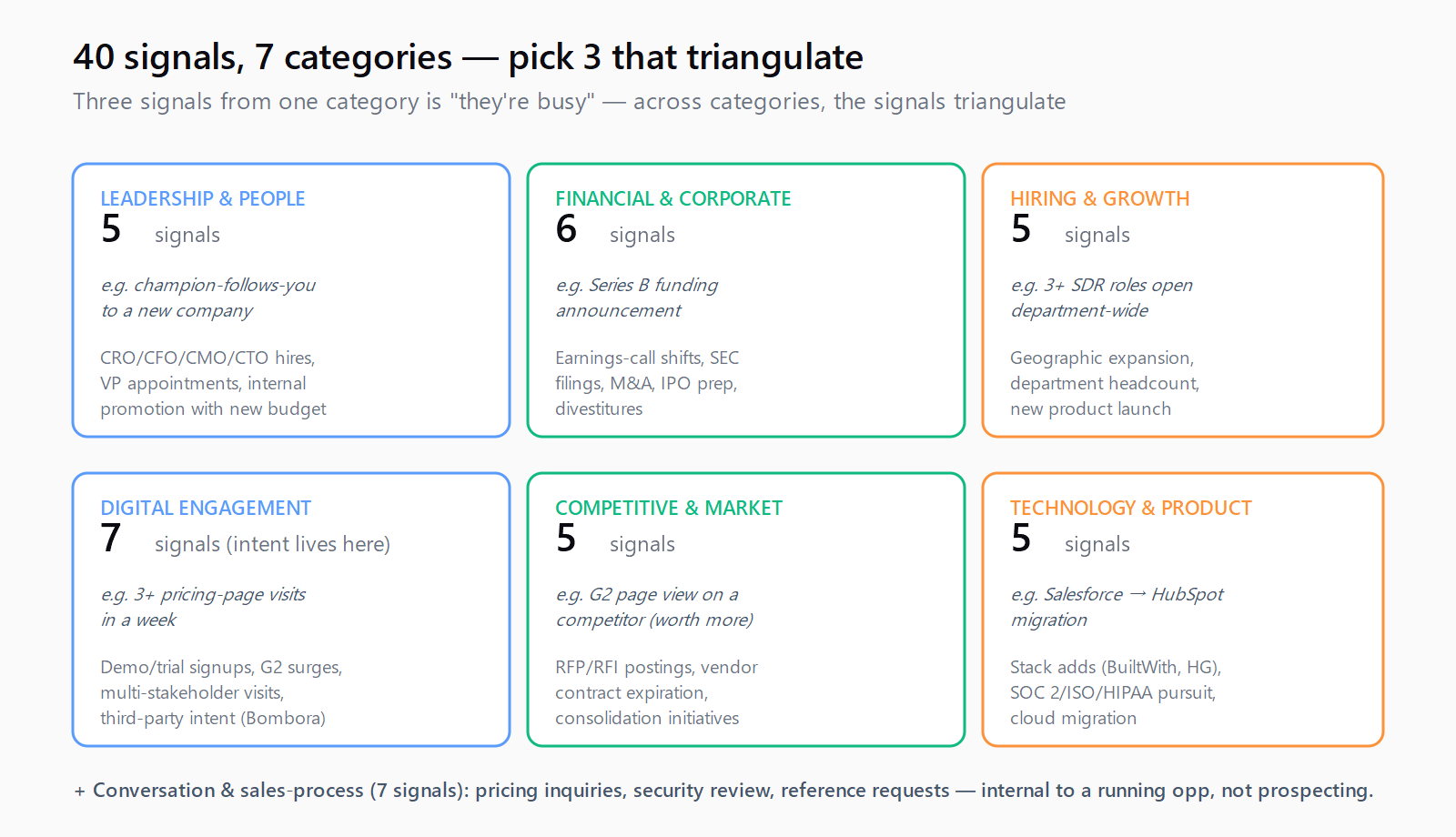
Leadership and people changes (five signals). Champion job change to a new company; new C-suite hire (CRO, CFO, CMO, CTO); VP or director-level appointment; internal promotion with new budget authority; decision-maker departure at the incumbent vendor's champion. The champion-follows-you pattern is the most underrated of the five - your last buyer's new company is a warm intro, not a cold lead.
Financial and corporate events (six signals). Funding announcement (seed through late-stage); earnings-call language shifts (new strategic priority named); SEC filing disclosures (S-1, 10-K, 8-K); M&A activity; IPO preparation; divestiture or carve-out. A Series B is a buying window; an earnings-call mention of "vendor consolidation" is a different buying window on the same account.
Hiring and growth (five signals). Hiring velocity spike (3+ open roles department-wide); job postings naming the exact problem your product solves; geographic expansion (new office, new country); department-specific headcount growth; new product or SKU launch. Hiring is the closest thing to a truth serum - companies hire for pain they've decided to solve.
Digital engagement and intent (seven signals). Pricing-page visits, three or more in a week; demo request or free-trial signup; case-study download; third-party intent surge (Bombora, G2 Buyer Intent, 6sense); interactive product-demo engagement; multi-stakeholder engagement from the same domain; webinar or event attendance. This is the narrowest category and the most crowded with vendors.
Competitive and market (five signals). G2 or Capterra research activity; negative vendor reviews on a competitor; RFP or RFI posting; vendor-contract expiration in the public record; explicit vendor-consolidation initiative. A G2 page view on your competitor is worth more than a visit to your own.
Technology and product (five signals). Tech-stack addition or removal (BuiltWith, Wappalyzer, HG Insights); cloud migration; platform migration (Salesforce to HubSpot, SAP to NetSuite); compliance certification pursuit (SOC 2, ISO 27001, HIPAA); digital-transformation initiative named publicly. Stack moves predict next-adjacent purchases reliably.
Conversation and sales-process (seven signals). Pricing or terms inquiry; integration or compatibility questions; timeline mention in a reply; champion introduces decision-makers; security or legal review; customer reference request; social-proof questions. These are internal - they fire inside an already-running opportunity, not for prospecting.
That's 40 signals across seven categories. The practical use is not to monitor all forty; it's to pick three that triangulate, one per category where possible. Detecting them is the easy part - every signal above has a vendor. The hard part is the next step: turn a fired signal into a researched, enriched account within the 30-minute window before it cools. That research-and-enrichment seam is where Leadex runs - a chat brief that stacks two or three of these signals ("companies that raised Series B this month AND posted three SDR roles AND added Salesforce to their stack") collapses the four-tool workflow into one run.
The taxonomy is a checklist for your detection layer. The bottleneck is always the next click. (See also: tech-stack displacement prospecting.) (See also: finding clients for a B2B marketing agency.) (See also: finding B2B leads on GitHub.) (See also: the internal-promotion signal.) (See also: finding companies hiring fractional CMOs, CFOs, or CROs.)