How to Combine 3+ Buying Signals for 5-10x Higher Reply Rates
Autobound's 2026 data puts stacked multi-signal outreach at 25-40% reply rates vs 3-5% generic. Why three signals across three categories is the floor.
The cold-email reply rate has been grinding downward for three years. Belkins measured 16.5 million sends and watched the average drop from 6.8% in 2023 to 5.8% in 2024; Instantly's 2026 benchmark puts the industry floor at 3.43%. The prevailing answer from the signals-based selling crowd is that single-signal outbound was always a coin flip, and stacking three independent signals on the same account is what actually moves the number.
Autobound published the sharpest version of the claim. Their 2026 signal-based selling guide breaks reply rates into four tiers by personalization depth:
Generic cold outreach: 1-5% reply rate (industry average: 3.43%). Basic personalization (name, company, title): 5-9% reply rate. Signal-based personalization (specific event + relevant value prop): 15-25% reply rate. Multi-signal stacked outreach (2-3 signals + behavioral profile): 25-40% reply rate.
Compare the top tier to the bottom and you get the 5-10x figure that's been quoted everywhere this quarter. It is not a small effect. A 25% reply rate means one reply for every four sends; a 3% reply rate means one for every 33. Same list, same copy template, different entry point.
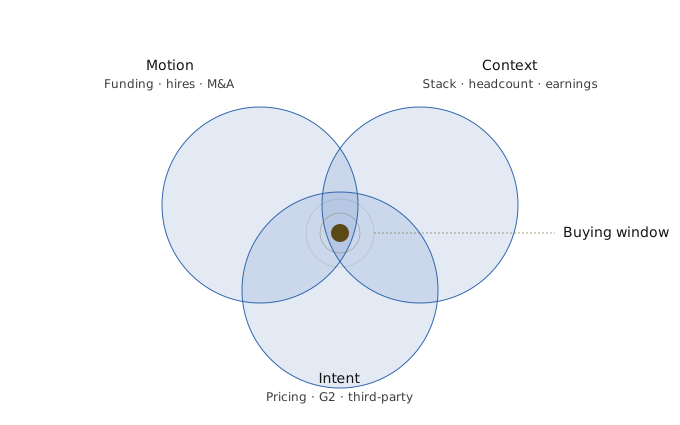
The reason the stacked version works isn't that three signals carry three times the information. It's that each extra signal kills a specific false positive. A pricing-page visit in isolation could be a candidate researching your company before an interview, a competitor's intern, or a journalist. Pair it with a hiring spike for the exact role your product enables and the candidate hypothesis dies. Add a new VP who posted publicly about "sales transformation" and the competitor hypothesis dies too. What's left is a buying window.
The three-signal rule also forces diversity of source, which is where teams that try to stack on a single vendor fall apart. The combinations that work, in my experience, pull one signal from each of three categories: a motion signal (funding round, executive hire, M&A), a context signal (hiring pattern, tech-stack change, earnings-call language), and an intent signal (pricing visit, G2 activity, third-party intent surge). Three motion signals stacked together is just "they're busy." Three intent signals stacked is just "they browse a lot." Across categories, the signals triangulate.
The bottleneck isn't detection. There are a dozen vendors who will sell you each of those feeds in isolation, and the 2026 outbound stack has more telemetry than anyone knows what to do with. The bottleneck is research and enrichment, in the narrow window between the third signal firing and the account going cold. This is the seam Leadex was built for - a chat brief like "Series B fintechs this month AND hiring 3+ SDRs AND with a new CRO" produces a deduped, enriched list from the open web, pushed straight to HubSpot, without the four-tool detour through a scraper and a CSV upload. The stack breaks on the AND; a research agent that composes sources in one run is the part nobody ships.
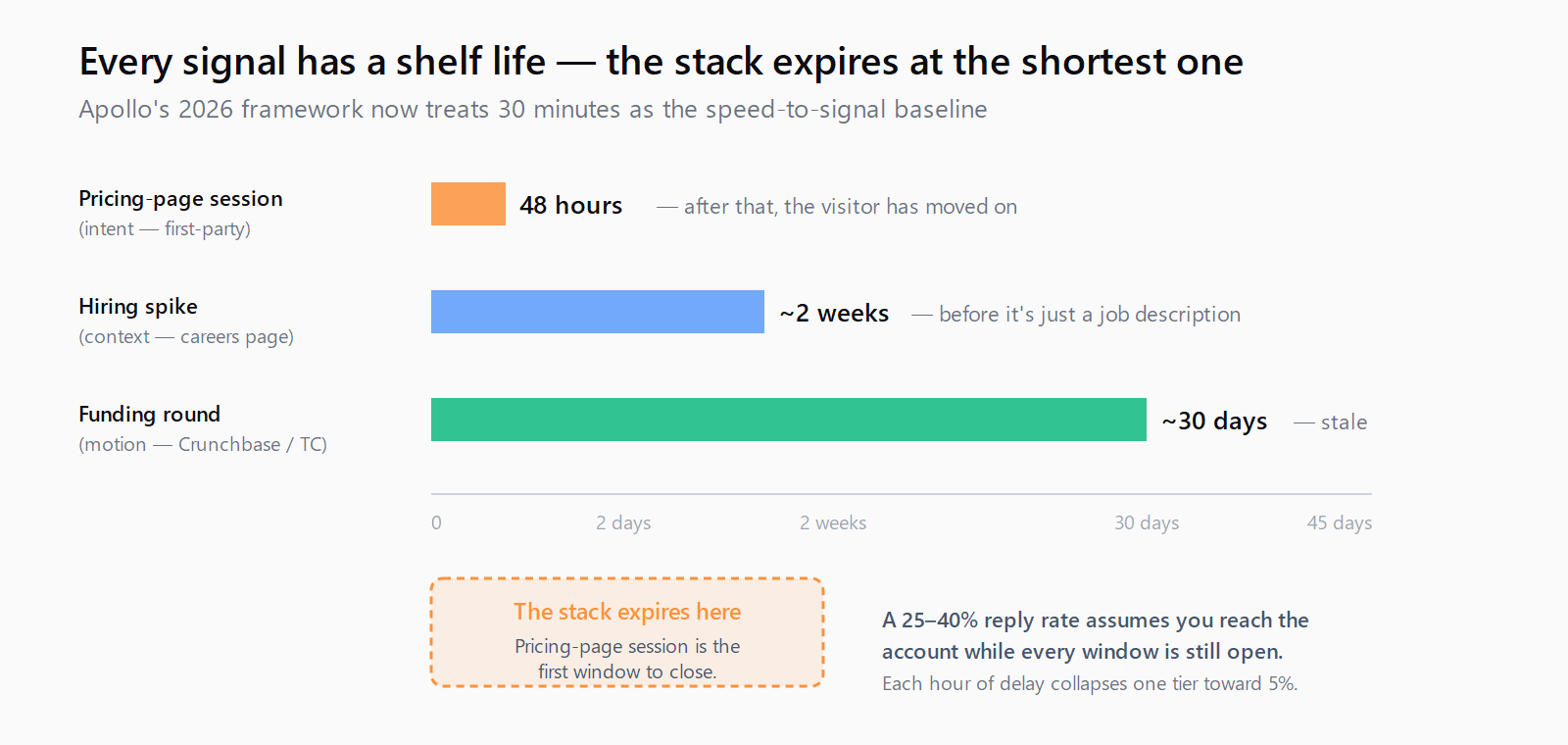
Two practical notes before you go stack signals. First, run an ICP gate before the signals, not after - a stacked account that doesn't match your ICP is still noise, just expensive noise. Second, the stack decays. Funding news is stale in 30 days, hiring spikes in two weeks, pricing-page sessions in 48 hours. A 25-40% reply rate assumes you reach the account while the window is open; Apollo's 2026 framework now treats 30 minutes as the speed-to-signal baseline. The stack is a window, not a state, and every hour you wait collapses one tier back toward 5%. (See also: tech-stack displacement prospecting.) (See also: the internal-promotion signal.) (See also: finding companies hiring fractional CMOs, CFOs, or CROs.)