Intent Data vs Signal Data vs Context Data: What's the Difference in 2026?
Three terms the outbound-tooling market keeps collapsing together. Intent data, signal data, context data - what each actually means and when you need which one.
Outbound-tooling marketing is currently collapsing three terms together: intent data, signal data, context data. They're not the same thing, and the difference is load-bearing when you're deciding which category of vendor to actually pay for.
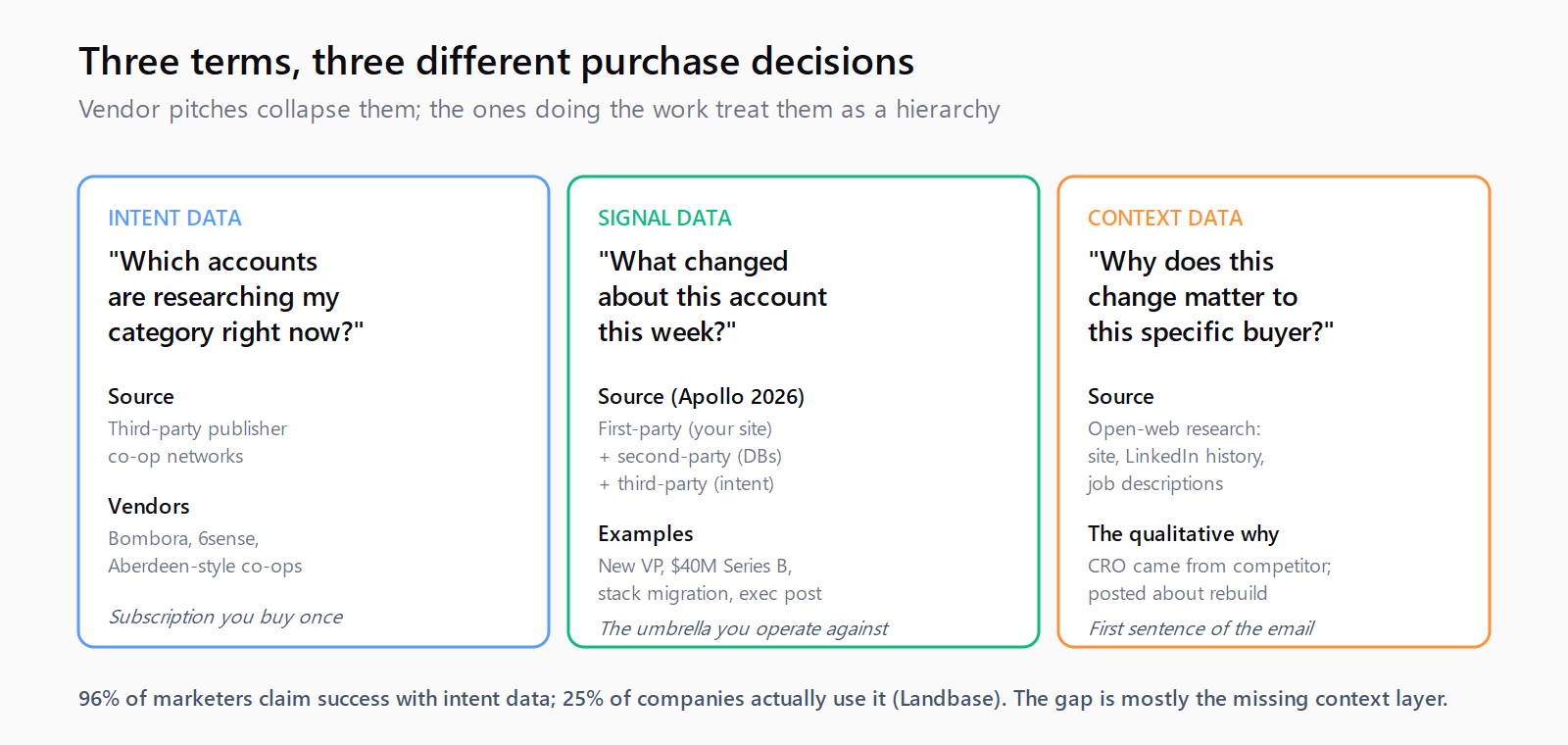
Start with intent data, which is the oldest of the three and the one most people mean when they say any of the others. Intent data is behavioral evidence from a third-party publisher network that an account is researching a topic - Bombora and the old Aberdeen-style cooperatives pioneered the category, and the shape is consistent across providers: a company plus a topic plus a "surge" score over a rolling window. Semir Jahic at Salesmotion frames the relationship precisely:
Intent data comprises one buying signal category specifically tracking digital research behavior - content consumption and topic surges across publisher networks. Buying signals constitute the broader ecosystem encompassing leadership transitions, earnings commentary, funding rounds, hiring trajectories, technology stack modifications, competitive dynamics, and sales conversation indicators.
Signal data, then, is the umbrella. It includes intent data and every other detectable event - a new VP of Sales, a $40M Series B, an AWS-to-Snowflake migration, a CEO LinkedIn post about hiring - that correlates with a buying window. Apollo's 2026 framework splits signal data into three sources: first-party (your site, your product), second-party (sales-intelligence databases), and third-party (intent networks, review sites). Intent data is the third-party slice; signal data is all three.
Context data is the term newer vendors keep slipping in, and it's narrower than either. Context data is the qualitative why underneath a signal - not that a company hired a new CRO, but that the CRO came from a competitor, has publicly posted about a tooling rebuild, and sits on a buying committee at an account where you already have warm contacts. It's the data you need to write the first sentence of the email, not the data that tells you the email is worth writing.
Each category answers a different question. Intent data answers which accounts are researching my category right now? Signal data answers what changed about this account this week? Context data answers why does this change matter to this specific buyer, in this specific role? Teams that collapse all three into "signals" end up firing generic sequences on accounts that happen to have one trigger event, which is one honest explanation for the gap Landbase reports between the 96% of marketers who claim success with intent data and the 25% of companies actually using it.
This is the part Leadex cares about. Signal data buys you the trigger; context data is the part that still requires open-web research - visiting the company site, reading the CRO's LinkedIn history, checking Crunchbase for the last round, pulling the job descriptions the account is currently hiring for. That's the seam where a chat-native research agent helps: one brief, one run, and the context sits alongside the firmographics in the same CSV. Intent vendors sell signals; context is still mostly manual (!), which is why it's the piece most outbound workflows quietly skip.
Name the three separately and the vendor conversation gets simpler. Intent data is a subscription you buy once you have a working first play. Signal data is the category you operate against, across your own systems and everyone else's. Context data is what turns a signal into a sentence the prospect might actually open. (See also: tech-stack displacement prospecting.) (See also: finding B2B leads on GitHub.) (See also: audit your contact database freshness.)