
Fix Clay Claygent 429 Errors From Your Own OpenAI or Anthropic Key
Bring-your-own-key Claygent runs that 429 are not a credit problem. They are a provider-tier problem with a hard tokens-per-minute floor.
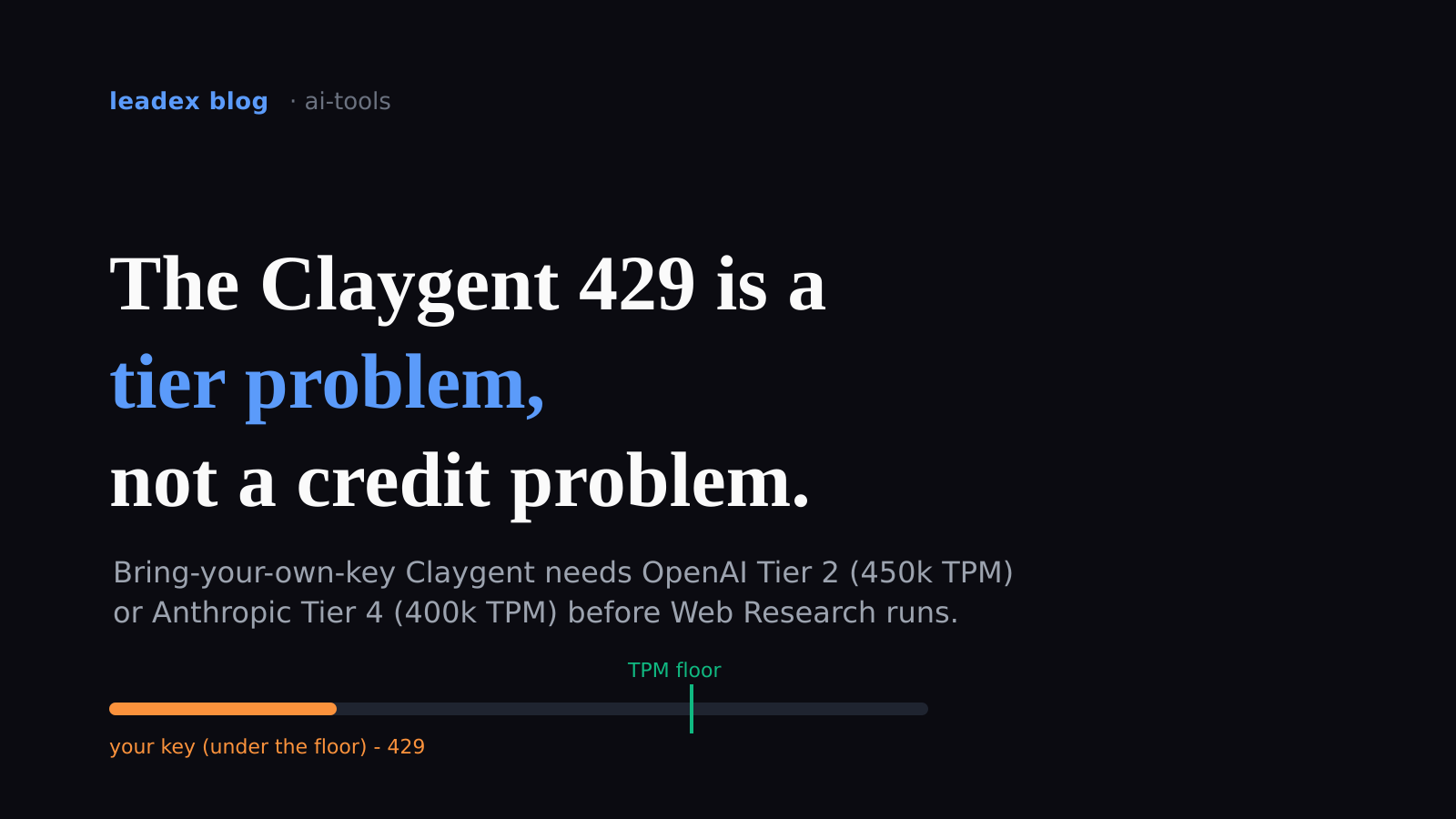
If you switched Claygent over to your own OpenAI or Anthropic key to stop burning Clay credits, and your runs now come back empty with a 429, the credits are not the problem. Your API tier is. This is the same trap I flagged when writing up a credit-efficient Clay waterfall - the bring-your-own-key path looks free until a rate limit eats the run and leaves no output to show for it.
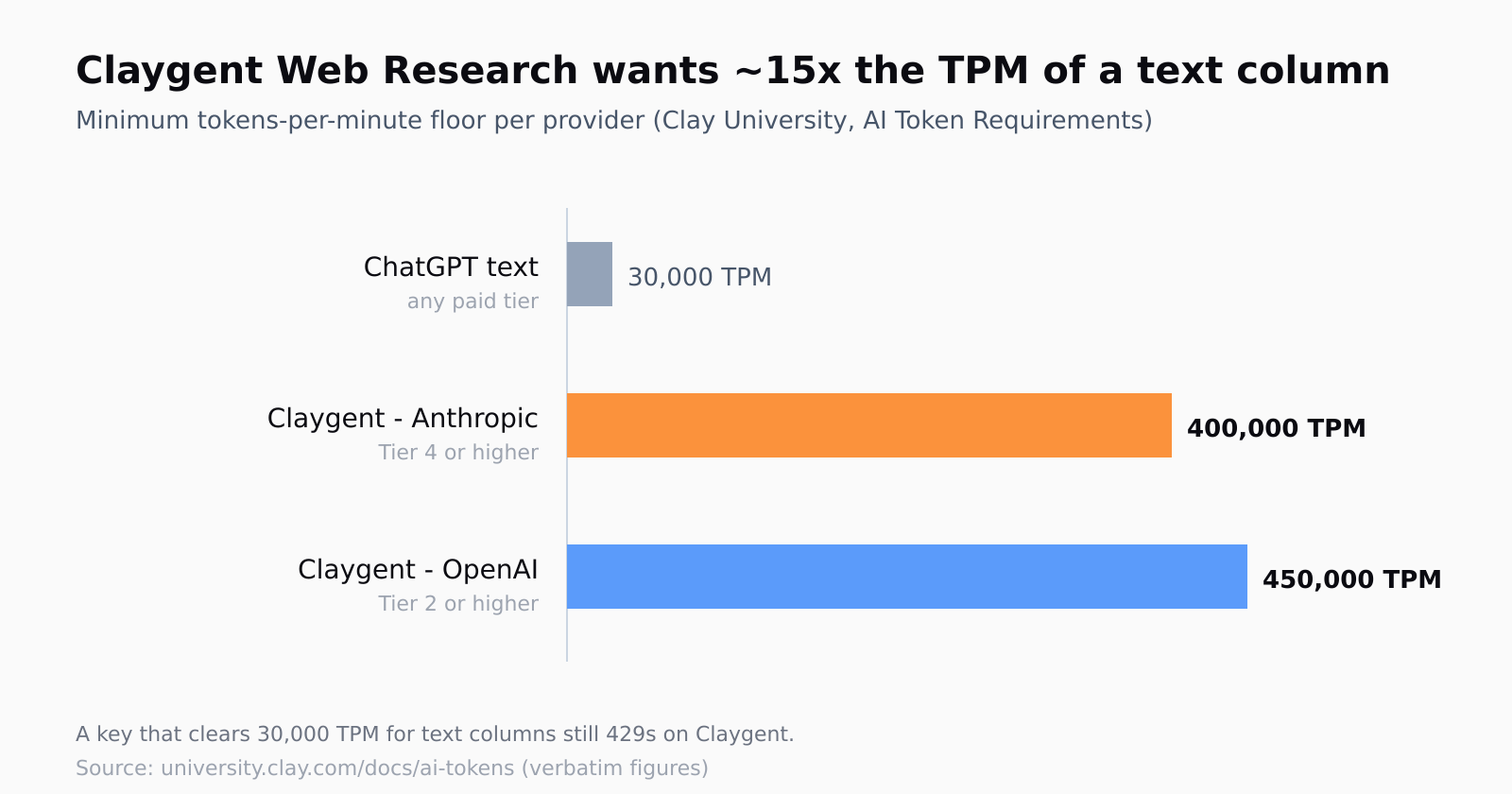
Here is the part that trips everyone up. Plain ChatGPT text columns in Clay work on almost any paid key. Claygent Web Research does not. It is a much heavier workload, and Clay's own documentation publishes a hard tokens-per-minute floor for it that is more than ten times what a basic text column needs. A key that happily generates text can still 429 the moment you point Claygent at the open web.
Clay University's AI Token Requirements doc spells the floors out per provider, and as of mid-2026 they are the verbatim numbers worth pinning to your monitor:
ChatGPT Generate Text - Requirement: 30,000 TPM, works with any paid tier. ClayGent Web Research - OpenAI: Tier 2 or higher (>=450,000 TPM). Anthropic: Tier 4 or higher (>=400,000 TPM). Gemini: Tier 2, but only works with the Gemini 2.0 Flash model.
So a key parked at OpenAI Tier 1, which is plenty for text generation, sits below the 450,000 TPM that Claygent Web Research wants and gets throttled the instant the agent fans out across pages. That is your 429. (I spent longer than I would like to admit blaming Clay's credit meter for exactly this.)
Why does Claygent burn credits but return a 429 with no output?
When Claygent runs on your own key, the request goes straight to OpenAI or Anthropic. If your account is under that provider's tokens-per-minute ceiling for the tier, the provider answers with HTTP 429 - too many requests - and the call fails before any research lands. Clay still meters the attempt, so you see the run move, maybe a credit tick, and then an empty cell. The empty cell reads like a Clay bug. It is a provider rate limit wearing a Clay costume.
The tell is consistency. A genuinely flaky run fails intermittently; a tier problem fails at scale every single time you push enough rows to cross the per-minute floor. If ten rows succeed and a hundred rows die, you are not unlucky - you are rate-limited. Check the provider dashboard, not the Clay credit balance. The other tell is timing: 429s that cluster at the start of a large batch, when concurrency peaks, and then ease off as the queue drains, are a per-minute ceiling problem almost by definition - the floor is measured per minute, so the densest minute is where you hit it.
How do I check which OpenAI or Anthropic tier my key is on?
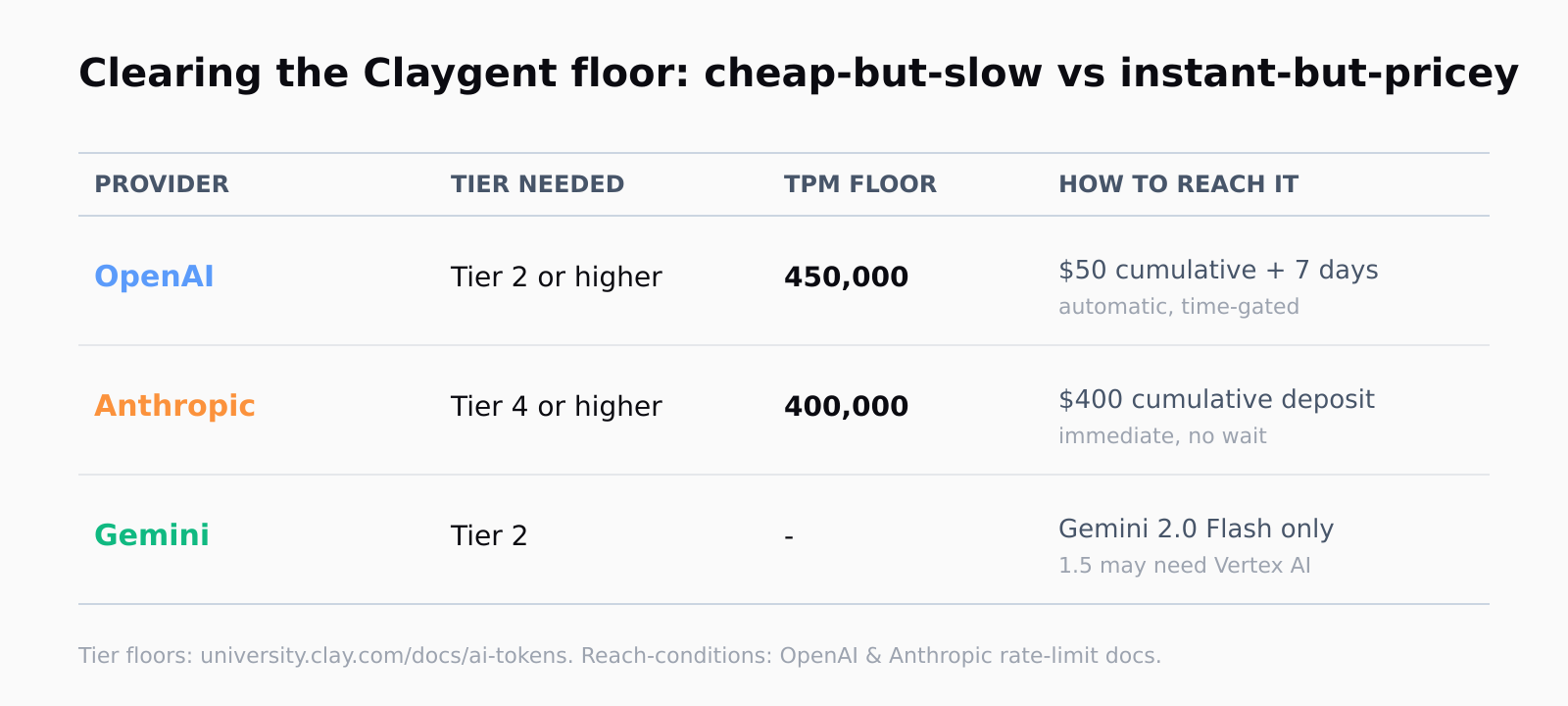
OpenAI publishes your current tier under the limits section of your account settings, and advancement is automatic - you do not file a request. OpenAI's rate-limits guide states Tier 2 requires $50 in cumulative payments and at least seven days since your first payment, and that the time clock runs from account creation, not from the moment you cross the spend threshold. So you cannot buy your way to Tier 2 in an afternoon - the seven days are load-bearing.
Anthropic gates the same feature higher. Per Anthropic's rate-limits documentation, Tier 4 requires a cumulative $400 deposit, and advancement happens immediately once you hit the threshold - no waiting period, no approval. That is the asymmetry to plan around: OpenAI's Tier 2 is cheap but time-gated, Anthropic's Tier 4 is instant but costs an order of magnitude more upfront.
How do I fix the 429 and get Claygent running on my key?
Three moves, in order of effort. First, raise the tier: for OpenAI, get a card on file and let $50 of usage plus the seven-day window carry you to Tier 2 and its 450,000 TPM headroom; for Anthropic, deposit to Tier 4 to clear the 400,000 TPM floor. Second, if you cannot wait or do not want to front the deposit, throttle the Clay run itself - smaller batches, lower concurrency, and a retry-with-backoff setting so transient spikes do not tip you over the per-minute limit. Backoff alone will not rescue a key structurally below the floor, but it smooths a key that is right at the edge.
Third, the unglamorous fallback: switch Claygent back to Clay credits for the columns that genuinely need web research, and keep your own key only on the cheap 30,000-TPM text columns where it actually saves money. Mixing the two per-column is the move most teams land on once they have done the arithmetic.
Is bringing your own key actually cheaper than Clay credits?
Not always, and this is where the BYOK pitch quietly oversells itself. To run Claygent Web Research on Anthropic you need Tier 4, which means $400 sitting with the provider before a single useful row comes back. If your workload is a few hundred enrichments a month, Clay credits may cost less than the deposit you are tying up - and they require zero tier management. BYOK wins at volume; it loses on small, bursty runs, which is exactly the shape of most prospecting jobs.
This is the seam Leadex is built to close. The whole reason to bring your own key is to skip a per-contact markup, and that is the model we run too: Leadex routes enrichment through your connected providers with no Leadex per-contact fee, so cost scales with provider consumption and nothing else. Describe the ICP in plain English, approve the plan, and the research runs without you hand-managing a column stack or a rate-limit budget. It is the same BYOK economics, minus the spreadsheet maintenance - and a close cousin of what autonomous agents still cannot do without a human approving the plan first.
One more honest caveat. Raising your tier fixes Claygent's 429s, but it does not make the underlying agent infallible - the same way auditing a HubSpot Breeze agent's drafts still matters even after the plumbing works. Clear the rate limit first; keep reading the output second.
FAQ
Why does Claygent burn credits but return no output?
On your own key, Claygent's request hits OpenAI or Anthropic directly. If your tier is below the tokens-per-minute floor, the provider returns a 429 and the run fails before research lands, while Clay still meters the attempt. The empty cell is a provider rate limit, not a Clay credit bug.
What API tier do I need for Claygent Web Research?
Per Clay University, OpenAI needs Tier 2 or higher (>=450,000 TPM) and Anthropic needs Tier 4 or higher (>=400,000 TPM). Gemini works on Tier 2 but only with the Gemini 2.0 Flash model.
My key works in ChatGPT text columns but 429s in Claygent. Why?
ChatGPT Generate Text needs only 30,000 TPM and runs on any paid tier. Claygent Web Research needs more than ten times that, so a key fine for text columns is still below the Claygent floor and gets throttled.
How long does it take to reach OpenAI Tier 2 or Anthropic Tier 4?
OpenAI Tier 2 needs $50 in cumulative payments and seven days since your first payment, and the time runs from account creation. Anthropic Tier 4 needs a cumulative $400 deposit and advances immediately once you hit it.
Should I just keep using Clay credits instead?
For small or bursty runs, yes - the Anthropic Tier 4 deposit alone can exceed what a few hundred enrichments cost in credits. Many teams mix the two: own key on cheap text columns, Clay credits on Claygent Web Research.