
How to Audit ZoomInfo Data Freshness Before Renewal
Run a stratified bounce-rate audit on your ZoomInfo export before signing the renewal. Use the empirical number to negotiate price or switch vendors.
Your SDR is staring at a 22% bounce rate on the campaign that was supposed to hit Q2 number, and the ZoomInfo renewal email just landed in your CFO's inbox quoting Vendr's median enterprise contract value of $54K. You have 30 days. You can either accept the quote, or you can run the data-freshness audit nobody on your team has run before, and use the empirical bounce rate as a procurement weapon.
This is a how-to-fix for the audit. The point is not to embarrass ZoomInfo - any contact provider's "verified" stamp ages. ZoomInfo's headline 95% accuracy guarantee covers company affiliation only - that the contact still works at the listed employer - not whether their email actually lands. Real bounce rates on ZoomInfo-sourced campaigns sit in the 15-25% range in normal practice, with one Reddit user reporting 50.7% on a 6,000-record send. So you should expect _some_ decay. The audit tells you _how much_, in your geography, on the segments you actually sell into.
Why renewal QA is non-negotiable in 2026
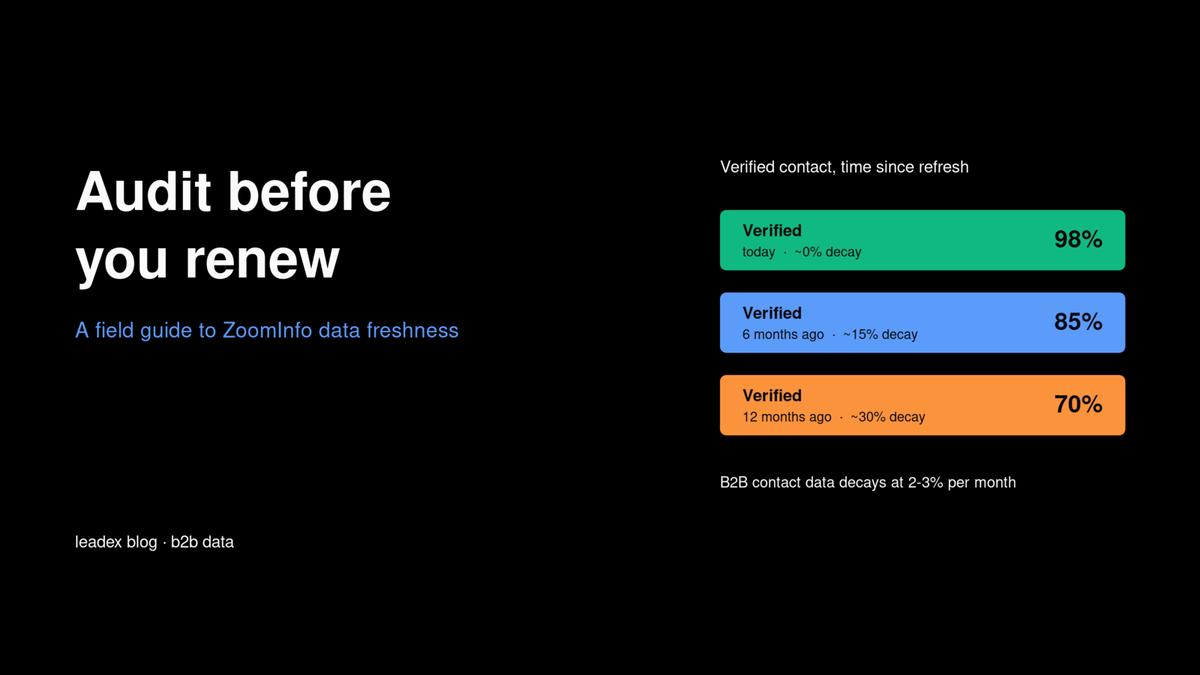
Two things changed in 2025 that turned a "nice to have" QA into a survival check. First, Gmail and Yahoo's bulk-sender requirements went from soft enforcement in February 2024 to permanent reject in November 2025. A list with 25% bad addresses no longer just under-performs; it accumulates spam-trap hits and DMARC failures that lock down your sending domain for weeks. Second, B2B contact data decays at 2-3% per month, around 30% per year per Lead411's 2026 benchmark, and ZoomInfo's refresh cadence on most records is 6-12 months, which means a record stamped "verified" nine months ago can be 22% stale before you ever pull it.
The renewal cycle is the one window where you have leverage. Enterprise tier starts at $40K with a three-seat minimum, Vendr's median is $54K, and ZoomInfo's reported net revenue retention is 90%, meaning roughly 10% of customers churn each year, which gives the AE on your account real reasons to discount when you walk in with hard numbers.
ZoomInfo is extremely US-centric and has the worst accuracy in Europe.
That is the modal complaint across the 8,997 reviews on G2 - a real signal once you read past the "great prospecting tool!" five-star noise. If you sell into EMEA or APAC at all, your audit needs to stratify by geography or you'll average away the worst cell.
Pull a stratified sample, not a convenience sample
The instinct is to grab the last 500 contacts your team exported and run them through a verifier. Don't. The bounce rate on a single segment isn't predictive - you'll either over-react (one bad cohort) or under-react (one clean cohort), and the renewal-negotiation argument needs a representative number.
Pull a stratified sample of 1,000-2,000 contacts across three axes: ZoomInfo's contact-accuracy confidence band (high / medium / low - the score you already pay for), seniority tier (C-level / VP+ / Director / IC), and geography (US / EMEA / APAC). Cells don't need to be equal-sized - weight them roughly to your actual outbound mix. The point is that when the audit comes back you can answer "where is the rot?" and not just "how much rot is there?".
Pull at least 200 records per cell or you can't tell signal from noise: a 20% bounce rate on a 50-record cell has a 95% confidence interval of roughly plus or minus 11 points, which is wide enough to lose any negotiation argument.
Run the bounce-rate QA: verifier vs email_status
The mechanic is a two-column comparison. Column A is what ZoomInfo claims about each address (the email_status field on the export, usually one of valid, invalid, catch-all, unknown). Column B is what an independent real-time verifier returns when you check the same address today. The cheapest two are NeverBounce and Kickbox, both around $0.01 per check at the volumes you'll need - so a 2,000-record audit costs about $20.
You're computing four things per cell: ZoomInfo-says-valid plus verifier-says-valid (true positive), ZoomInfo-says-valid plus verifier-says-invalid (false positive - what would actually bounce), ZoomInfo-says-invalid plus verifier-says-valid (false negative - what you're throwing away unnecessarily), and the catch-all rate. The false-positive rate _is_ your projected bounce rate. If your verifier returns 18% invalid on a sample ZoomInfo claims is 100% valid, your real-world send will bounce around 18%.
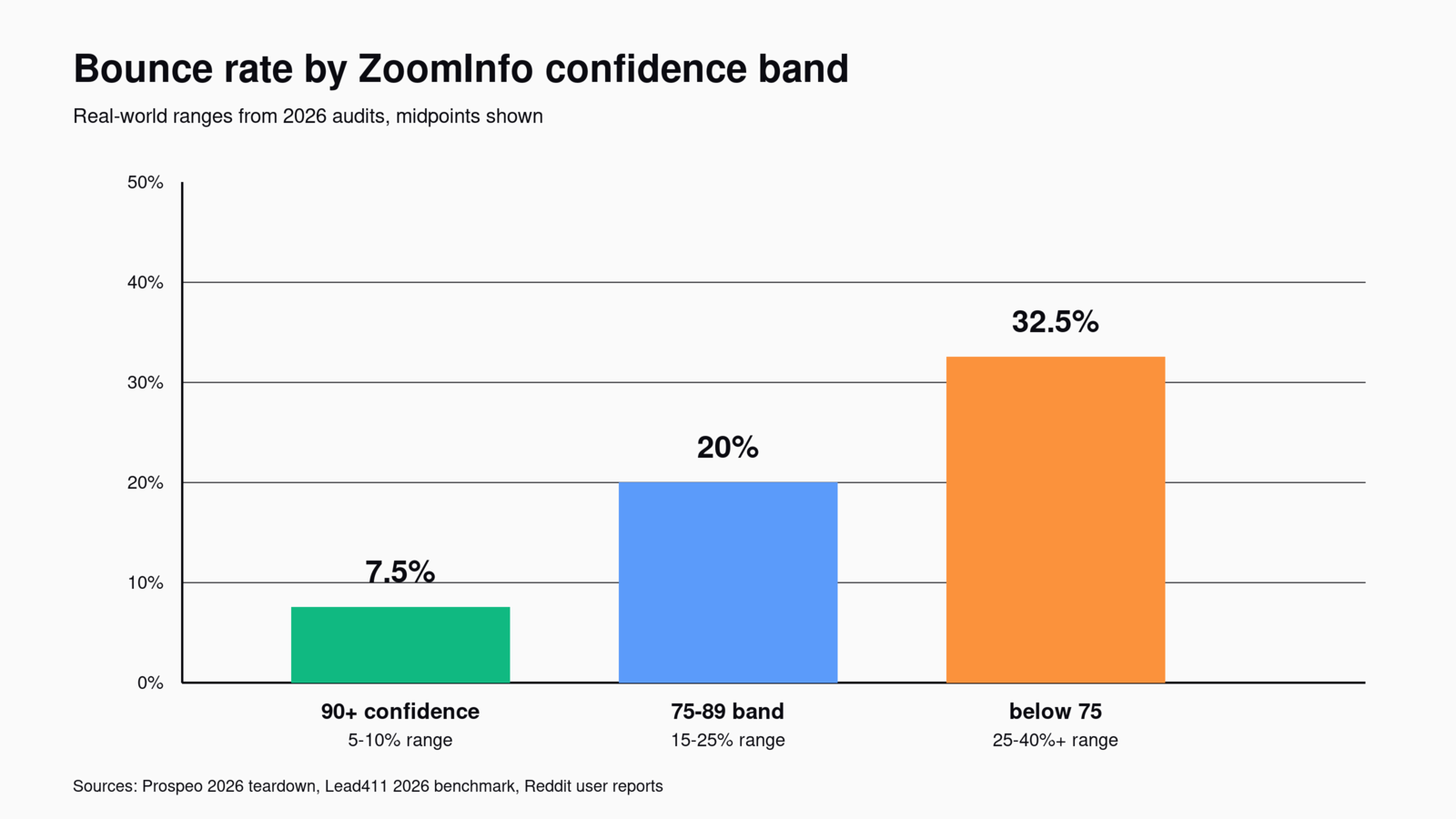
(I believe) the most useful single statistic that comes out of this is the bounce-rate-by-confidence-band. ZoomInfo lets you filter exports to a confidence score of 85+, and the Prospeo teardown reports that filtering at that threshold cuts bounce rates by roughly 40% in their sampling. If your audit confirms that pattern, you've just discovered a workflow change worth more than the renewal discount you're chasing - and you can chase the discount anyway, since the unfiltered data is what the AE sold you.
Read the result like a procurement officer
Don't read the result like a marketer (the marketer voice in your head says "we should improve our targeting"). Read it like a procurement officer comparing what was promised to what was delivered. ZoomInfo's contract language guarantees company affiliation. It does not guarantee email deliverability. So the question becomes: are you getting what you paid for, given what they actually promised?
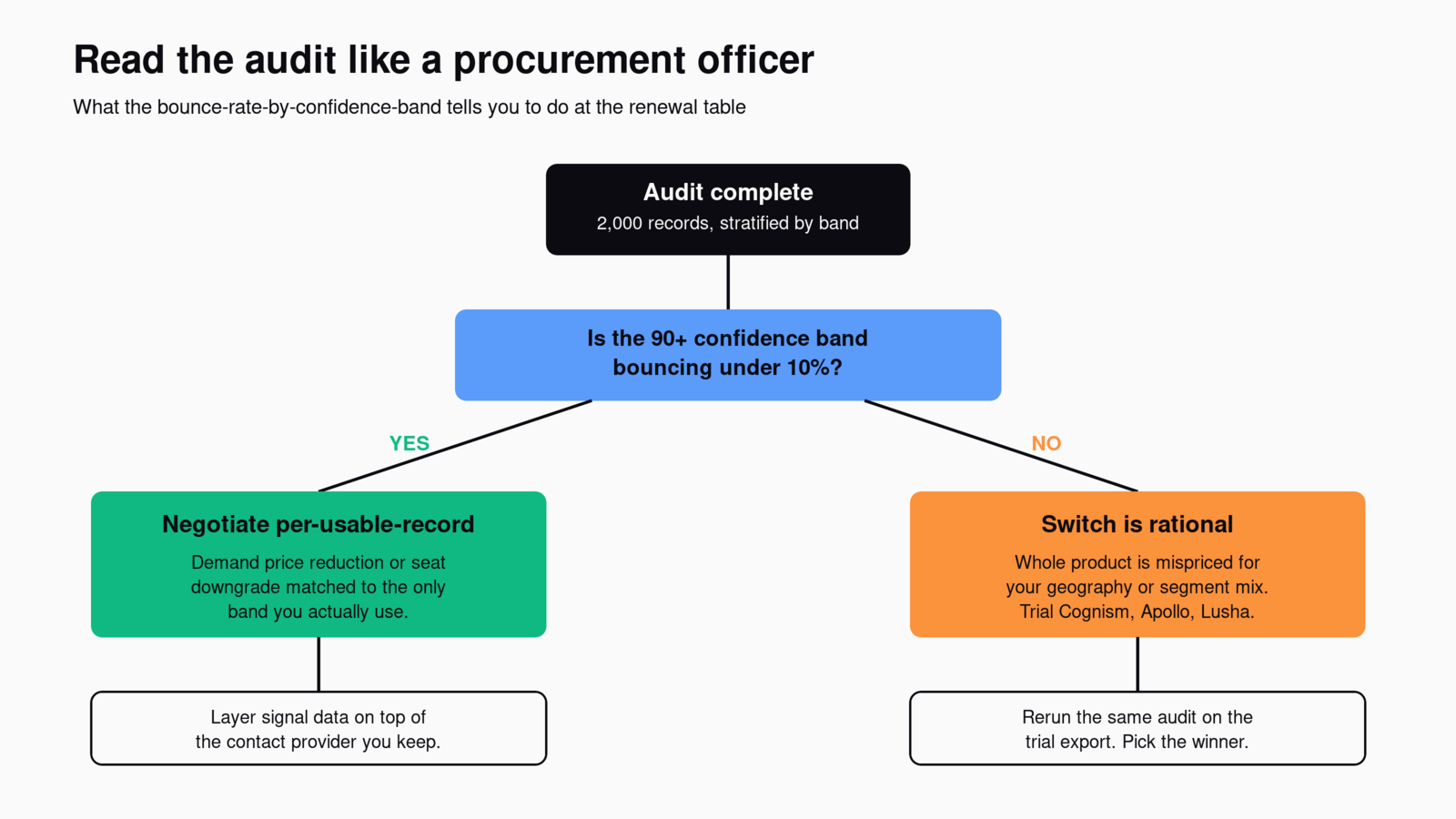
If your bounce-rate-by-confidence-band shows 5-10% on the 90+ band and 25-40% on the 70-85 band, you have a clear two-tier picture: high-confidence inventory is genuinely usable, medium-confidence inventory is what's killing your campaigns. That's negotiation material - either price the contract per usable record, or downgrade the seat count and refresh-credits package to match the segment you actually use.
If the high-confidence band is also bouncing 15%+, the audit just told you the whole product isn't priced correctly for your use case, and switching is rational. The skeptic's read is harder to argue with at that point: paying enterprise prices for 75-85% deliverability is overpaying when 30% annual decay means you have to verify everything anyway.
Use the number to negotiate or switch
Two paths from the audit number. Path one: walk into the renewal call with a printed table - bounce rate by cell, total records sampled, verifier identity - and ask for either a price reduction proportional to the deliverability gap, a credit-balance reset, or a free upgrade to the higher tier (the higher tier usually has a richer refresh cadence). The 90% NRR is your friend here; the AE has internal pressure to retain. Path two: walk into a Cognism, Apollo, or Lusha trial with the same audit methodology and rerun it on the trial data. Cognism customers like Mollie report _30% better data quality_ on EMEA contacts than ZoomInfo, which matches the G2 critique of ZoomInfo's European weakness.
Whichever path you pick, you'll find that contact databases are the foundation of your stack but not the differentiator (!). The differentiator is the signal layer that sits on top - what's happening at the account this week that didn't show up in any contact export. That's the gap Leadex is built to fill: a research agent that surfaces hiring patterns, funding events, and technographic shifts as fresh, web-sourced signals, layered on whatever contact provider survives your audit. The math is straightforward: Leadex prices at least an order of magnitude below ZoomInfo's enterprise tier, because it's pricing a different layer of the stack.
The audit is the upstream gate for any signal-based outbound motion - if your contact records are stale, no amount of clever signal stacking will make the campaign land. And if you're already shopping the alternatives, the Apollo alternatives roundup covers the contender shortlist; for teams without a full RevOps function, waterfall enrichment without a RevOps engineer covers the workflow side.
FAQ
How accurate is ZoomInfo really?
ZoomInfo's contractual 95% accuracy guarantee covers company affiliation only - meaning a contact still works at the listed employer. Real-world email accuracy on enterprise samples runs 75-85% per Prospeo's 2026 teardown, with bounce rates 15-25% in normal practice and up to 50% on poorly maintained campaigns. US enterprise data is the strongest segment (around 85-90%); EMEA and APAC are weaker.
How often does ZoomInfo refresh its data?
ZoomInfo claims to update 4 million contact records daily across a 320M+ contact database, with refresh cadence cited at 90 days for high-priority records and 6-12 months for the long tail. With B2B data decaying at 2-3% per month, a record marked "verified" nine months ago can be 22% stale by export time.
What bounce rate is acceptable on a B2B campaign?
Industry guidance puts around 5% as the soft ceiling for sending-domain health under Gmail and Yahoo's bulk-sender rules. Above 10% you flirt with deliverability damage; above 15% you accumulate spam-trap hits that take weeks to recover from. Lead411's 2026 benchmark for healthy B2B cold outreach sits at 5-8%.
How much does an email-verifier audit cost?
Around $20 for a 2,000-record audit using NeverBounce or Kickbox at roughly $0.01 per check. The cost is trivial compared to a $54K renewal decision and is the cheapest insurance you can buy heading into a renewal negotiation.