
How to Find Companies Hiring a Fractional CMO, CFO, or CRO
LinkedIn went from 60K fractional execs in 2022 to 120K by 2024. Almost nobody covers it as a buying signal. A fractional CMO, CFO, or CRO has six-to-twelve months to ship visible delta - which means they're buying tools on a deadline. Per Jason Lemkin, half the titles are advisor cosplay.
The number of people listing "Fractional" in their LinkedIn title went from roughly 60,000 in 2022 to about 120,000 by the end of 2024, per the Frak Report. Vendux's narrower count of fractional sales leaders in the US and Canada nearly doubled in the same window. Most of the coverage of this trend treats it as a labor-market story - what fractional execs charge, how they find clients, why founders prefer them to full-time hires. Almost nobody writes about it as a buying signal, which is strange, because of all the GTM triggers worth tracking it might be the most concentrated.
A company that hires a fractional CMO, CFO, or CRO has done two things at once. They've admitted there's a function-sized hole. And they've decided to fix it without committing to a full-time exec - which means they're picking a six-to-twelve-month sprint with someone whose entire job is to leave the place better than they found it. That second part is what makes it interesting. Fractional execs change tools. They have to. The clock is short and they're being measured on visible delta, not on quarterly steady-state.
The supply side has been institutionalising for about five years now. Continuum, founded in 2020 by ex-Carta CPO Nolan Church, places fractional execs at venture-backed companies. Catalant has a network of 100,000+ vetted independent operators - heavy on ex-McKinsey, BCG, Bain - serving Fortune 1000 and PE-backed portcos. Bolster, run by Return Path founder Matt Blumberg, was the highest-profile of the bunch and wound down in 2025 with Blumberg moving on to run Markup AI; the marketplaces around it kept growing anyway. The point isn't the marketplaces themselves, it's that the placements they generate are now numerous enough to model. A handful of fractional CMOs hired in your TAM in a month was rounding error in 2021. Now it's a list.
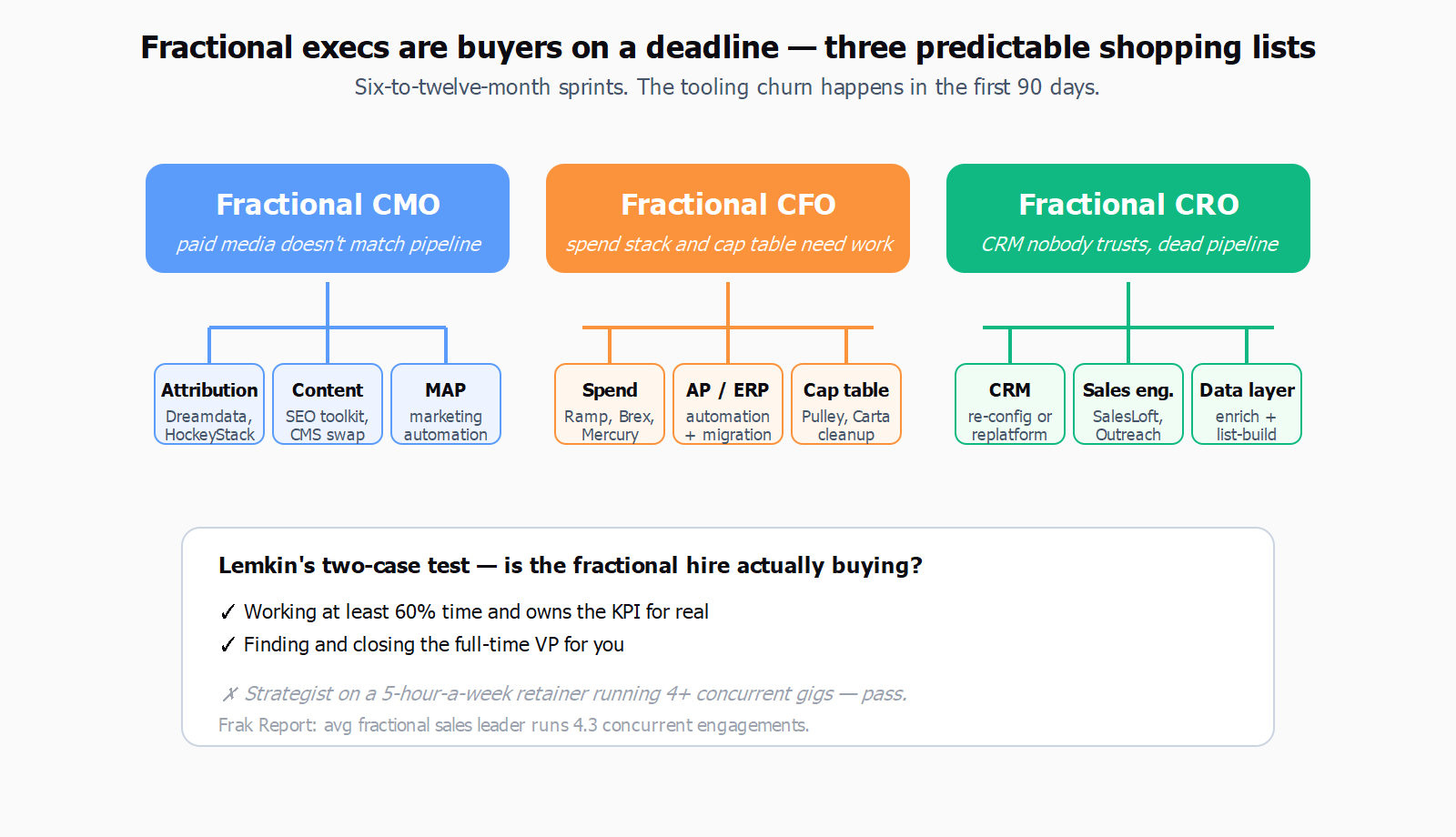
The three roles signal three different shopping lists. A company hiring a fractional CMO is usually staring at a paid-media bill that no longer matches pipeline, or a content engine that stopped producing leads. The fix tends to involve attribution (Dreamdata, HockeyStack, or just a properly wired GA4), a content/SEO operator's toolkit, and sometimes a swap of the marketing automation platform itself. A fractional CFO almost always rebuilds the spend-management stack - the Ramp / Brex / Mercury decision, an AP automation tool, an ERP migration, and frequently a cap-table cleanup on Pulley or Carta before the next round. A fractional CRO walks into a CRM that nobody trusts, a sales-engagement platform that's been "evaluating" for nine months, and a data layer that the SDRs have stopped using; the rebuild touches all three, plus usually a new outbound list-building approach because the old one stopped working (which is often why the CRO got hired in the first place).
None of this is speculative. The honest version of the fractional-CRO job description is that they "audit existing go-to-market efforts, design or refine SDR playbooks, set KPIs ... and help select and configure tools like CRM, sales engagement, dialers, and data providers." Brex's own writeup of the fractional-CFO role lists "AP automation software, ERP software, and data analytics tools" as table stakes for the person you're hiring. These aren't strategists in the abstract sense; they're specifically buyers, on a deadline.
Which is why the most useful thing ever written about fractional execs is also the most cautionary. SaaStr's Jason Lemkin has placed and watched dozens of these hires:
Hiring a Fractional CRO or CMO rarely solves much of any problem, except in the two cases above [working at least 60% time and owning the KPI for real, or finding and closing the full-time VP for you].
Usually, they just want to be strategists. Tell you where to focus, and what to do better. What you almost always just need is a great full-time leader to implement all the ideas.
- Jason Lemkin, SaaStr
Read that twice if you sell into this market. Lemkin's two-case test is the thing you're actually trying to detect: is this fractional hire owning a KPI on more-than-half-time, or is it a strategist on a five-hour-a-week retainer? The first one is buying. The second one is talking. Outbound that doesn't distinguish between the two will burn through both populations and learn nothing.
This is exactly the kind of nuanced job-title query that doesn't fit static contact databases cleanly. LinkedIn has no structured "is fractional" field; the label lives in free-text job titles, with variants like "Fractional CMO", "Interim CMO", "Part-time CMO", "Chief Marketing Officer (Fractional)", and the awkward "Advisor - Marketing" that may or may not mean the same thing. Apollo and ZoomInfo ingest those titles, but a substring search for "Fractional" pulls in everyone who's between jobs and rebranding on LinkedIn alongside the people who actually got placed at a company spending money. The honest take on this kind of ICP is that it needs open-web matching - reading the company's site, the press release, the exec's last three concurrent listings - plus context-clue verification before it's clean. That's the seam Leadex sits in: chat-native research where the brief is "fractional CMO hires at Series B-or-later SaaS in the last 90 days, with a content focus, only the placements that look like real engagements," and the agent goes and reads enough of the open web to actually answer.
The companion question - useful even if you don't believe the buying-signal frame yet - is who else hired what. A founder going fractional this quarter is often two quarters away from a full-time exec hire, and the same company might already have run an internal promotion signal on the marketing or sales side that didn't take. Stacking those three searches gives you a much sharper picture than any one of them alone, and is part of the broader buying-signals taxonomy worth tracking.
The counter-take, courtesy of Lemkin: a meaningful share of self-described fractional execs have no real buying authority. The title is aspirational, the engagement is five hours a week of advice, and the company's actual budget owner is still the founder or an existing VP. Pitching a $30K/year platform to a fractional CMO who is functionally an advisor wastes both of your time. The mitigation is unglamorous: before reaching out, check whether the person is listed as "Fractional CMO" at one company or four, whether they have a single concurrent operating role or are clearly running a portfolio, and whether the company has a press release or a launched campaign that bears their fingerprints. If all three answers point at "advisor," skip them and reach the founder directly. (The Frak survey reports the average fractional sales leader runs 4.3 concurrent engagements - a portfolio big enough that "owns the KPI" stops being plausible at the higher end of that range.)
The practical move tomorrow morning is a saved search on "Fractional [CMO|CFO|CRO]" with a start-date filter of the last 60 days, cross-referenced against companies that have raised in the last 18 months and have between 30 and 300 employees. Then read each one. The ones with the real signal will tell you in the first paragraph what they were brought in to fix, and that paragraph is your opening line.