How to Find Companies That Just Hired a New CRO, CMO, or VP of Sales
A new CRO, CMO, or VP Sales walks in with a fix-it mandate, ~6 quarters of runway, and budget that has not been spent. Forrester's 74% first-mover stat says the vendor in the room first wins. Here is how to detect those appointments across LinkedIn, press wires, and SEC 8-Ks - and the counter-take.
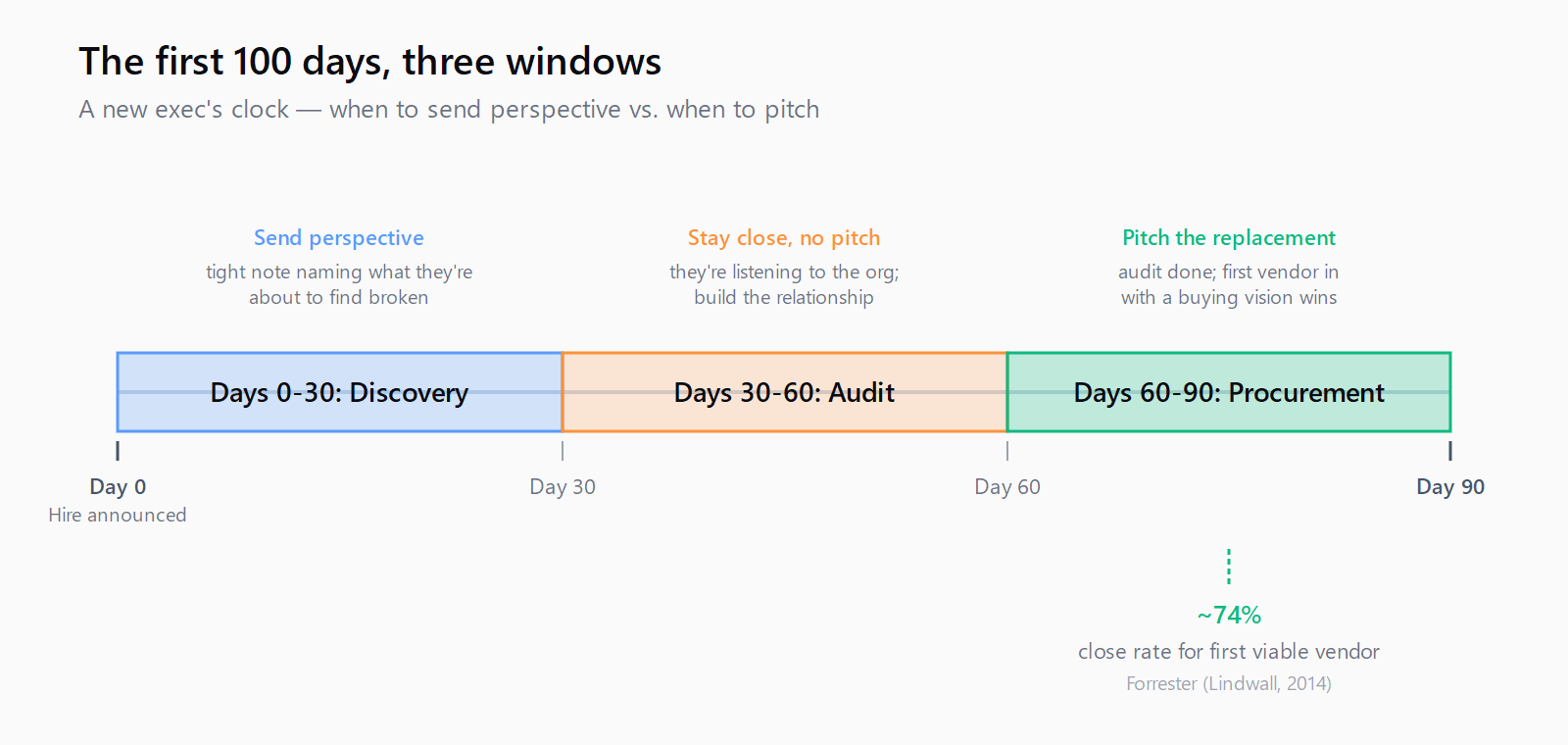
The cleanest buying signal in B2B is a person with a new title and budget they have not spent yet. Funding announcements get most of the attention, but the exec-change signal is often stronger - a new CRO walks in with a mandate to fix something specific, a runway of roughly six quarters (the average SaaS CRO tenure is 19 months according to SBI), and a board that wants to see a plan inside 100 days. The vendor that gets in front of them in the first 30 of those days has a structurally different conversation than the one that books a meeting in month four.
The reason is shortlist mechanics. Forrester's research on B2B buying vision is the load-bearing number behind the whole "first vendor through the door" thesis:
Our research proves that this win rate is upwards of 74%.
- Mark Lindwall, Forrester, on the close rate of the first viable vendor that helps a buyer establish a buying vision. The number is from 2014 and has been re-cited so many times it has lost its source attribution in most places it appears, but it is real and the underlying study is the one to quote. New execs are exactly the audience this applies to - they are doing the buying-vision work in real time, often out loud, and they have not yet built the political capital to defend an inherited vendor against a sharper challenger.
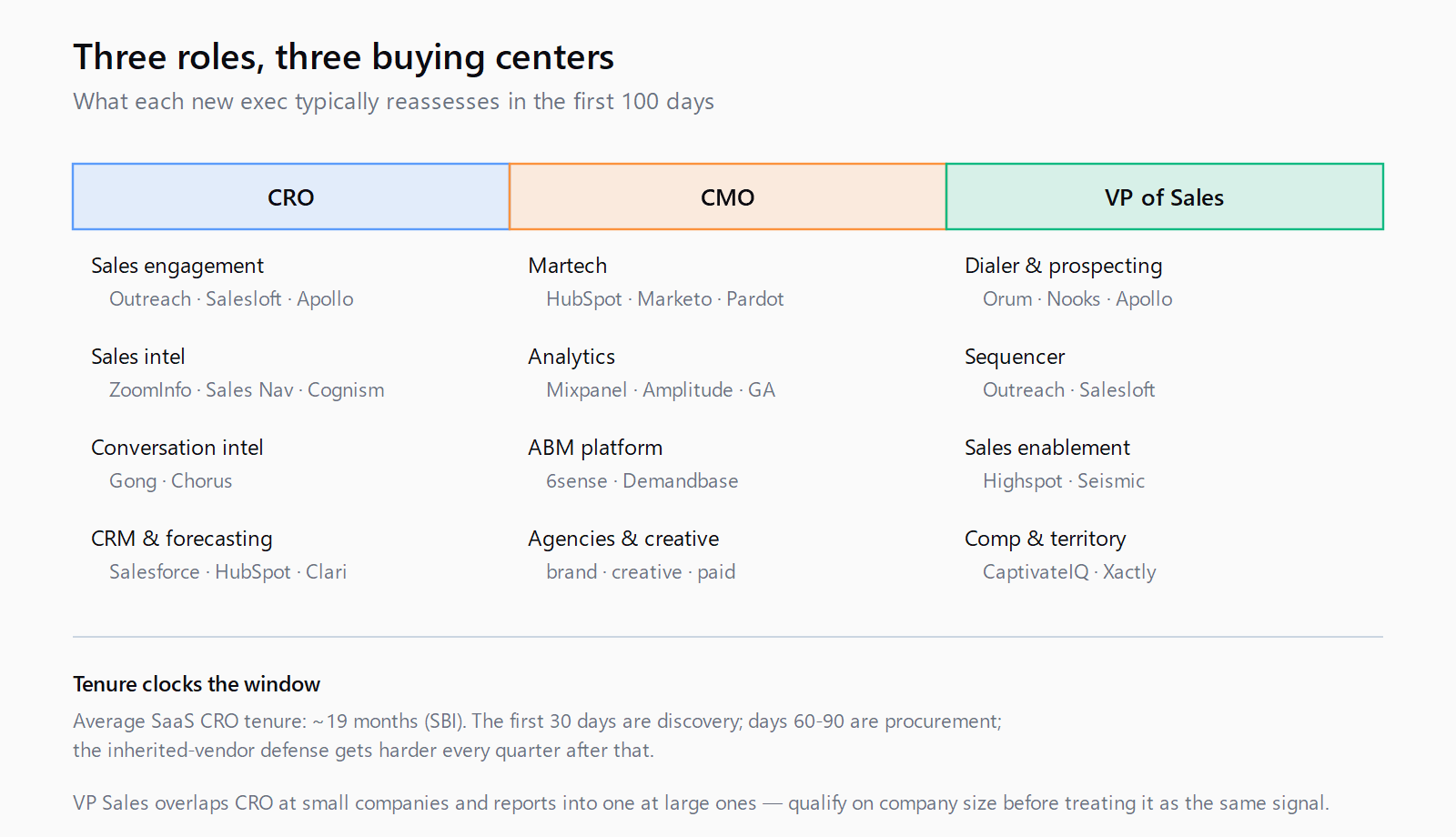
Three roles, three different buying centers, and the detection tactic is slightly different for each. The CRO is the cleanest case. A new CRO almost always touches the sales-engagement stack (Outreach, Salesloft, Apollo), the sales-intel layer (ZoomInfo, LinkedIn Sales Navigator, Cognism), and the conversation-intelligence layer (Gong, Chorus). They also frequently revisit the CRM seat count and forecasting tooling. JumpCloud appointed Shianne Sampson as CRO on 23 March 2026 - Eventbrite alumna, prior leadership at New Relic and Zenefits - and her on-record statement to the press in week one was a strategy preview any pipeline operator should treat as free intelligence:
There is a massive opportunity to win the unified platform narrative. My goal is to help our customers consolidate workflows into a single console.
- Shianne Sampson, CRO, JumpCloud, in the company's 23 March 2026 appointment release. Read that quote as a vendor and you can already see which categories are about to get a hard look (consolidation plays) and which are safer (anything that is already the unified console). That is the kind of read you cannot do from a job-title change alone - you do it from the press release the change came in, which is why scraping the announcement matters more than scraping the LinkedIn update.
The CMO is the role that drives the most spend in the shortest time. New CMOs typically reassess the agency roster, the martech stack (HubSpot vs. Marketo vs. Pardot), the analytics layer (Mixpanel, Amplitude, GA), the ABM platform (6sense, Demandbase), and the brand/creative vendors. The cycle is faster than the CRO's because marketing budgets are easier to redirect mid-quarter than sales comp plans. Bridget Perry's move from Contentful to Amperity as CMO on 6 March 2026 is a textbook case - a CMO who scaled Contentful through enterprise growth landing at a CDP company that is repositioning around AI. Her vendor priorities at Amperity are not Contentful's, and any vendor that pitched Contentful into Perry's last regime has roughly a 90-day window to re-pitch into the new one.
The VP of Sales is messier, partly because the title is overloaded. A VP of Sales at a 50-person Series A is the de facto CRO; a VP of Sales at a 5,000-person enterprise is one of nine and the buying authority is somebody else's. The detection tactic stays the same but the qualification matters more - filter the result set on company size and current CRO presence before treating a VP-Sales hire as a real signal. When it is real, the VP Sales tends to own the dialer, the prospecting tool, the sequencer, and sales enablement (Highspot, Seismic). Less often the CRM, almost never the analytics stack.
Detection comes down to four feeds, in roughly increasing order of operator effort. The fastest is LinkedIn's "Started a new position" filter, layered with title and date; Sales Navigator's Spotlights "changed jobs in the past 90 days" facet does the same job at scale and is what most outbound teams already have a seat for. The second is press-wire scraping - PR Newswire and Business Wire both expose RSS feeds with stable URL patterns, and a keyword filter on "appointed" / "joins as" / "named Chief" against title strings catches the tier-1 announcements with title and direct quote attached, which is far more useful than a bare LinkedIn diff. Third, for public US companies, EDGAR's full-text search over Form 8-K Item 5.02 filings is a free firehose of officer changes filed within four business days of the event - close to real-time, and almost no outbound team uses it (!). Fourth, board and leadership pages on company sites get edited within a week of a new hire; tools like visualping.io that watch a URL for diffs catch the long tail that wires miss.
The exec-change signal sits in the same family as hiring after funding and is one of the strongest entries in the broader buying-signals taxonomy. It also pairs naturally with champion job-change tracking on the customer-side - the same LinkedIn firehose that surfaces a new CRO at a prospect surfaces your old champion at a different prospect. We think about this a lot at Leadex because the natural-language brief that combines it - "US SaaS companies that announced a new CRO, CMO, or VP Sales in the last 45 days, headcount 100-2000, enrich with the new exec's email, push to HubSpot" - is the kind of cross-source query that the four-tab discovery-plus-enrichment-plus-CRM-import workflow makes painful and that a single chat is supposed to make trivial. The plan preview shows which sources will get hit (LinkedIn, press wires, EDGAR, the company's own news page) before any credits are spent, which matters when a sloppy filter could pull every "new VP Sales" in a Fortune 500 reorg and burn enrichment budget on noise.
The counter-take is the one practitioners of the role itself give. Most new execs do not rip and replace inside the first 30 days, and the canonical advice from the people who write the first-100-days playbooks is the opposite - listen, audit, do not show up with the slide deck from the last gig. PE Alpha's guide is blunt about it: "every company is different even if it looks similar." The implication for the outbound side is that the first 30 days are discovery for the new exec, not procurement. Pitching a tool replacement in week two is too aggressive and reads as exactly what it is. Pitching a perspective on the problem - sending a tight note that names the thing they are about to find broken, with a pointer to a resource - is the move. The procurement conversation comes in days 60-90 once the audit is done.
What this means for ICP design: an exec-change-only ICP is a thin signal and will produce a noisy list. An exec-change plus a second filter - recent funding, recent layoffs, a known competitor of yours in the inherited stack, a SaaS renewal date that falls inside the new exec's 100-day window - is the signal worth running. The first signal tells you a buyer is on the clock; the second tells you which clock.