
How to Find VC-Backed Companies Hiring in [Department] After Funding
Part 3 of a three-part series on funding-signal prospecting. Funding alone is the most over-indexed play in outbound; stacking a hiring signal on top is what tells you which product to pitch.
Part 3 of a three-part series. Part 1 was about speed - beating the canonical list by a week. Part 2 split the funded-startup ICP into four distinct playbooks by stage. This one is about the multiplier: what happens when you stack a second signal on top of the funding one.
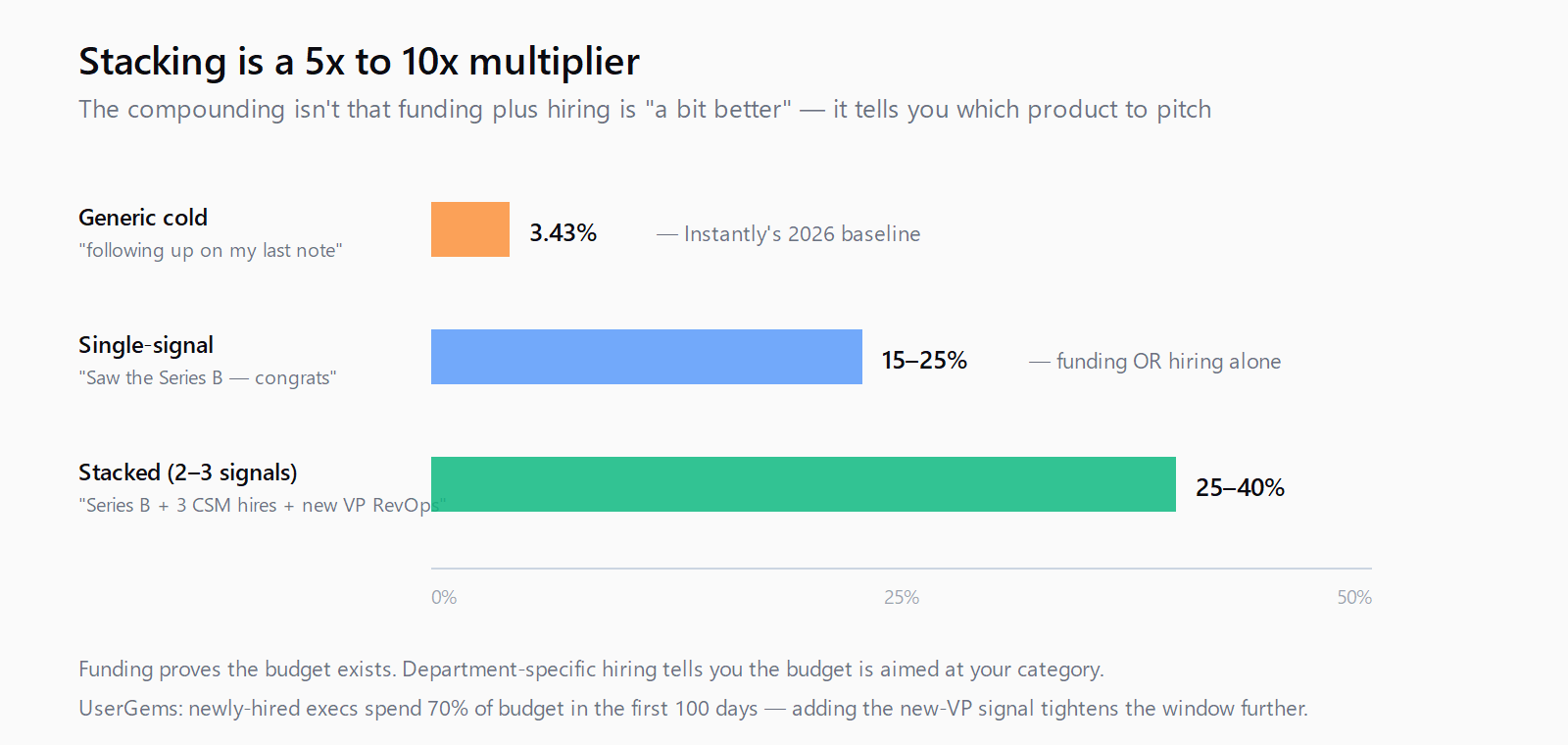
The funding-only pitch ("congrats on the Series B, would love 15 minutes") is the most over-indexed play in outbound. Every SDR sees the announcement on the same Tuesday and sends the same congratulations note. The result is the inbox we all see. Autobound's signal-based-selling guide, summarizing Instantly's 2026 Cold Email Benchmark Report, puts the generic cold-email reply rate at 3.43%. Single-signal outreach (funding or hiring, tied to a real value prop) gets 15-25%. And:
Multi-signal stacked outreach (2-3 signals plus behavioral profile) achieves 25-40% reply rate, which represents a dramatic improvement over generic cold outreach.
That is a 5x to 10x gap over the baseline, and a 2x to 3x gap over single-signal. The compounding effect is not that funding plus hiring is slightly better than either one alone - it is that the combination tells you which product to pitch, which is the thing funding alone never does.
Example: "Series B fintech in New York hiring three Customer Success Managers" is a different pitch than "Series B fintech in New York hiring four ML engineers." Same company, same round, different department in hiring mode, entirely different product fit. The funding signal proves the budget exists. The department-specific hiring signal tells you the budget is aimed at your category. A CS-tool vendor should be pitching the first company; a data-infra vendor should be pitching the second. The only teams that get this right are the ones running both signals together.
Three places to pull the hiring layer from, free or cheap. First, LinkedIn Jobs filtered to "posted in the last week" against the funded-company list - the freshest signal, because jobs post hours after the kickoff meeting. Second, the ATS itself - Greenhouse, Lever, and Ashby all expose public job boards with stable URL patterns (boards.greenhouse.io/<company>) that can be polled for week-over-week deltas. Third, the company careers page, which often lists roles that have not yet been pushed to LinkedIn. A department jumping from 2 openings to 9 in a week, cross-referenced against a funding hit from the same 30-day window, is as strong a signal as outbound gets.
Timing compounds. UserGems' research, cited in the same Autobound piece, finds that newly hired executives spend 70% of their budget within the first 100 days - so a "funded in the last 30 days, just hired a VP of RevOps" composite is tighter than either signal alone. The VP is named, on the clock, and has budget that resets in Q1 to zero if unspent (!).
This is the seam Leadex is built to close. A chat brief like "US Series A or B SaaS companies funded in the last 45 days AND hiring 3+ sales roles on LinkedIn this month, enrich with VP Sales email, push to HubSpot" is one prompt; the plan preview shows which sources the agent will hit before any credits are spent. The "first 500-lead list by lunch" framing on the site is really about this case - the multi-signal query that no single filter UI can express.
What is still missing from this stack: the why layer. Funding says they can buy; hiring says where they are investing; neither tells you what is broken. A future post on pulling language from hiring manager LinkedIn posts, earnings-call transcripts, and G2 reviews as the third signal - the pain-point one - closes the series. (See also: finding companies in stealth mode before they launch.) (See also: finding companies hiring fractional CMOs, CFOs, or CROs.)