How to Find Startups That Just Raised a Round (Before Your Competitors Do)
Part 1 of a three-part series on funding-signal prospecting. The list of recently funded startups is the same list every rep works on Monday; the only differentiator is being a week earlier.
Part 1 of a three-part series on funding-signal prospecting. The earlier piece on recently-funded startups covered which public signals exist. This one is about getting to them a week before the rep at the next desk.
Every sales team discovers the same thing after their first month of outbound: the list of "companies that raised in the last 30 days" is roughly the same list everyone else is working. Crunchbase exports land in hundreds of inboxes on Monday morning, TechCrunch's weekly roundup hits on Friday, and PitchBook's "new deals" digest goes to every BDR with an enterprise data budget. By Tuesday afternoon the CEO's inbox is already at 80 congratulations emails, and the fifteenth one to say "saw the Series A, would love 15 minutes" is not the one that books a meeting.
The numbers behind this are sharp. Growth List's analysis of trigger-event response data, cited in Autobound's signal-based-selling guide, finds the first seller to reach a decision-maker after a trigger event is 5x more likely to win the deal than those who arrive later. Jolly Marketer's research on B2B trigger events, quoted in the same piece:
Vendors contacting funded firms within 48 hours experience 400% higher conversion rates compared to those who delay, and 71% of funded companies finalize vendors within 90 days of their announcement.
That 48-hour window is the whole game. The question is not "where can I find newly funded startups" (everyone has that list) but "where can I find them two, five, ten days before the canonical source publishes them?"
Four sources, ranked by latency rather than coverage. The SEC EDGAR Form D filing is the most official but also the most lagged - the 15-day filing window plus the 24 to 48 hours to appear in EDGAR's search means a Form D hit is typically 2 to 3 weeks after the wire cleared. Useful for reconciliation, weak as a first-mover lead. Crunchbase and PitchBook sit a step later than the announcement itself; Crunchbase updates daily but publishes mostly from PR submissions and portfolio-page scrapes, while PitchBook's 2,500 in-house researchers manually verify every record, which is why the data is cleaner and a few days later.
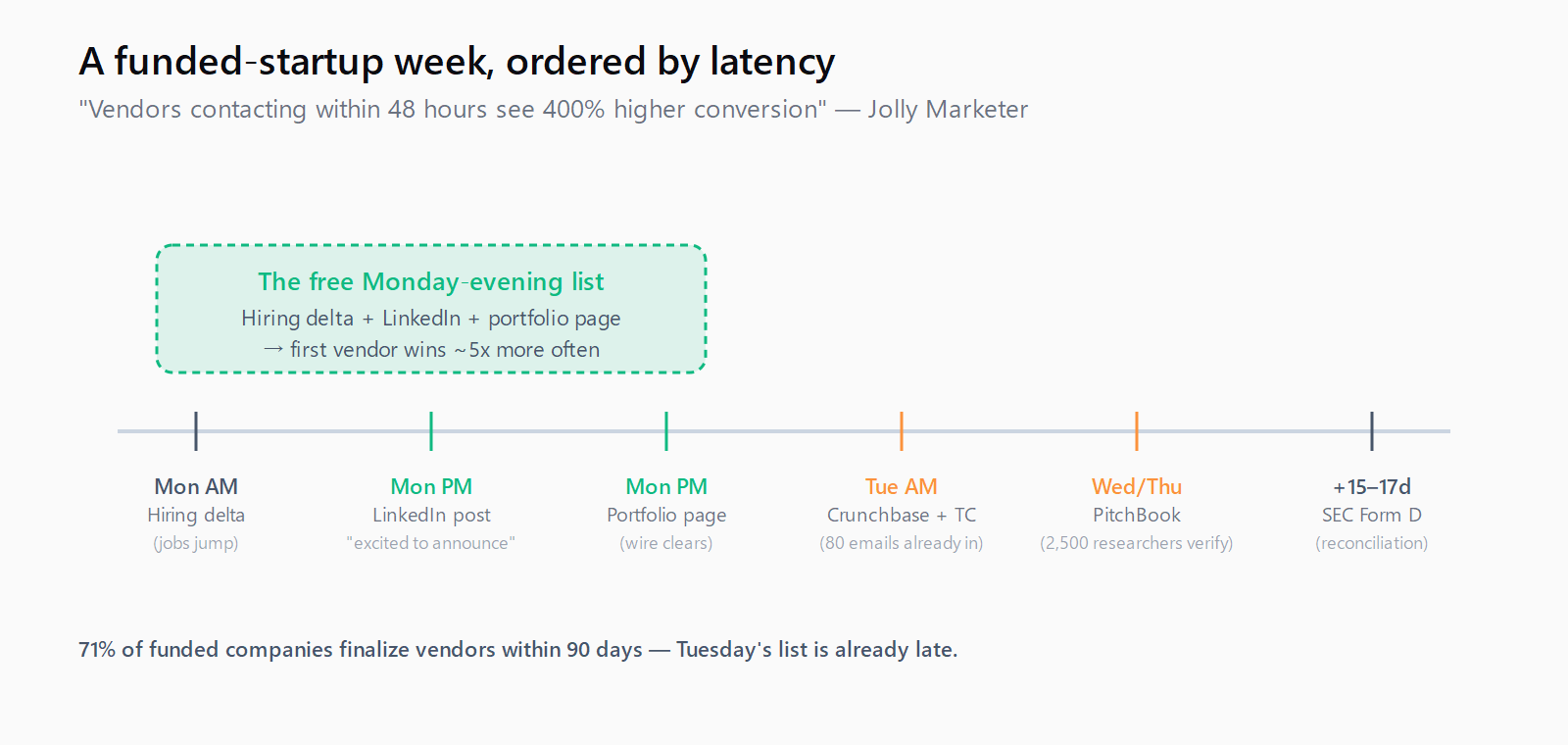
What beats them: the investor's own portfolio page, updated the day the wire clears (see the portfolio-page method), and LinkedIn founder posts, often published hours before the embargoed TechCrunch piece lands. A curated LinkedIn query for "excited to announce" paired with "seed round" or "Series A," scoped to the last 48 hours, surfaces funded companies roughly a week before Form D, three to five days before Crunchbase updates, and a day or two before TechCrunch (I believe). Third, the hiring delta - a company that jumped from 4 to 18 open roles on Tuesday almost certainly wired funds on Monday, even though the press release is still queued for Thursday.
We think about this a lot because Leadex runs the four-source stack from one chat brief - portfolio scrape, LinkedIn search, hiring delta, EDGAR reconciliation - and the research plan previews before the agent runs, so you can see whether it is going to hit the fresh sources or the lagged ones before any credits are spent. A founder without a Crunchbase Pro subscription can still beat the Tuesday-morning list, because the Monday-evening list is free.
Part 2 of the series breaks this stack down by funding stage - the seed-round outreach that works on a founder is not the outreach that works on a Series C CRO. Part 3 layers hiring signals on top of funding for the multi-signal version of the same question. (See also: finding companies in stealth mode before they launch.) (See also: finding SaaS companies in Berlin, London, or Amsterdam.)