
Seed to Series C: How to Prospect Newly Funded Companies by Stage
Part 2 of a three-part series on funding-signal prospecting. Seed and Series C are not the same ICP, and outreach that treats them as one is outreach that gets ignored at both ends.
Part 2 of a three-part series. Part 1 argued that the "newly funded" list is the same list every rep works on Monday; speed is the only differentiator. This piece is about the other differentiator: that seed and Series C are not the same ICP, and outreach that treats them as one is outreach that gets ignored at both ends.
Four stages, four playbooks. The numbers below are US medians for 2025, compiled from Pitchwise, Carta, and Revelio Labs headcount data.
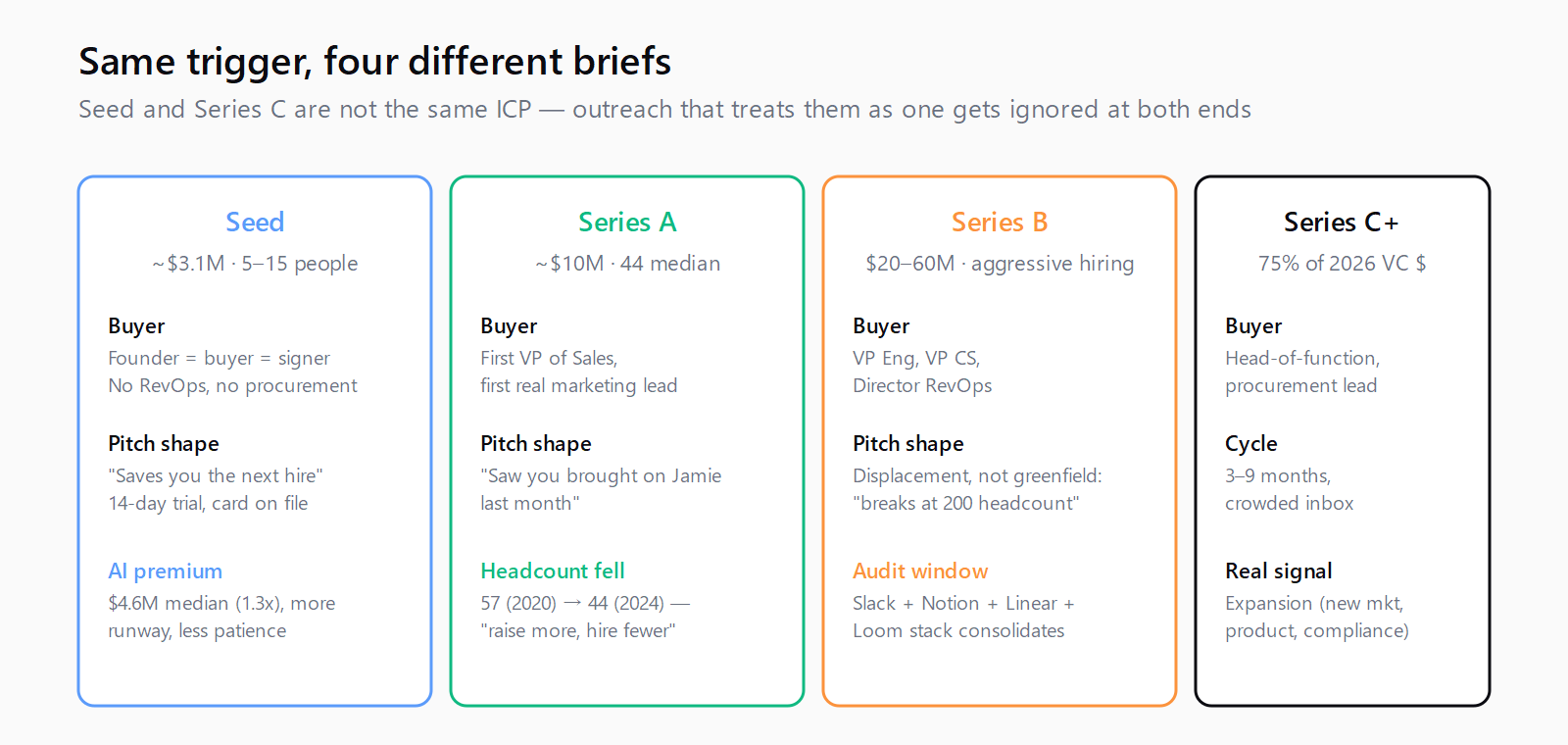
Seed, ~$3.1M raise, 5 to 15 people. The founder is the buyer, the signer, and usually the only person on the pricing page. There is no RevOps, no VP of Sales, no procurement. The question a seed-stage CEO is answering every day is "does this tool save me from hiring the next person," and outreach that skips that frame - "here is a 14-day trial, your card on file, unbeatable by the 6-month procurement cycle you do not have yet" - lands better than enterprise boilerplate. The AI-vertical premium is real, by the way: Pitchwise's 2026 data puts the median AI seed at $4.6M, 1.3x the broader seed market. A seed-stage AI company has both more runway and less patience than the 2021 version.
Series A, ~$10M raise, 44-person median headcount. This is the stage where the traditional list-building playbook starts to work, because the company is hiring its first VP of Sales and its first real marketing lead - named buyers for sales and marketing tools. The headcount number has been moving: Revelio Labs' panel shows median Series A headcount fell from 57 in 2020 to 44 in 2024, reflecting the "raise more, hire fewer" regime that became standard post-2022. The buyer is named; the tooling decision is fresh; the budget is three months old. The outreach that works here references the specific VP hire ("saw you brought on Jamie last month") rather than the round.
Series B, $20-60M raise, aggressive headcount plans. Ampleo's 2026 hiring-strategy piece on the stage captures what changes:
Five years ago, a Series B startup might have had forty engineers and a generously staffed growth team; today, similar companies often run with half the headcount and expect each hire to have more range.
Middle management is the new budget line - VP of Eng, VP of CS, Director of RevOps. Vendor consolidation starts here (the Slack-plus-Notion-plus-Linear-plus-Loom stack gets audited). Outreach that works at Series B is the displacement pitch, not the greenfield pitch: "you are already on X, here is what breaks at 200 headcount that did not break at 80."
Series C and later. Qubit Capital's 2026 venture data reports that 75% of VC investment in 2026 went to Series B and later rounds, so these are the deepest budgets and the most crowded inboxes. The buyer is a named head-of-function or a procurement lead; the sales cycle is three to nine months; the relevant signal is usually expansion (new market, new product line, new compliance regime) rather than the round itself.
We think about this a lot because Leadex takes the ICP as a prose brief, not a filter-UI query - "Series A fintechs in France whose Head of Eng posted about hiring in the last 90 days" runs as a single chat prompt, which is exactly the kind of stage-specific slice that the big-database UIs cannot express in a dropdown. The "hundreds to a few thousand rows" it returns map cleanly onto whichever of the four playbooks above fits the stage.
Part 3 of the series stacks funding against hiring for the multi-signal version of the same lookup.