
How to find a VC's portfolio companies (and what to skip)
Four methods for finding any VC's portfolio companies: the firm's own page, Crunchbase, SEC EDGAR Form D, and PitchBook - ranked by cost and coverage.
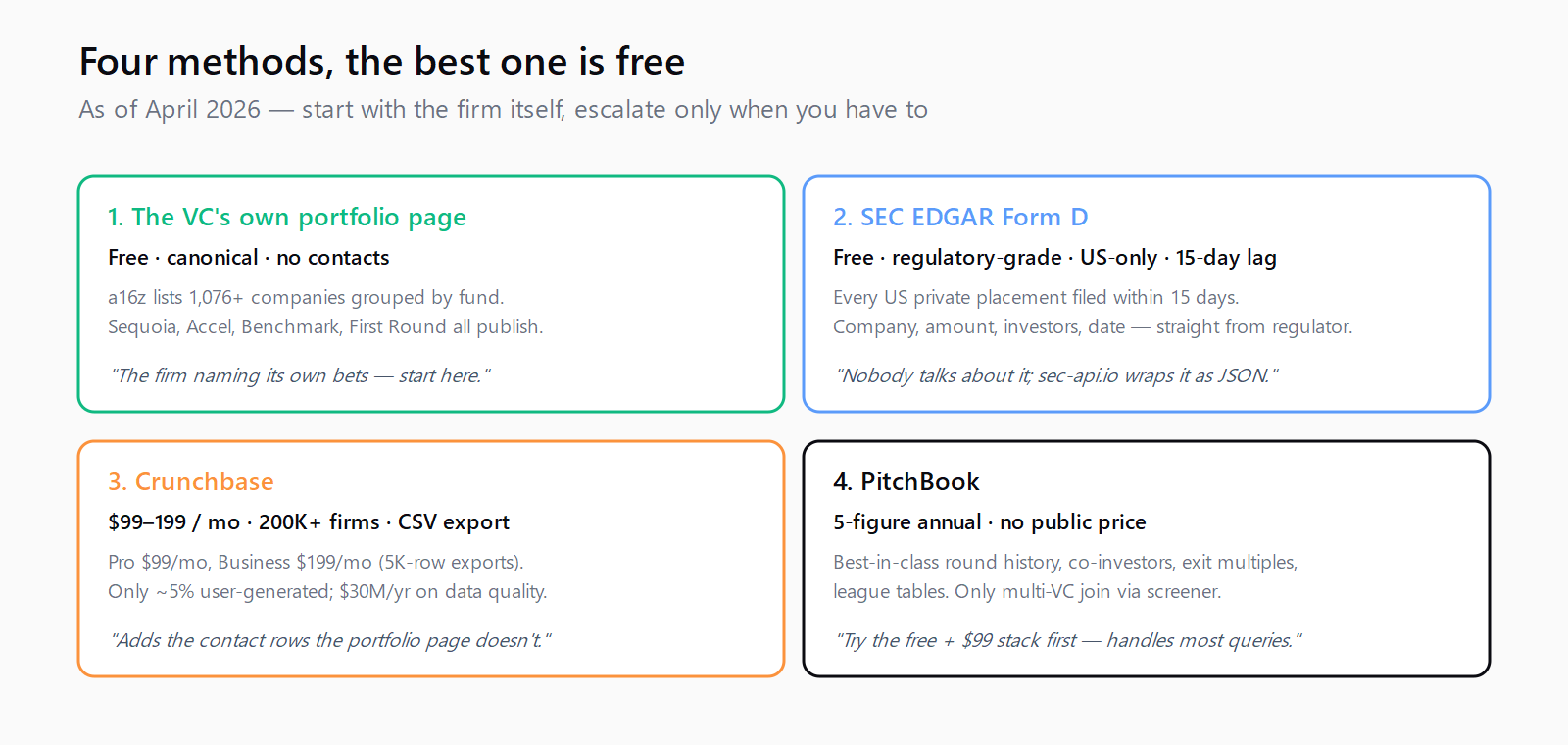
"How do I find every company funded by (insert VC name)?" is one of the most common questions I see in sales and agency Slack channels, usually followed by a link to a half-working Zapier script or a stale LinkedIn list. The answer is less exotic than most of the scripts suggest. As of April 2026, four methods cover it, and the best one is free.
The first is the VC's own portfolio page. Andreessen Horowitz publishes theirs at a16z.com/portfolio - 1,076+ companies as of November 2025, grouped by fund (American Dynamism, Bio + Health, Consumer, Crypto, Enterprise, Fintech), with a separate investment list covering historical positions. Sequoia, Accel, Benchmark, First Round, and almost every named firm does the same. These pages are canonical (the firm is naming its own bets) and free, which matters because the three methods that follow all cost something in time or money.
They don't, however, give you contacts. For that you reach for Crunchbase or PitchBook.
Crunchbase is the second method. Their investor directory covers 200,000+ firms, with a portfolio tab on every investor profile and CSV export on the paid tiers. It's more curated than the site's crowdsourced origins suggest - CEO Jager McConnell told OMERS Ventures in December 2024:
Only about 5% of our data is user-generated.
The remaining 95% comes from Crunchbase's own data operation, which McConnell says spends roughly $30 million a year on quality. Pro starts at $99/month; Business is $199/month and adds 5K-row exports, AI trend summaries, and auto-enrichment add-ons. Fine for a small team running a handful of portfolio pulls a month. A bottleneck if you want the raw data in a warehouse.
Third, and my favourite because nobody talks about it: the SEC. Every US-based private placement has to file a Form D notice within 15 days of the first sale, and those filings are public at EDGAR full-text search. You get the company name, the amount raised, the named investors, and the date - for free, straight from the regulator. The lag is real (15 days after close, and many rounds are announced weeks later for press-cycle reasons) and the coverage is US-only, but for a regulatory-grade list of who-backed-whom it's unbeatable. APIs like sec-api.io wrap the same data in JSON if you'd rather not parse XBRL yourself.
Fourth, worth naming only to skip unless the budget is there: PitchBook. Best-in-class for round history, co-investors, exit multiples, and league tables, but list prices are five figures a year and they don't publish them (!). If you're an agency targeting VC-backed companies and you're about to expense PitchBook, try the stack of portfolio page plus Crunchbase plus EDGAR first - it handles the large majority of prospecting queries at a fraction of the cost.
What to skip: LinkedIn's "Past investors" filter (coverage is thin and self-reported, I believe), "free VC database" Notion pages (stale within a quarter), and data brokers who claim to sell "exclusive portfolio lists" (they are usually reselling Crunchbase exports with a markup). If the source isn't the firm itself, the SEC, or one of the two real databases, treat it as a secondary rewrite.
The practical workflow, then: start with the portfolio page to get the canonical company list, cross-reference Crunchbase for round context, dip into EDGAR for the most recent US raises, then enrich the whole list with contact data and dedupe against your CRM. We think about this a lot because Leadex runs exactly this pipeline from a single chat prompt - "every a16z portfolio company in enterprise infrastructure, enriched with the VP of Eng's LinkedIn, deduped against HubSpot" - and the enriched list lands in the CRM a few minutes later.
One detail this four-method stack doesn't cover gracefully: finding companies funded by multiple specific VCs (the "both Sequoia and a16z" lists, useful for spotting consensus bets). That's a join across two portfolio pages, and none of the methods above handle it natively - PitchBook gets closest with its screener. A post for another day. (See also: finding companies in stealth mode before they launch.) (See also: finding SaaS companies in Berlin, London, or Amsterdam.)