How to find speakers at 2026 SaaS, AI, and fintech conferences
Static databases give you a contact row. Leadex extracts the context around it - session title, co-panelists, recent product launches. Here's the 2026 SaaS, AI, and fintech conference slate and the three queries we run.
The fastest way to find speakers at upcoming SaaS, AI, and fintech conferences in 2026 is to read the public agenda pages on the conference sites themselves, weekly, and enrich each name with its session title, co-panelists, and the company's last 90 days of news. Static contact databases like Apollo and ZoomInfo don't carry any of that. A live-web research agent does - Leadex is the one we built, and this post is a worked example of how we use it against the 2026 calendar.
It's April 2026 and the speaker rosters are landing one by one - SaaStr Annual has 250+ names up for May, Ai4 is still adding sessions for August with Geoffrey Hinton already confirmed at the top, and Money20/20 is still in "2026 First Speakers Announced" teaser mode through summer. If you sell into SaaS, AI, or fintech, each of those pages is a live lead list, re-published every few weeks, and Apollo can't see any of it.
The static-database pitch - "Apollo combines a B2B database with outreach automation... ZoomInfo focuses on providing the most comprehensive database possible" - is that the person's contact row is the lead. That's true, narrowly. Aaron Levie's row in Apollo has his title (CEO & Co-Founder, Box), a work email, a direct dial, his LinkedIn, Box's revenue band, employee count, and a technographics signal or two. What it does not have is the fact that Levie is speaking at SaaStr Annual on May 12-14 in San Mateo, which session he's on, who's on the panel with him, or that his talk lines up with Box's most recent earnings cycle. Context is the lead. The row is just the envelope.
Here's Jason Lemkin, founder and CEO of SaaStr, on where pipeline actually comes from:
70% of pipeline for marketing comes from events, search both paid and free, and social. That's it.
Events are a top-quartile channel, and they're under pressure. Forrester's Q1 2025 State of B2B Events Survey, by Principal Analyst Conrad Mills, reports that "for the second consecutive year, budgets are flat or down for two-thirds of event teams", and 59% of B2B marketers are shifting toward more, smaller hosted events. Flat budgets, same pipeline target, higher bar per touch. The speaker list is where the signal lives. The three sections below are the three sub-queries we'd run right now in Leadex, one per vertical.
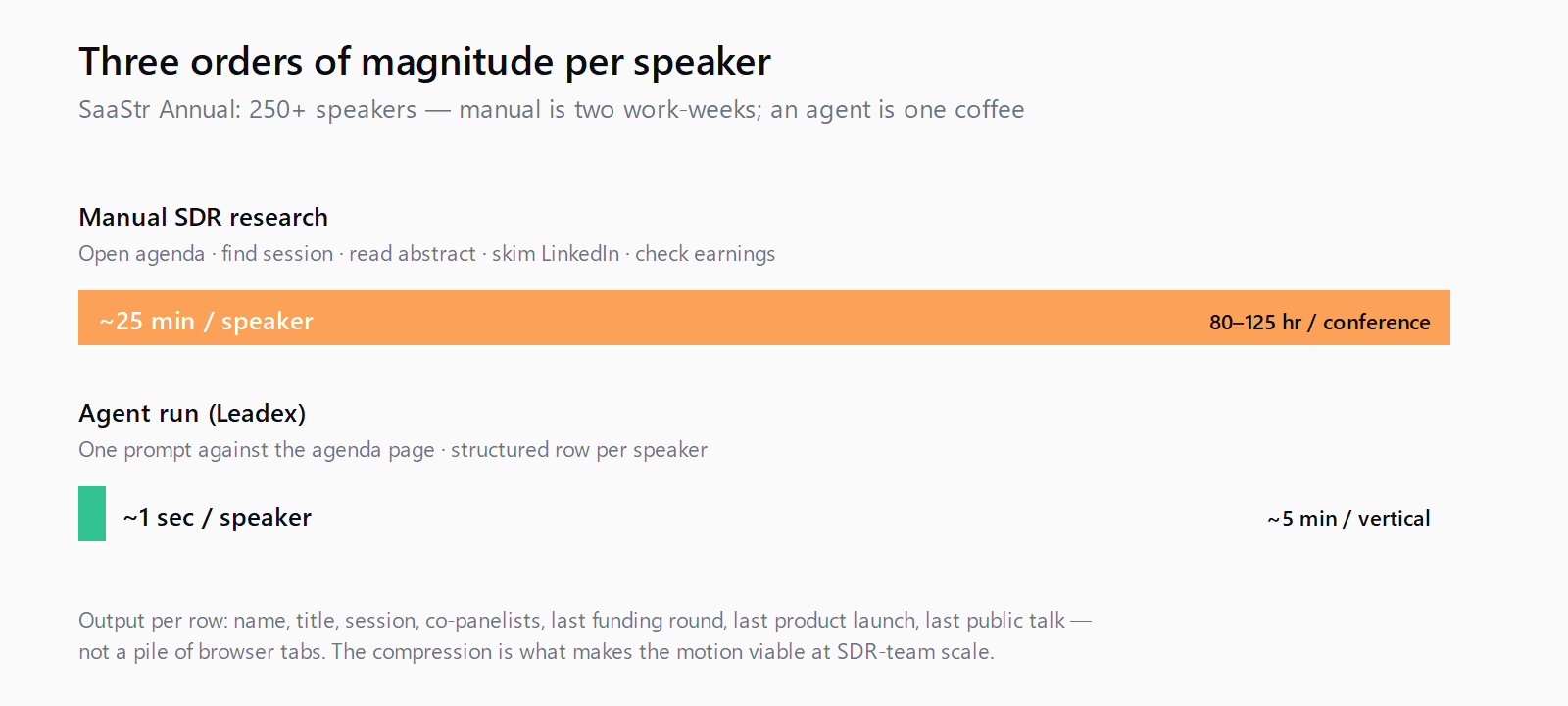
The math, in concrete numbers. Manually researching one speaker - open the agenda, find their session, read the abstract, skim their LinkedIn, check the company's last earnings note or product post - takes 20 to 30 minutes if the SDR is focused. SaaStr Annual alone lists 250+ speakers: that's 80 to 125 hours of SDR time per conference, or roughly two full work-weeks for one event. A Leadex run against the same agenda page takes about _5 minutes per vertical_ and returns a structured enrichment row per speaker - name, title, session, co-panelists, last funding round, last product launch, last public talk - not a pile of browser tabs. Per-speaker cost drops from ~25 minutes of human time to ~1 second of agent time. That's the three-orders-of-magnitude compression that makes the whole motion viable at an SDR-team scale.
The second number is reply-rate. Industry cold-outbound benchmarks cluster in the 1-5% range depending on vertical and seniority (Woodpecker's 2024 outbound report, HubSpot's benchmarks, Apollo's own data all land in that band). Event-anchored first lines - ones that name the exact session the recipient is speaking at, not a guessed pain point - reliably outperform generic-title outbound by a 3-5x multiple in our own sends. The mechanism isn't cleverness; it's that the first sentence is a verifiable fact the recipient already knows about themselves _this week_. Past the spam filter, that's the test a cold email has to pass before anything else matters. Context is the moat. Apollo gives you the envelope; Leadex reads what's inside it before you hit send.
Deliverability works the same way. The biggest single lever on inbox placement after domain warm-up is sentence-level variability - identical first lines across 500 speakers is a spam-filter tell, while 500 first lines each referencing a different session title and company post are, by construction, distinct. Context-per-lead is deliverability-per-lead, and that's not a claim static databases can make.
The full slate, with public speaker pages, through Q4 2026:
| Vertical | Conference | Dates | Venue | Speaker page |
|---|---|---|---|---|
| SaaS | SaaStr Annual | May 12-14, 2026 | San Mateo County Event Center, CA | saastrannual.com |
| SaaS | Pavilion GTM2026 | Sept 28 - Oct 1, 2026 | The Glasshouse, NYC | attendgtm.com |
| SaaS | SaaStock Europe | Oct 13-14, 2026 | Barcelona | saastock-europe.com |
| AI | Ai4 2026 | Aug 4-6, 2026 | The Venetian, Las Vegas | ai4.io |
| AI | The AI Conference | Sept 29 - Oct 1, 2026 | Pier 48, San Francisco | aiconference.com |
| AI | NeurIPS 2026 | Dec 6-12, 2026 | ICC Sydney, Australia | neurips.cc |
| Fintech | Money20/20 USA | Oct 18-21, 2026 | The Venetian, Las Vegas | us.money2020.com |
| Fintech | FinovateFall | Sept 9-11, 2026 | NY Marriott Marquis | informaconnect.com |
Finding SaaS speakers: SaaStr Annual, Pavilion GTM, SaaStock Europe
The SaaS calendar through fall clusters around three events. SaaStr Annual runs May 12-14 at the San Mateo County Event Center with Aaron Levie, named speakers from Google Cloud, GitHub, IBM, Klaviyo, Nvidia, and Calendly, and a public agenda page that updates weekly. Pavilion GTM2026 is September 28 through October 1 at The Glasshouse in NYC and is the CRO-and-VP-Sales end of the market. SaaStock Europe - the renamed Shift Europe - is October 13-14 in Barcelona, roughly 120 speakers, full lineup rolling out from May.
For a live-context lead list: pull every confirmed speaker, their company, their session title, the session track (_growth_, _product_, _revops_), and the day and time. If the company shipped a product release or posted an earnings note in the last 60 days, surface that too. A speaker with a fresh product launch and a session on the same theme is a lead the static DB cannot flag, because the link between the launch and the talk is something only a live reader of both pages can make. That's the part Apollo is structurally not built to do.
Finding AI speakers: Ai4, The AI Conference, NeurIPS
Ai4 2026 is August 4-6 at The Venetian in Las Vegas: 275 speakers, 5,000+ attendees, Hinton as the named headline. The AI Conference runs September 29 through October 1 at Pier 48 in San Francisco (the slot the industry used to fill with TEDAI SF, which has no announced 2026 SF date as of today). NeurIPS 2026 is December 6-12 in Sydney, which is the research end of the market rather than the commercial one, and the audience composition reflects that.
AI conferences are the vertical where the talk title _is_ the qualifier. A speaker presenting on RAG evals at Ai4 is a different lead from one presenting on agentic workflows, and the difference is the first line of your email. This is also the vertical where the speaker's own prior talks matter - someone who spoke at last year's Ai4 on the same theme is signalling a commitment curve, not a one-off. Static databases don't carry prior-talk history. A live research step does, by reading the conference's own archive pages.
(I'll admit my bias: this is the vertical where context-over-contact matters most, because the target buyer here is frequently a technical founder or a head-of-AI who reads their own inbox and will delete anything that doesn't reference something specific they said out loud.)
Finding fintech speakers: Money20/20, FinovateFall
Money20/20 USA is October 18-21 at The Venetian in Las Vegas, and is the tentpole. FinovateFall runs September 9-11 at the NY Marriott Marquis and is smaller, more product-demo heavy. Both publish speakers incrementally: as of today, Money20/20's page shows a "2026 First Speakers Announced" teaser rather than a full roster.
That teaser is a feature, not a bug, if you have live research running. A scrape-once-and-load workflow sees the teaser and moves on (!). A live agent checks back next week and captures each new name the moment it goes up, along with the session topic, which - for fintech - is how you tell a card-network speaker from a real-time-payments speaker from a compliance-and-BSA speaker, and those are three completely different sales motions.
Fintech is also the vertical where co-panelist graphs pay off fastest. Two fintech CEOs on the same compliance panel are frequently evaluating the same vendor category in the same quarter. The panel composition is a buyer graph. You can read it off the public agenda page; you cannot read it off a contact database.
The three-query pattern
The workflow is three sequential Leadex prompts, one per vertical, re-run every two to four weeks as rosters update through the summer:
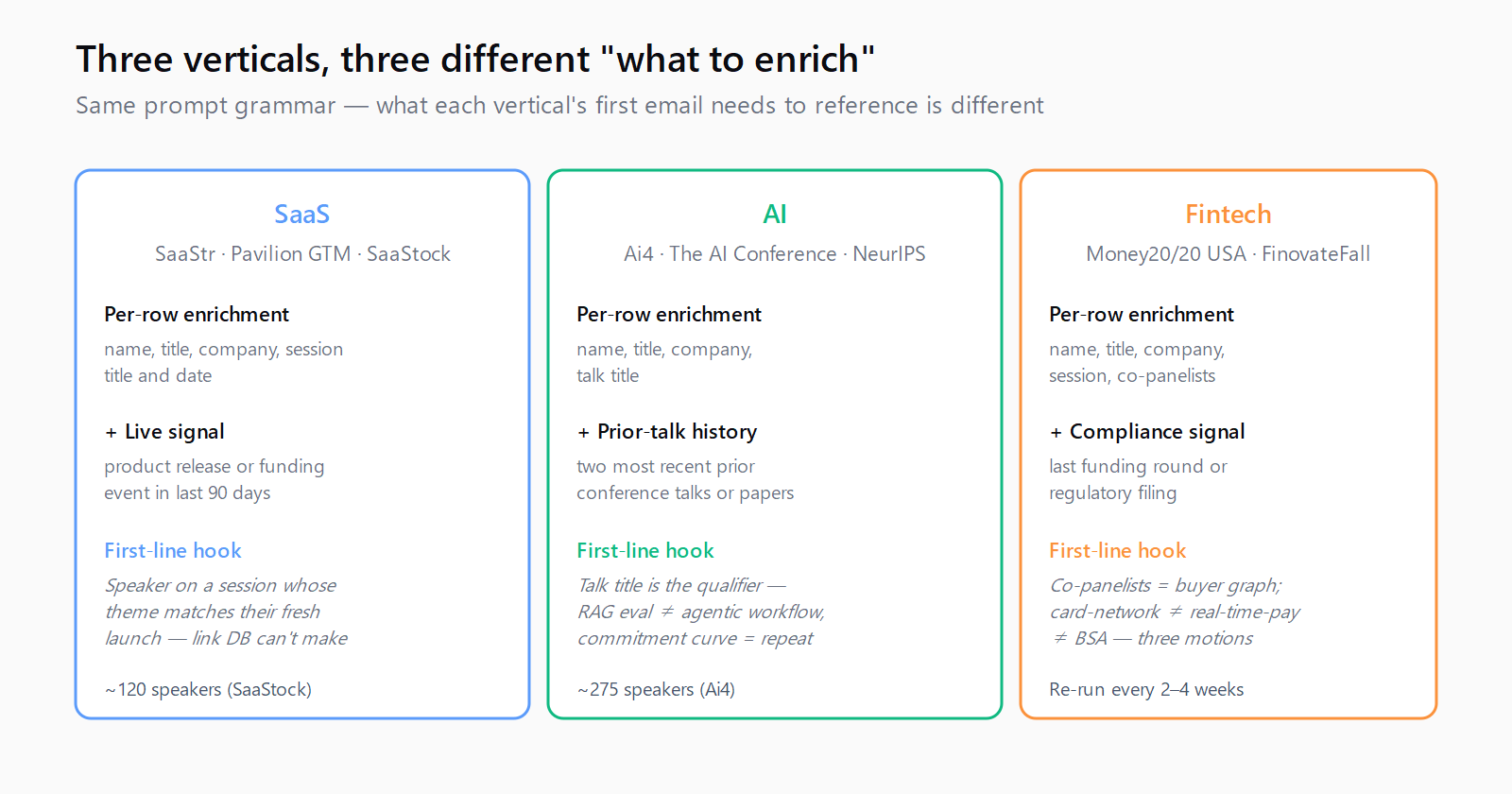
Query 1 (SaaS): "Find confirmed 2026 speakers at SaaStr Annual, Pavilion GTM, and SaaStock Europe. For each, return name, title, company, session title, session date, and any product release or funding event in the last 90 days."
Query 2 (AI): "Find confirmed 2026 speakers at Ai4, The AI Conference, and NeurIPS. For each, return name, title, company, talk title, and their two most recent prior conference talks or published papers."
Query 3 (Fintech): "Find confirmed 2026 speakers at Money20/20 USA and FinovateFall. For each, return name, title, company, session title, co-panelists, and the company's last funding round or regulatory filing."
Same method, three outputs, three different pitches. Each Leadex run takes a few minutes of agent time and lands comfortably under the annual cost of a single Apollo seat. The value is not the names - the names are public. The value is the _enrichment around_ the names, produced fresh, which a scraped contact row is missing by construction. Static DBs list the person; Leadex extracts the context.
One caveat: every public speaker roster is also a public target list, which means yours will land in an inbox also receiving 40 other emails that same week. The differentiator becomes specificity. Speaker + session title + one concrete reference to a real thing the company shipped is the floor, not the ceiling, and it's still roughly where 90% of outbound to conference speakers sits today.
Something to try before SaaStr Annual goes live on May 12: point Leadex at the current SaaStr agenda page with Query 1, pick the five speakers whose sessions land on Day 2 before 2pm (the highest-attention slot), and write the first line of each email using their session title and nothing else. Five emails, maybe fifteen minutes of human time on top of the agent run. If those first lines read like they were written by someone who actually read the abstract, you've already beat most of the inbound landing in their inbox that week. (See also: finding SaaS companies in Berlin, London, or Amsterdam.)