
How to Find Startups That Raised Funding in the Last 30 Days
Crunchbase gates funding-date filters. Four free public signals - Form D on EDGAR, investor portfolio pages, LinkedIn announcements, hiring deltas - get you there first.
Every sales team has had this week. "Get me a list of SaaS companies that raised a Series A in the last 30 days, with the CEOs, by Friday." The canonical answer is Crunchbase, which gates funding-date filters behind Crunchbase Pro at $49 per month billed annually (or $99 on the monthly plan). PitchBook, the gold standard for institutional data, runs $12,000 to $30,000 per seat, per year. Most teams have neither, and the list is still due on Friday.
What saves the week is that "recently funded" is a public signal in four separate places, and the free ones are often fresher than the paid ones. The four, in descending order of reliability: SEC Form D filings on EDGAR, the investor's own portfolio page, LinkedIn founder announcements, and the weekly hiring-delta on a target list.
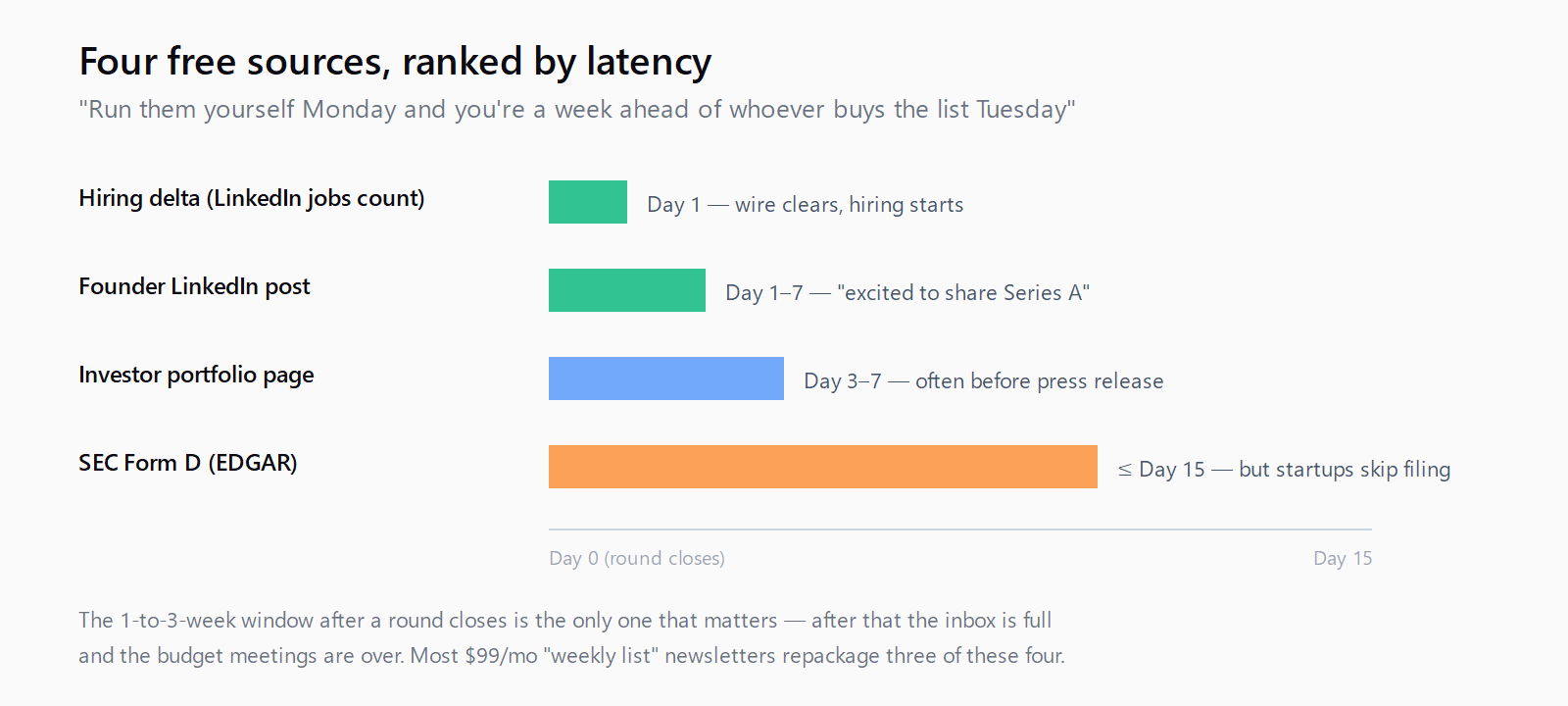
First, SEC EDGAR's full-text search. Any U.S. company taking investor money under a Regulation D exemption files a Form D within 15 days of the first sale - free, electronic, searchable by form type and date range. Filter to last-30-days, form type "D," and you have every Reg D round closed in that window, with the company name, HQ address, named executives, and the amount raised. No paywall, no credits, no API key.
The catch, flagged by Danny Crichton at TechCrunch in 2018 and still accurate in 2026:
My working hypothesis is that startups are (increasingly?) not filing disclosures with the SEC as a specific strategy to avoid scrutiny. [...] American courts, along with the SEC, have upheld that a startup does not lose its covered security exemption by failing to file the form.
So Form D is necessary but not sufficient (!). The second source is the investor's own portfolio page. Most seed and Series A firms update their "companies" grid the same week a round closes, often days before the press release. A curated list of the thirty firms you care about, scraped weekly, is a surprisingly complete feed on its own, and one a Form D search cannot reproduce because many rounds from accelerators and SAFE-heavy stacks never file.
Third, LinkedIn, which is the actual firehose. Search for "excited to share" or "thrilled to announce" paired with "Series A" or "seed round," restrict to the last week, and you get the founder's own post before the press cycle lands. The founder's announcement is the primary source; the recap newsletter you paid for is the derivative.
Fourth, the hiring delta. A company that jumps from three open roles to fifteen in a week has almost certainly just closed a round and is onboarding the money into headcount. Tracking the LinkedIn jobs count on your target list, week over week, is a strong leading indicator - often earlier than the Form D filing itself, because hiring starts the day after the wire clears.
We think about this a lot because Leadex is a chat-native research agent that runs exactly this stack from one brief: "U.S. SaaS companies, under 200 headcount, Form D filed in the last 30 days or a LinkedIn funding announcement in the last 14, enrich with founder email, push to HubSpot." The first 500-lead list by lunch is the spec, because the 1-to-3-week window after a round closes is the only one that matters - after that the inbox is full and the budget meetings are over.
The reason the "weekly list of newly-funded startups" business is so crowded is that the underlying data is free, stale by day three, and nobody enjoys stitching it together by hand. Most of what sells for $99/month is three of these four sources (I believe), run once a week, re-packaged with a logo. Run them yourself on Monday and you are a full week ahead of whoever buys the list on Tuesday. (See also: finding clients for a B2B marketing agency.)