
How to find companies that just opened a new office
The other trigger event worth tracking, after a funding round lands, is the new office. Five free-or-cheap sources for catching it before competitors do.
The other trigger event worth tracking, after a funding round lands, is the one that happens right after: the new office. A company signing a lease, breaking ground, or quietly moving HQ has approved budget, a hiring plan, and a fresh list of operational problems - IT, benefits, facilities, local legal, insurance, local services. If you sell anything adjacent, expansion is the cleanest budget signal the open web will hand you.
The 2026 framing for this is signal-based selling, which Apollo's framework piece argues is now a deliverability strategy as much as a conversion one - untargeted volume gets penalized by inbox providers, and the first vendor contacted still wins roughly 80% of deals. The metric Apollo pushes hardest is speed-to-signal:
Speed-to-signal emerged as the critical operational metric in 2026. Top-performing teams route signals to the right rep and trigger the appropriate play within 30 minutes of detection.
That 30-minute benchmark matters for expansion news specifically, because by day seven every competitor is already calling. Five free-or-cheap sources cover most of it. First, Google Alerts with boolean queries like "opens new office" OR "new headquarters" OR "relocates" AND your target city, delivered as RSS so the stream pipes into a reader instead of burying your inbox. Former HubSpot sales rep Ali Powell, writing on the HubSpot sales blog, puts it plainly: "Create a Google Alert for every lead you work - make it part of your process." Second, PR Newswire's corporate-expansion feed, the raw firehose where as of this week AbbVie announced "a $1.4 billion investment to build a 185-acre pharmaceutical manufacturing campus in Durham, North Carolina" and Brock Group relocated its HQ to Houston's Energy Corridor.
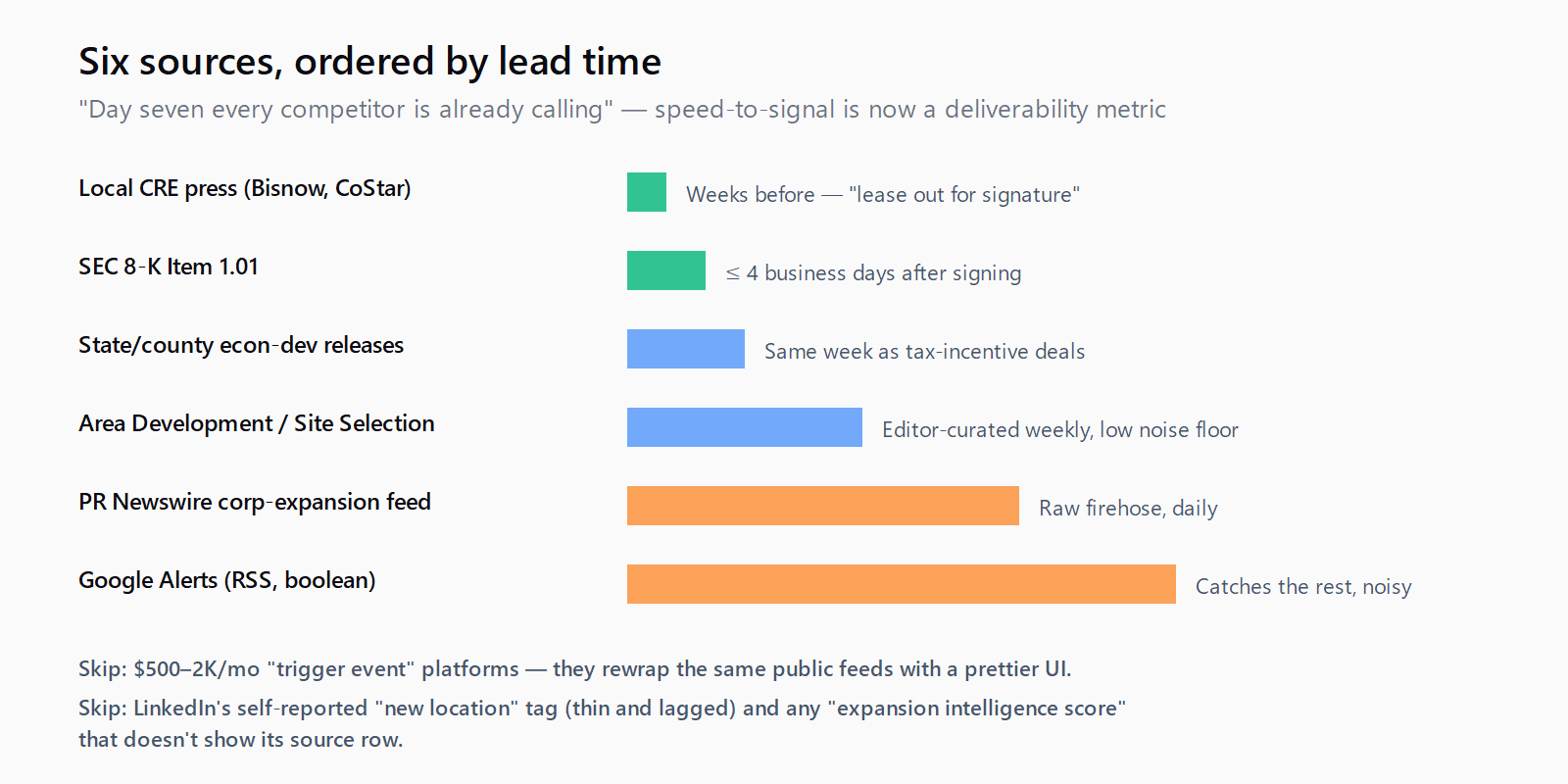
Third, the trade press: Area Development's news feed and its sibling Site Selection magazine, both editor-curated and both running off the Conway Projects Database, so the noise floor is much lower than a raw Google Alert. The last week alone logged L3Harris in Virginia ($1.27 billion, 350 jobs), Suniva in South Carolina ($350 million, 564 jobs), and JST Corp in Alabama ($500 million, 80 jobs). Fourth, for US public companies, SEC EDGAR and Form 8-K Item 1.01 - new HQ leases and large facility contracts must be disclosed within four business days of signing, with the counterparty and material terms. That is the earliest-arriving, legally-binding version of an expansion announcement, often landing days or weeks before the press wire. Fifth, state and county economic-development press releases: when a state hands over a tax-incentive package, the governor's office announces it, sometimes before the company is publicly ready to talk.
This is exactly the kind of workflow that sits at the seam between discovery and enrichment, which is where Leadex is built to live. The same brief - "every SaaS company that opened a US office in the last 30 days, enriched with the VP of IT's LinkedIn, deduped against HubSpot" - would land as a research plan you approve before the agent browses Area Development, EDGAR, and PR Newswire in one pass and returns a deduped CSV.
What to skip: paid "trigger event" platforms charging $500-$2,000 per seat per month that mostly rewrap the same public feeds with a prettier UI; LinkedIn's self-reported "new location" tag, which is thin and lagged (I believe); anything calling itself an "expansion intelligence score" without showing you the source row. And one detail the five-source stack misses: the earliest, quietest signal is local commercial-real-estate press - New York Real Estate Journal, Bisnow, CoStar's trade desk - reporting a lease out for signature (!) weeks before the official press release. That's where a good SDR finds the deal before anyone else is even looking. (See also: finding clients for a B2B marketing agency.)