
How to Find Companies Where Your Former Customers Just Landed
Export closed-won contacts to CSV, hand it to a research agent, get back their new employers. The champion-tracking play without a $12k/year subscription.
Export your closed-won contacts from HubSpot and look at the column next to each name. The value there is the company where they worked when they bought from you. Two, five, ten years ago. How many still work there?
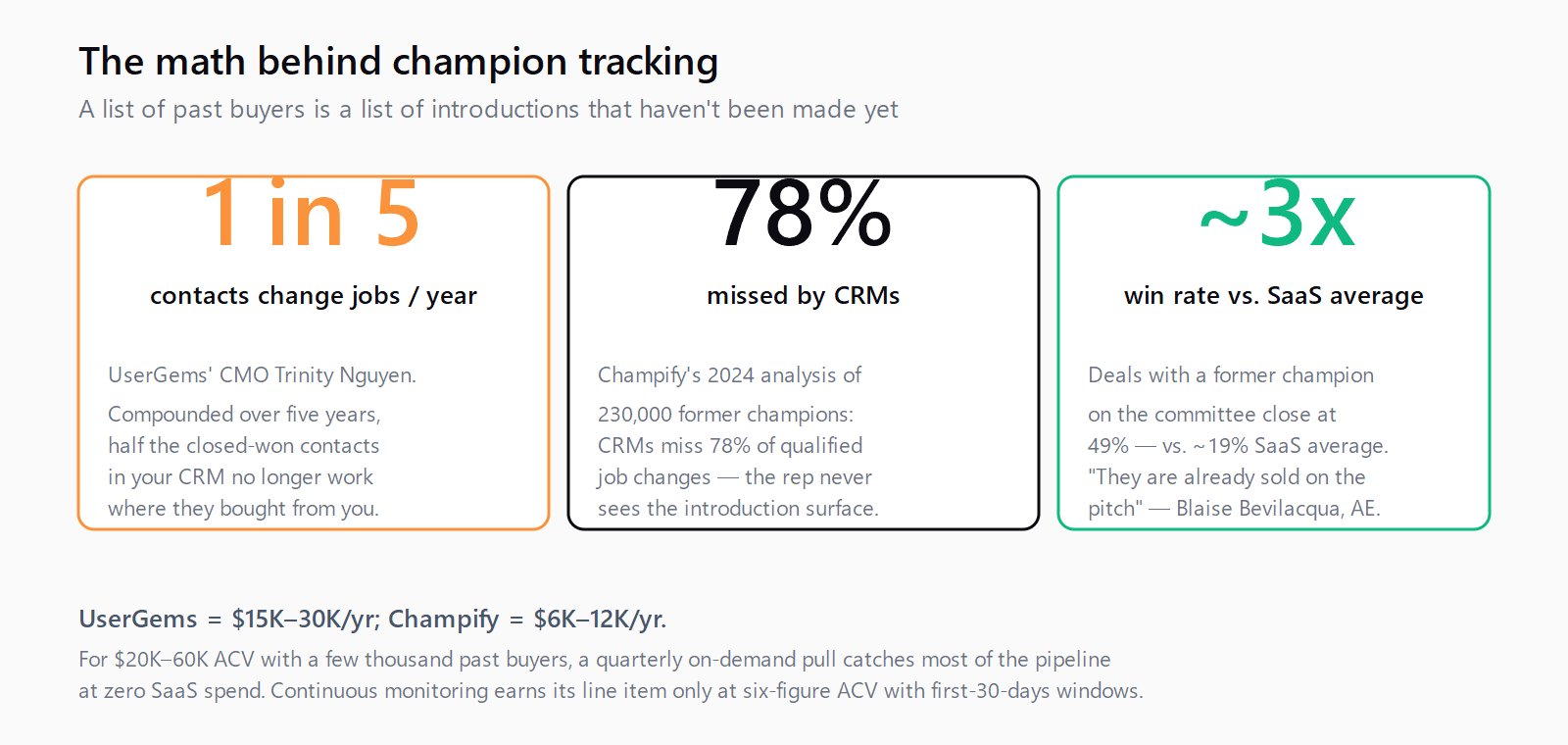
Roughly one in five change jobs each year, per UserGems' CMO Trinity Nguyen. Champify's 2024 analysis of 230,000 former champions found that CRMs are missing 78% of former champions with qualified job changes. And deals with a former champion on the buying committee win at 49% against a SaaS average around 19%, close to 3x.
The tactic has a name: champion tracking. Monitor your closed-won contacts for job changes, reach out when they land somewhere new, and open the new account on the strength of the relationship you already built. It isn't new. As of April 2026, UserGems sells it as a service for $15k-$30k a year. Champify does a narrower version for $6k-$12k. Salesmotion's write-up on the category is blunt about why the standalone tools churn: they sit outside the primary workflow, someone has to own list curation, and when the line item comes up for review nobody can point cleanly at attribution.
We call this playbook UG4UG, and it accounts for about 25% of my quota attainment. I prioritize all of my deals that are being led by a former customer given the propensity to buy. They are already sold on the pitch, so the hard part is done.
That's Blaise Bevilacqua, an enterprise AE at UserGems, in the company's own guide. 25% of quota from one play is a big number, and (I believe) not unusual at companies that actually run it.
Here's the exact how-to without a dedicated tool. Export your closed-won contacts to CSV with name, old company, title, work email, and LinkedIn URL if you have one. Hand the file to a browser-based research agent with a brief like: for each row, find the person's current employer, title, and company domain; flag rows where the current employer differs from the old one; enrich each new company with headcount, funding stage, and HQ city via my Apollo key; dedupe on the new domain; push everything back to HubSpot with the tag champion-move-2026Q2. Review the first ten rows by hand. Run quarterly.
Two things matter for this to work. One, the agent needs to handle the messy cases in the middle of the list: people who moved, then moved again; people whose LinkedIn says one thing and whose signature says another; common names at big companies where disambiguation goes wrong. Two, the output has to land in the CRM with enough metadata that a rep opening it on a Tuesday morning can tell why the row is there without clicking back through the logs.
In Leadex this is the default shape. You paste the brief, the agent shows you a plan preview (which sources it'll hit, which enrichment keys it'll burn, which CRM it'll write to), you approve, and the company-enrichment step typically completes in under 60 seconds per batch. The only fees are your own Apollo or HubSpot costs.
The fair counter-take: a quarterly batch misses the move that happened three weeks in. UserGems and Champify are built around the first-30-days window, which is real (!). If your ACV makes that speed matter, call it enterprise with six-figure deals and a short window after an exec lands, continuous monitoring is worth the invoice. For anyone with a $20k-$60k ACV and a few thousand past buyers, quarterly on-demand catches most of the pipeline at zero SaaS spend.
Open the CSV again. That isn't a list of who worked where three years ago. It's a list of introductions that haven't been made yet. (See also: the internal-promotion signal.)