
How to Track Customer & Champion Job Changes (Without UserGems)
UserGems lists at $33k-$120k/yr in 2026. Here's the cheap stack that catches the same champion-job-change signal with Sales Navigator, Slack, and a CSV - plus when paying UserGems is genuinely worth it.
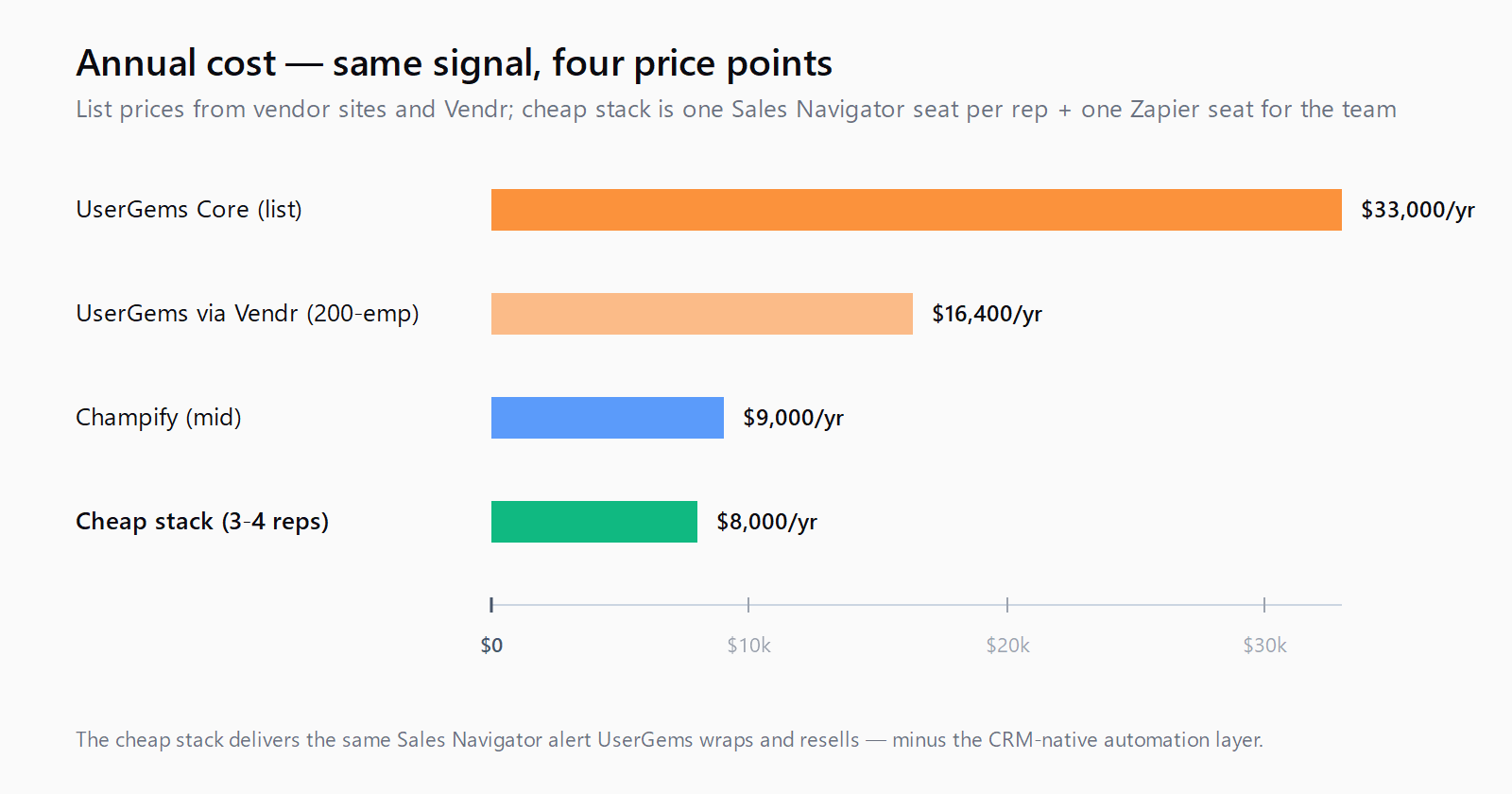
UserGems publishes its prices on the website now, which is a small mercy. As of April 2026 the Core plan is $2,750/month plus a $3,000 implementation fee; Advanced is $5,750/month; Elite is $10,000/month. Vendr's anonymized data on actual contracts shows a 200-employee company paying around $16,400 a year and a 1,000-employee company paying $81,900. The cheapest line item is well into the territory where someone needs to defend it on a Tuesday morning call.
The signal UserGems sells is the highest-intent missing one in most CRMs: the day a customer or champion shows up at a new company. LinkedIn's own data, in a January 2024 piece by Carla Intal and Paul Petrone of LinkedIn Insights, is the standard citation for why this matters.
Over the last three years, decision-makers globally are 55% more likely to start a new role in January compared to the other months of the year. [...] People who have started a new job at a new company within the past 90 days are 62% more likely to accept a Sales Navigator InMail compared to everyone else. [...] Eight of ten sellers have lost a deal because their champion left the account.
- Carla Intal, Insights & Applied AI, LinkedIn
Eight of ten is the number that ought to make a head of sales sit up. Champify's 2024 study of 230,000 former champions found CRMs were missing roughly three-quarters of the qualified job changes that had already happened. Add the average VP of Sales tenure of 19 months and the conclusion is that your buyer list is decaying faster than your renewal cycle. This is the most useful instance of former customers landing at new companies as a pipeline source - it's the one that pays back the fastest, because the relationship hasn't gone cold yet.
The honest version of the argument for paying UserGems goes like this: continuous monitoring beats batch, the warm-intro window is short (the LinkedIn data is about the first 90 days, not the first 90 weeks), and a CRM-native alert that fires while the rep is already in HubSpot beats a Slack ping the rep ignores. Fair. The dishonest version is that you can't get any of this without a $33,000 line item, and that one is wrong.
Here's the cheap stack, top to bottom. Export your closed-won contacts and your top-of-funnel champions from your CRM into a single CSV - name, last known company, title, LinkedIn URL. Upload that as a Lead List in Sales Navigator (Advanced or Advanced Plus, around $1,600 per seat per year). Sales Navigator now ships native job-change alerts on saved Lead Lists; turn them on. Pipe the alerts into Slack with a $20/month Zapier seat or a free Make scenario, with a channel per AE. Once a quarter, re-export your CRM's closed-won and a Champify-style "former champions" segment so the list stays current. That's the whole thing. Total: one Sales Navigator seat per rep who actually works the signal, plus a single automation seat for the team. Three or four reps and you're under $8,000 a year all-in.
The bits people miss when they try this and bounce: tagging and disambiguation. Tag every alert in Slack with which CRM segment it came from - "lost-deal champion" and "closed-won power user" both fire job-change alerts and both want different opening lines, and a rep on a Tuesday morning can't reverse-engineer that from a name and a new company. Second, Sales Navigator alerts will fire on common-name false positives - "John Smith" leaving Salesforce can match three Lead-List rows out of the gate. The fix is forcing the export to carry a LinkedIn URL on every row, not just a name, and matching on the URL slug in the Zapier step. Skip that and the rep gets noise within a week and stops opening the channel.
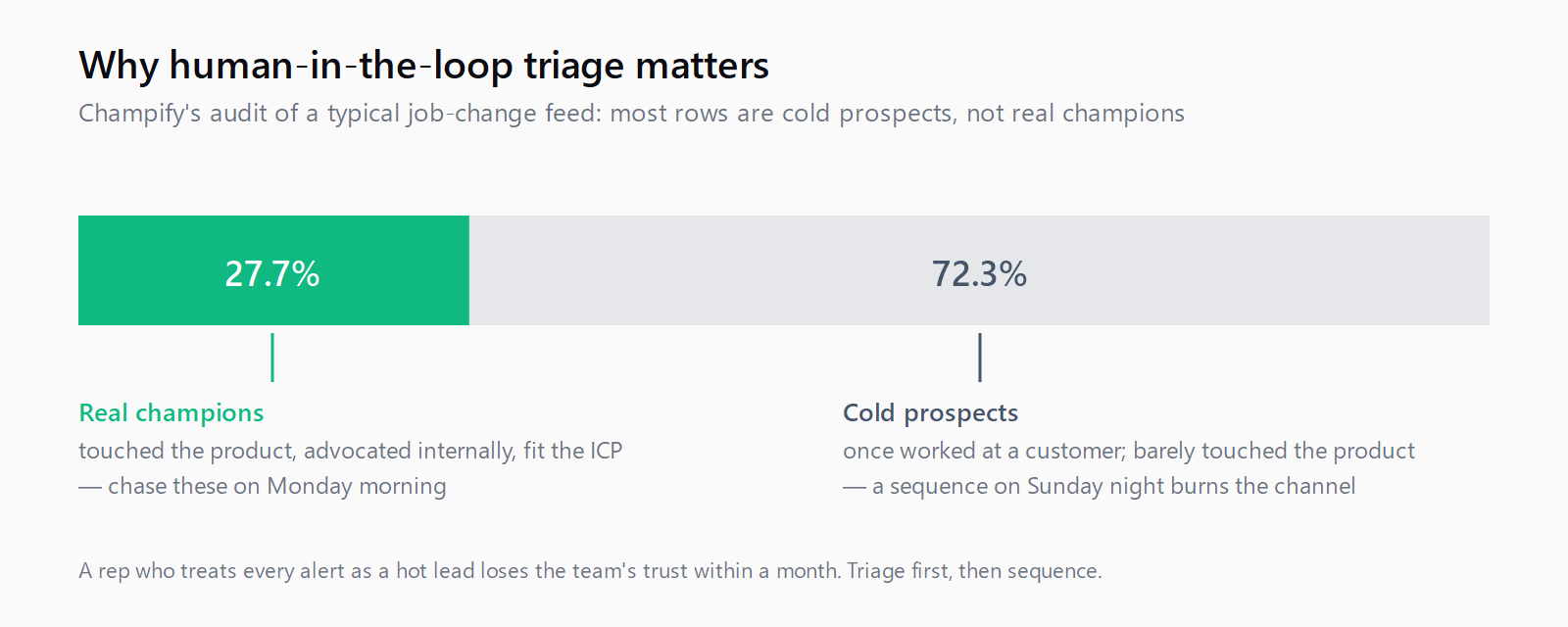
The other piece that's easy to underrate is what you do with the alert once it lands. The LinkedIn data above measures InMail acceptance, not booked meetings; a 62% open rate on a softened "saw you landed at the new gig, congrats, want to catch up?" message is a different number than a 62% reply-with-calendar-link rate. Taylor Udell's caveat above is the same point - over half the contacts on a raw job-change feed are people who barely touched the product when you sold to them, and a rep who treats every alert as a hot lead burns the channel in a month. The play is human-in-the-loop triage by the rep on Monday, not a sequence on Sunday night.
Champify is the obvious commercial middle ground - $6,000 to $12,000 a year for the same core signal without the AI-GTM-Command-Center marketing wrap that UserGems has bolted on top. Their own primer on the SalesNav workflow, by Taylor Udell, makes the useful caveat that only about 27.7% of the contacts a job-change feed surfaces are real champions; the other half are cold prospects who once worked at a customer. You want the human in the loop deciding which ones to chase, not an AI agent batch-emailing all of them.
This whole topic sits inside the broader question of signal stacking - one trigger on its own is rarely enough to justify a sequence, and a job change is at its strongest when it lands next to a hiring spike, a funding round, or a product mention. We think about this a lot at Leadex because the same brief that produces a champion-tracking re-run ("for each row in this CSV, find the current employer, flag the moves, enrich the new account, push to HubSpot") is also the brief that produces a funded-startups list or a sponsor-extract from a conference page. One chat, one plan preview, one CSV in the CRM. Company enrichment typically completes in under 60 seconds per batch via your own Apollo key, no per-contact markup. It doesn't replace the continuous-monitoring promise UserGems makes - it's a different shape of tool - but it does cover the quarterly-refresh half of the workflow without a separate invoice.
The counter-take, which I think is genuinely correct in a narrow band of cases. If your ACV is in the high six figures, your buying committees are eight-deep, and a champion landing at a new logo is worth a quarter-million in pipeline within the first 30 days, the difference between "Sales Navigator emailed me Tuesday" and "UserGems wrote a record into HubSpot Monday morning with my AE assigned and a sequence already drafted" is genuine money. Add the ROI guarantee on Elite (3x revenue or your money back) and a procurement team that can't onboard six tools, and the Core or Advanced tier earns its keep. (I believe) this describes maybe the top 5% of the market, which is roughly the slice UserGems is now openly chasing with its "AI GTM Command Center" repositioning. Everyone else is paying enterprise prices for a Sales Navigator alert.
One last thing worth knowing: a job change isn't the only signal worth chasing on a former customer, and it isn't even the highest-intent one when it fires alone. The full buying-signals taxonomy is thirty triggers deep, and a champion move stacked with a hiring post for the same role you sold into is the version that actually moves the close rate. Run the cheap stack first for two quarters. Track three numbers: how many alerts the rep actually opened, how many turned into a meeting on the calendar, and the close rate against your normal cold-outbound baseline. If a year in those three columns justify the spend, then have the UserGems conversation - with your own pipeline numbers in hand instead of theirs.