
How to Find Companies That Just Promoted Someone Internally (Promotion Signal)
Job-change tracking gets all the attention; internal promotions get almost none. Same company, new budget authority - but the budget is mostly committed, the vendor stack stays, and the play in week 2-4 is different. The 70% first-100-days stat doesn't apply cleanly here.
Most of the noise about job-change tracking is about people moving between companies, and the noise around new exec hires is about the day a fresh face shows up on the org chart. The third box on this shelf - someone promoted into a new title at the same company - gets almost no airtime, and it's the one that fires the most often. Spencer Stuart's 2025 CMO Tenure Study found 58% of Fortune 500 CMOs in seat were originally promoted from within their current company. The signal is everywhere; the tooling treats it like a footnote.
The mechanical difference between "Sarah is the new CMO at Acme" and "Sarah was promoted to CMO at Acme" is one company name. The economic difference is bigger. A new hire arrives with a mandate to change something visible in their first quarter, which is why Autobound cites UserGems' research that "newly hired executives spend 70% of their budget in the first 100 days". A promoted exec arrives with the existing vendor stack, the existing renewals they themselves signed off on a year ago as the deputy, and a quieter mandate - "do more of what you've been doing, with the title now." Same company, new budget authority, but the budget is mostly already committed. The window is narrower and the play is different.
The detection is easier than the new-hire case in one respect and harder in another. Easier: the LinkedIn URL doesn't change, so you don't have the disambiguation problem of matching "Sarah Chen at Acme" to "Sarah Chen at Globex" against three other Sarah Chens. Harder: the company doesn't put out a hire-day press release, the new title may show up first on the LinkedIn profile and only later (or never) on the corporate site, and the official corporate Twitter or Mastodon account may quietly add the person to the leadership page without an announcement. The data sources in practice: a saved LinkedIn Sales Navigator lead list with title-change alerts on, the company's /about or /leadership page diffed quarterly, official Twitter and corporate blog announcements, and SEC 8-K filings for board-of-directors appointments. Champify and Common Room both advertise internal-movement detection alongside job-change tracking; Apollo's Champion Tracker covers it as a sub-feature; SalesLoft surfaces title diffs through Cadence.
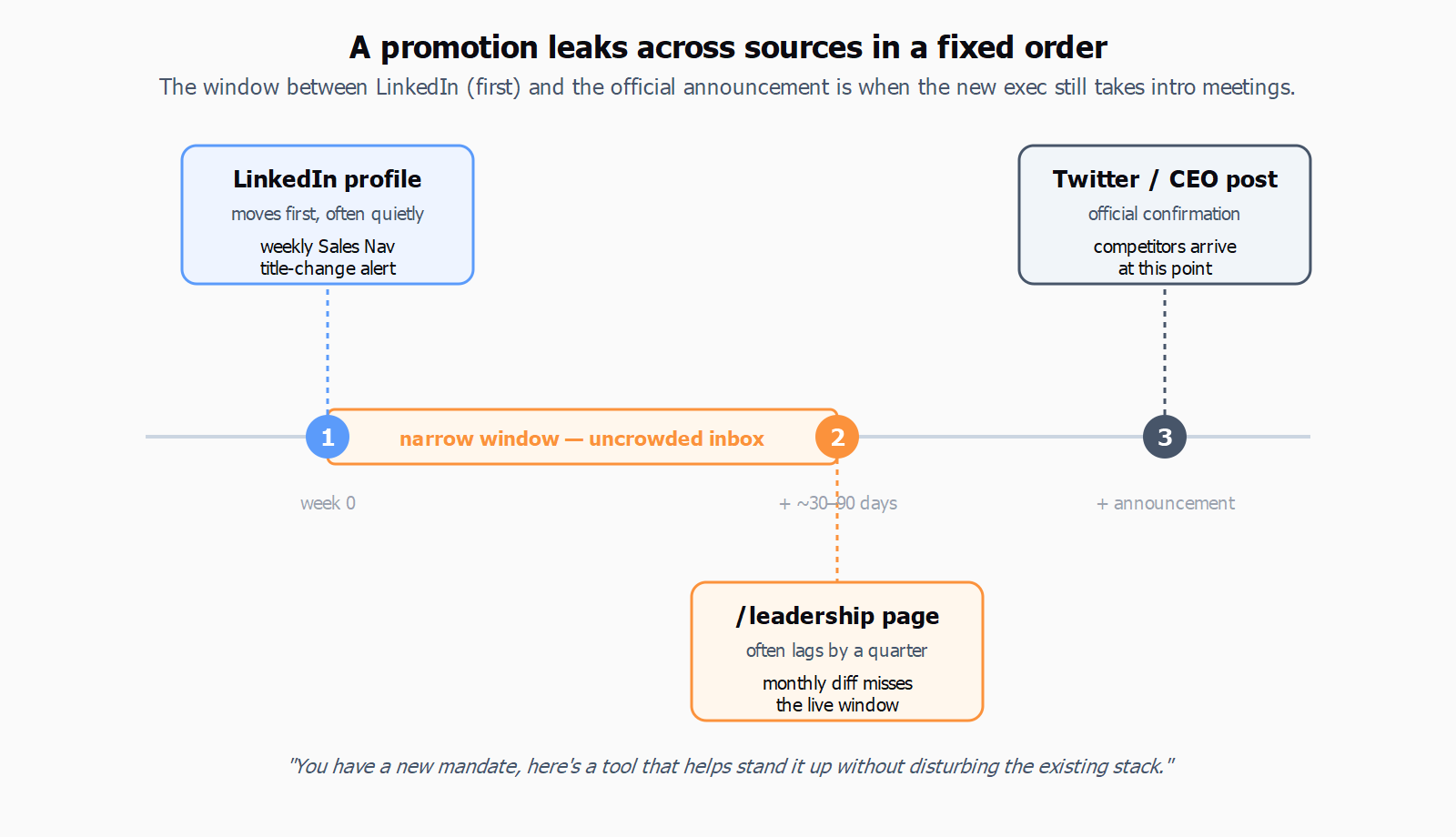
The order in which those sources update matters more than the rep checking the alerts realises. The LinkedIn profile usually moves first, often quietly, sometimes for weeks before any official announcement. The corporate /leadership page moves second, and frequently lags by a quarter. Internal Twitter or a CEO LinkedIn post is the official-confirmation moment, and that's the one your competitors are watching. The narrow window worth chasing is the gap between change one and change two - the period where the new title is real but not yet broadcast, and the new exec is taking introductory meetings without a packed inbox. A weekly diff of the LinkedIn lead list catches that window; a monthly scrape of the leadership page misses it.
A worked example from the last sixty days. On January 27, 2026, Prophet (the strategy and marketing consultancy) made permanent the CMO promotion of Mat Zucker, who had been their interim/acting CMO for the prior eighteen months. Zucker was already a senior partner running the global marketing strategy practice; the title change moved him from "deputy who quietly owns marketing" to "C-suite peer who openly owns marketing." Michael Wright at CMO Ladder, who tracks these moves, framed it as a rarity:
Internal succession remains a sore spot. Almost 84% of new CMOs were hired externally in 2025, suggesting that internal pipelines are still more wishful thinking than a working system. [...] On the other hand, many of our readers are selling goods and services to CMOs. What better time to say hello when they are potentially new in role and evaluating suppliers.
- Michael Wright, CMO Ladder
That last sentence is the whole point. The vendor-evaluation window is real for a promoted exec too - it just looks different. Zucker's not going to rip out the marketing analytics stack he picked himself two years ago. But he is going to want to put a flag in the ground for the new title - probably a brand campaign, possibly a category-creation push, possibly a new piece of insourced research - and the budget for that comes from the discretionary line, not the renewal line. The play in week 2-4 of the new title is not "we replace your incumbent"; it's "you have a new mandate, here's a tool that helps you stand up the new mandate without disturbing the existing stack."
This is exactly the kind of compare-against-history workflow that lives outside any filter UI. To act on a promotion you need yesterday's title, today's title, the date the diff happened, and a link to the source page where the change was visible - because a new title on a profile but not on the company's /leadership page is a different signal from one that's gone official. That's an open-web research job, not a database lookup. Leadex sits on this side of the line: a chat brief that says "for each row in this list of 200 strategic accounts, find the current head of marketing, compare to the title we had recorded last quarter, and flag anyone whose title now contains 'Chief' where it previously didn't" produces a CSV with URLs and timestamps per row, pushed to HubSpot. Honest caveat: detecting the promotion is only half the battle. Knowing whether the new title actually carries budget authority - whether "VP Marketing" became "CMO" in a real sense or just a politeness sense - requires reading the org around them. A flat re-org with three new "Chiefs" reporting to a President is different from a real elevation, and no automated diff tells you that. You still have to look.
The counter-take, and it's the one nobody selling promotion-tracking wants to admit. Internal promotions are usually a status-quo signal, not a change signal. The Bradsby Group's framing of the recruiting tradeoff is the right intuition: a board that wants drastic change goes outside; a board that wants continuity promotes from within. The promoted exec's incentive is to validate the prior decisions, not overturn them - they made some of them. So the *vendor-evaluation* part of the budget-window story is genuinely weaker for a promotion than for a fresh hire. The 70% statistic that gets quoted everywhere is about new hires, and the cohort of promoted execs almost certainly indexes lower (I have not seen a clean number on this; if anyone has Spencer Stuart or Forrester data that splits the cohort, I'd like to read it). What promotions are stronger at: expansion within the existing stack. The CMO who was VP Demand Gen for two years already has a paid CDP and an MAP; she's much more likely to expand seats, add modules, or buy a complementary tool than to swap the core platform.
So the operational read. Track promotions on your customer accounts as an expansion signal first, on prospect accounts as a "stand up the new mandate" signal second, and only treat them as a vendor-replacement signal when you have a second confirming trigger - a press release about a new strategic direction, a posted job for a role that didn't exist before, a public RFP. Stacking is the rule the rest of the buying-signals taxonomy obeys, and the promotion signal obeys it more strictly than most. One trigger, ignore. Two triggers, sequence. Three, pick up the phone.