
How to Find SaaS Companies in Berlin, London, or Amsterdam
European SaaS prospecting feels harder than US prospecting because the data is split across five surfaces with different access models. Here's how Companies House, Handelsregister, KvK, Sifted, and Tech.eu fit together - and the noise problem most lists skip.
Most B2B prospecting tools were built by US engineers using US data sources, and it shows the moment you try to build a list of European SaaS companies. Crunchbase coverage thins out past Series A in continental Europe, LinkedIn's company-search filter for "Berlin" cheerfully returns every consulting one-pager registered at a coworking address, and the canonical "find SaaS companies in city X" filters that work in San Francisco fall apart against the structure of European company registries. The data is there - it just doesn't live where the US-trained playbook expects it.
The other half of the problem is that "Berlin SaaS" is a marketing label more than a category. The Berlin tech scene includes hardware companies that ship a cloud app, marketplaces that call themselves SaaS for the multiple, AI wrappers, and a long tail of agency-and-product hybrids. The London and Amsterdam scenes are no cleaner. Whatever your filtering looks like, you'll need a step that throws away two thirds of what the registry returns, and that step is what most lists skip.
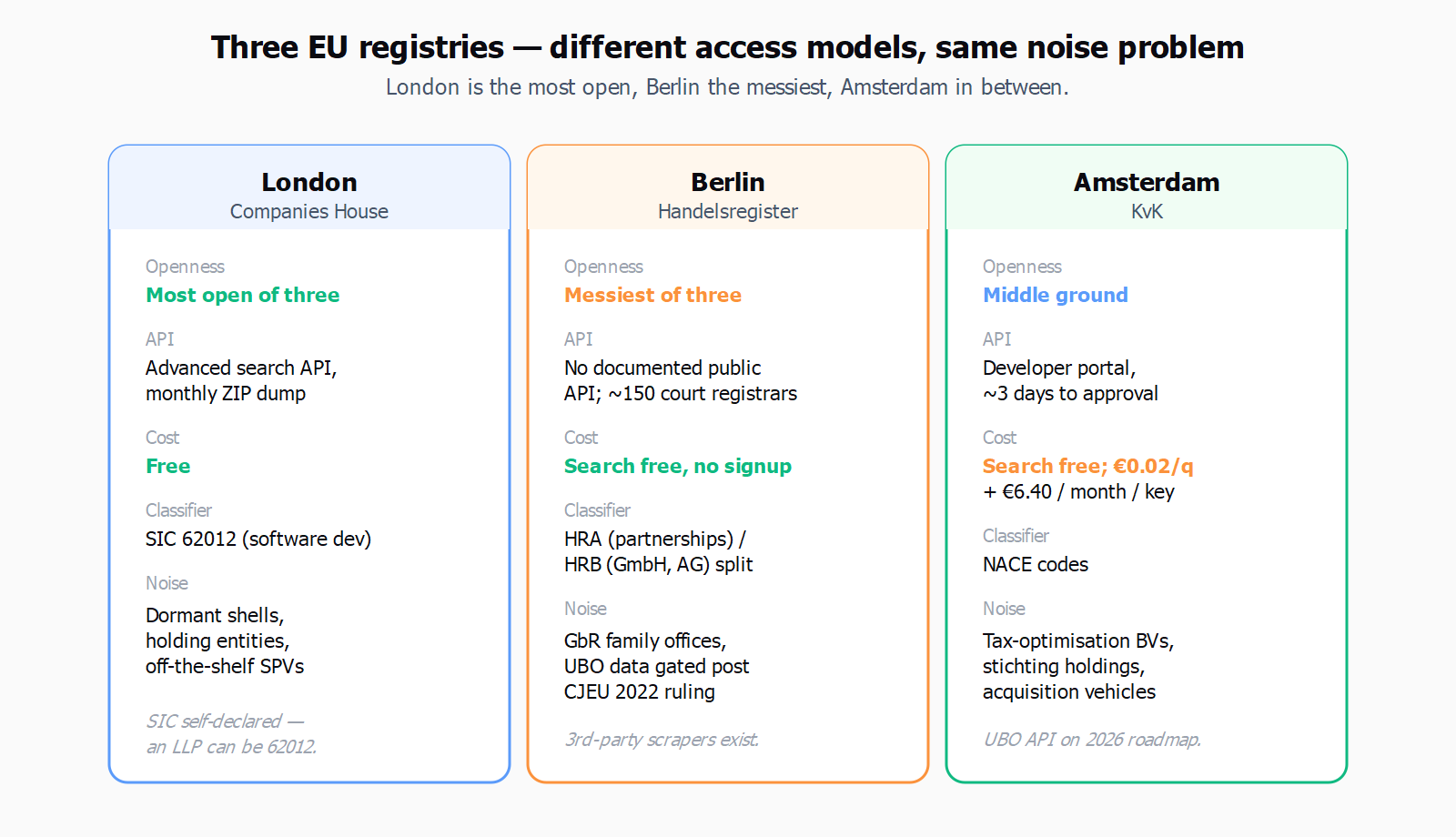
London first, since Companies House is the most open of the three. The full live-companies dataset is downloadable as a free monthly ZIP, and the advanced search API lets you filter by SIC code, incorporation date, and registered-office postcode without paying anything. SIC 62012 (business and domestic software development) is the rough proxy for SaaS; layer in incorporation date in the last 36 months and an EC1V or N1 postcode and you've cut the firehose to something an SDR can scan. The catch is that Companies House contains every UK company, including dormant shells, holding-only entities, and the off-the-shelf company-formation industry's output. SIC codes are self-declared; an asset-management LLP can list itself as 62012 because someone in compliance copy-pasted a code from a template (I've seen it).
Berlin's Handelsregister is the messiest of the three, and not because the data is bad. It's distributed across roughly 150 local court registrars, split between HRA (partnerships, GbRs) and HRB (the GmbHs and AGs you actually want), and the official portal does not expose a documented public API. Basic search is free with no registration; structured access via the unofficial unifiedSearch endpoint exists but isn't a stable contract, as far as I can tell. Since the November 2022 CJEU ruling, beneficial-ownership data is gated behind a "legitimate interest" check, which most prospecting workflows can't pass. Third-party scrapers like handelsregister.ai and viaductus exist precisely because the official source doesn't ship one.
Amsterdam's KvK developer portal sits between the two on openness. The basic Zoeken (search) endpoint is free, every other endpoint costs roughly EUR 0.02 per query plus a EUR 6.40 monthly per-key fee, and a UBO API for beneficial ownership is on the 2026 roadmap. Approval takes about three days. The catch with KvK is the same as with Berlin's GmbH soup: a Dutch BV registered at a Zuidas address can be an operating SaaS company, a tax-optimization holding for a US parent, a foundation (stichting), or a single-purpose acquisition vehicle. NACE codes help; the company name almost never does.
For everything the registries can't tell you - that a company actually ships software, has paying customers, and is hiring - the two press sources to wire into a list are Sifted and Tech.eu. Sifted's funding coverage is the closest EU equivalent to TechCrunch in latency, and Tech.eu publishes a weekly recap of every meaningful European deal. Together they are the index for newly funded startups in Europe, the way Crunchbase plus TechCrunch is for the US. Layer in the Antler London and Antler Berlin portfolio pages, plus Techstars London, and you've got the accelerator cohort signal that doesn't show up in Companies House for another 12 to 18 months.
The catch with the press feeds is that funding announcements are noisy too, and Sifted's own former deputy editor, Eleanor Warnock, called this out last year:
Europe has seen 478 Series A rounds so far this year, while Sifted has published 686 news articles - far from all of which would have covered funding rounds, let alone Series A funding rounds.
- Eleanor Warnock, former deputy editor, Sifted
That's the right framing. A funding announcement isn't a target; it's a context tag you stick on a target you found elsewhere. The list-building work is in the registries and the accelerator pages; Sifted and Tech.eu tell you which entries on that list just got money.
The reason European SaaS prospecting feels harder than US prospecting isn't that the data is missing, it's that the data is split across five surfaces with different access models, and stitching them is the actual job. Leadex runs that stitching from a single chat brief - one prompt that hits Companies House, Handelsregister, KvK, the Antler and Techstars portfolio pages, and the last 30 days of Sifted and Tech.eu, dedupes by domain, and writes the deduped list to a CSV or pushes it to your CRM. There's no magic in this; the data sources are all public, and any SDR with a week could write a Python script that hits the same endpoints. The value is the assembly - and the part where the assembly is one prompt instead of five tabs and three subscriptions. Same idea applies to European SaaS conferences as a cohort source: pulling the speaker list and reconciling it against the registry data is exactly the kind of job that's annoying enough by hand that most SDRs just don't do it.
The counter-take, and the part most "find European SaaS companies" guides skip: the registries are extraordinarily noisy, and the noise is structural. Companies House contains every UK company - including the substantial industry that exists to register shells for tax planning, off-the-shelf vehicles for property holdings, and one-person SPVs that file dormant accounts for a decade. KvK lists every Dutch BV, which means it lists every holding company in a country famously hospitable to holdings. Handelsregister mixes the GmbH you want with the family-office GbR you don't. SIC and NACE codes are self-declared and routinely wrong. The job isn't pulling the data - it's filtering aggressively enough that what comes out the other side is actually a SaaS company and not a real-estate vehicle whose director happens to have once worked at SAP. Without that filter step, every "1,500 Berlin SaaS companies" list you've ever seen on a marketing page is roughly 60% true.
The thing the registries do well, though, is age. A funding announcement is fresh for a week and stale for a month; an incorporation date in the Companies House record is the same number forever. If you're building a list to work over a quarter, the registry layer is the durable spine and the press feeds are the timing layer on top. Inverting that - press first, registry second - is how most lists end up reflecting the same fifty companies everyone else is also chasing because Sifted wrote them up on Tuesday. The registries don't tell you who's hot. They tell you who exists, and that's a different and more useful question for outbound that runs longer than a week. The prospecting prompts we keep coming back to are the ones that take the durable layer first and the press layer second, not the other way around.