
Why ZoomInfo EMEA Mobiles Return Landlines (And How to Fix It)
ZoomInfo verifies EMEA mobiles via community confirmation, not phone verification - here's why that returns landlines outside the UK and DACH, and how to build a supplement waterfall.
If you've spent any time auditing ZoomInfo data freshness before renewal, you've probably noticed the freshness score looks fine right up until you dial a "verified" mobile number in Lyon or Milan and get a company switchboard. That's not a stale-record problem. It's a verification-method problem, and it's specific to Europe.
ZoomInfo verifies mobile numbers through a community-based system - contributed and confirmed by other ZoomInfo users, not by an in-house calling team - rather than the phone-verified model some competitors use. Cognism's 2026 comparison of ZoomInfo's European data puts it plainly: the community approach "could increase the likelihood of obtaining inaccurate information when enriching contact records." The same post cites a customer case study where Cognism's match rate hit 98% against ZoomInfo's 72% on the same EMEA contact list, with call-connect rates of 22% versus 14%. ZoomInfo also screens against eight European do-not-call registries (France, Germany, Ireland, UK); the same comparison lists Cognism screening fifteen.
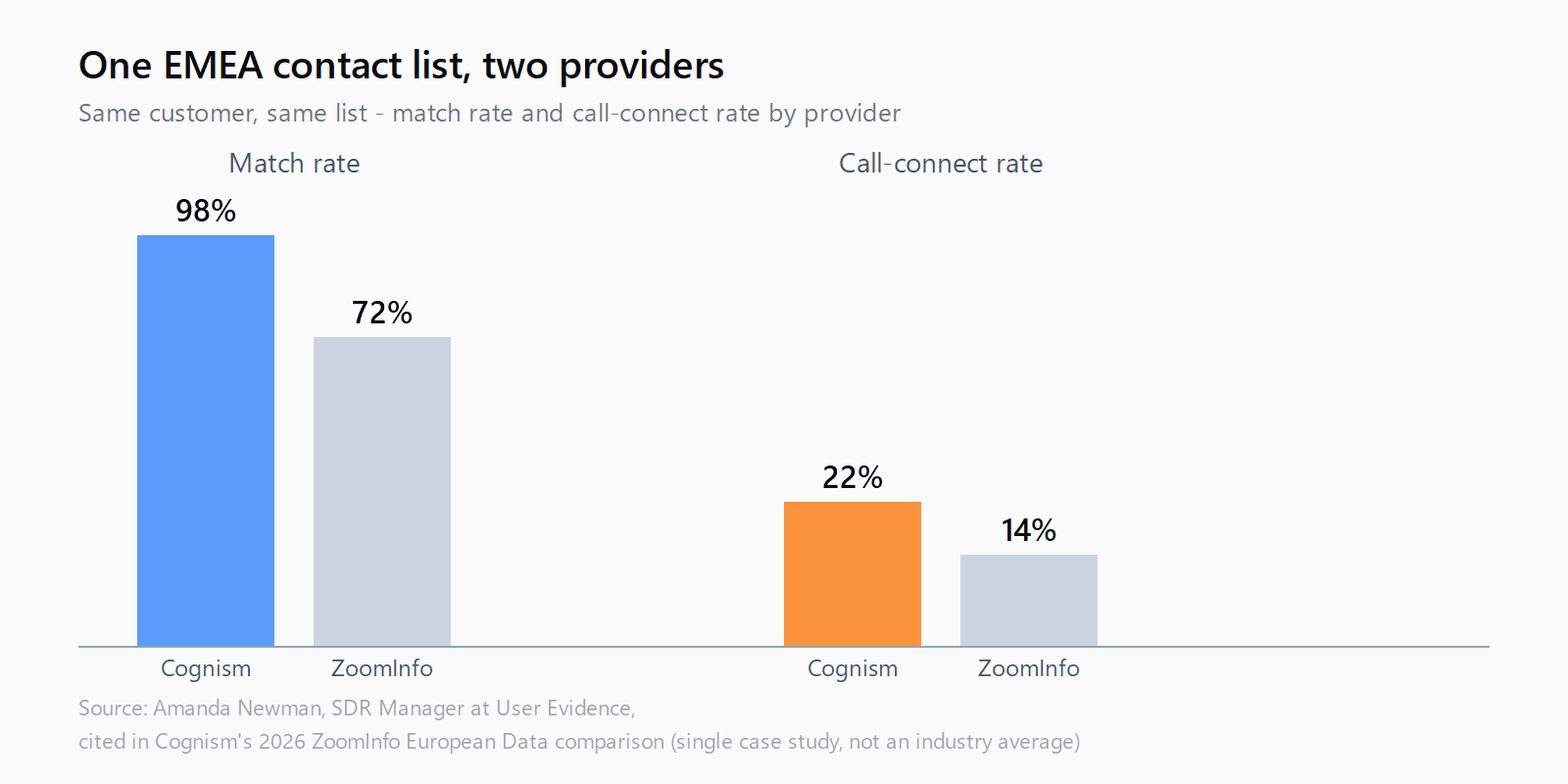
Cognism blew ZI out of the water. Cognism's match rate was 98% vs. 72% by ZoomInfo, and we found that Cognism returned a ton more phone numbers. [...] When we called them to verify the numbers, the call connect rate was 22% with Cognism and 14% with ZoomInfo. - Amanda Newman, SDR Manager at User Evidence
The mechanism explains the geography. Community verification works when there's a dense community - US and UK ZoomInfo seats are numerous enough that a mobile number gets confirmed or flagged quickly. Continental Europe has thinner seat density per country, so a number sits unverified, or gets confirmed once and never rechecked, for longer. ZoomInfo also gates its deeper EMEA record set behind the separately purchased Global Data Passport add-on, which Cognism Diamond Data comparisons flag as a cost teams "find hard to justify" once they've paid for it and still hit the same accuracy gap.
Why community verification breaks outside UK and DACH
Three things compound. First, seat density: fewer ZoomInfo users per capita in France, Italy, Spain, and the Nordics means fewer independent confirmations per record, so a wrong number takes longer to get flagged and corrected. Second, number portability: European mobile users port numbers between carriers and sometimes between mobile and fixed-line contracts more often than the community-verification cadence catches. Third, format ambiguity: several European countries use overlapping prefix ranges for mobile and landline blocks (Germany's is notoriously non-obvious outside the 015x/016x/017x mobile bands), so a community contributor can mis-tag a landline as a mobile without anyone catching it downstream.
None of this makes ZoomInfo's US or UK data suspect (I'd trust it there about as much as anything else on the market). The failure mode is specifically "the record says mobile, verified, and it's a landline" for contacts outside the markets where the community is dense - which is exactly the segment an EMEA-first pipeline can't afford to get wrong.
How to spot a mistagged landline before you dial
Two cheap checks catch most of it before a rep wastes a call. Run every "community-verified" EMEA mobile through a phone-type classifier keyed to national numbering plans - most countries publish official mobile prefix ranges (Ofcom for the UK, Bundesnetzagentur for Germany, ARCEP for France), and a prefix mismatch is a hard signal, not a guess. Second, treat "community verified" and "phone-verified" as different confidence tiers in your own CRM field, not the same "verified" checkbox ZoomInfo exports - a rep who knows the number came from crowd confirmation, not a call center, will hedge the first attempt differently than one who thinks it's guaranteed.
A third, cheaper check: run a bulk carrier-lookup pass (most phone-verification APIs return a line-type flag - mobile, fixed, VOIP) across the whole EMEA segment before it hits a sequence, and quarantine anything the classifier disagrees with ZoomInfo on rather than trusting either source blind. This catches the case a static prefix table misses too, since number portability means a mobile prefix can end up ported to a landline-style contract in some markets.
Building the supplement waterfall
The fix isn't replacing ZoomInfo - it's routing around the specific gap. Keep ZoomInfo as the first hop for US, UK, and DACH contacts, where community density is high enough that the verified tag holds up in practice. For the rest of continental Europe, fall back to a phone-verified specialist for that specific contact before it reaches a sequence. Cognism's Diamond Data layer is the most-cited fallback in the 2026 comparisons I found for this specific gap; Lusha's own EMEA and APAC coverage gaps mean it's a reasonable second-tier fallback for lower-priority accounts but not a full substitute for the primary EMEA layer on your highest-value targets.
Route the decision by contact, not by a static country allowlist. A waterfall that reads "if country != US/UK/DE, use fallback provider" is close but sloppy - German coverage is decent, not uniform, and a rigid country gate will burn fallback-provider credits on contacts ZoomInfo could actually resolve correctly. Better: check the ZoomInfo record's verification source field first (community vs. proprietary-verified, where ZoomInfo exposes it), and only waterfall to the fallback when that field says community-sourced or is missing entirely.

Where this fits in a broader enrichment stack
This is exactly the kind of seam problem that shows up whenever you're stitching together a waterfall across enrichment providers, and it's the seam Leadex sits on: instead of a fixed provider order baked into a spreadsheet, you can brief Leadex to enrich US/UK/DACH contacts through ZoomInfo and fall back to a second connected provider for the rest, and it routes each contact through your own credentials rather than a hardcoded rule. That's not a replacement for ZoomInfo's database - Leadex vs. ZoomInfo is upfront that ZoomInfo wins on enterprise DB depth and compliance paperwork - but for teams who need the fallback logic to flex per campaign instead of living in a fixed integration config, it's a lighter way to express the same waterfall.
Worth saying the skeptic's version too: if your outbound is 90% US and UK, none of this matters much, and adding a second phone-data vendor for a thin slice of continental contacts may cost more in vendor management than it saves in connect rate. The fix earns its complexity budget only once EMEA is a real fraction of pipeline, not a handful of opportunistic accounts.
FAQ
Does ZoomInfo verify mobile numbers with a human calling team?
No. ZoomInfo's mobile verification relies on a community-based system where other users contribute and confirm numbers, rather than in-house phone verification. This is the mechanism cited as the source of European accuracy gaps in Cognism's 2026 comparison.
Why does ZoomInfo's community verification work better in the US and UK than continental Europe?
Community verification depends on seat density - enough ZoomInfo users in a market to confirm or flag a number quickly. The US and UK have dense enough coverage for this to work reasonably well; France, Italy, Spain, and the Nordics have thinner seat density, so mistagged numbers persist longer.
Is Cognism's Diamond Data the only fallback option for EMEA mobile accuracy?
It's the most-cited fallback in current comparisons for phone-verified EMEA coverage, but Lusha is a reasonable second-tier option for lower-priority accounts, with its own coverage gaps in EMEA and APAC worth checking against your specific target countries first.
Should I route the fallback by country or by contact?
By contact. A static country allowlist either wastes fallback-provider credits on contacts ZoomInfo can resolve correctly, or misses contacts in a "covered" country whose specific record is still community-sourced and unverified. Check the record's verification-source field when ZoomInfo exposes it.
Does this mean I should drop ZoomInfo for EMEA-heavy outbound?
Not necessarily. ZoomInfo's enterprise database depth and compliance tooling are real advantages that a smaller EMEA specialist won't replace outright. The fix here is a targeted fallback for the specific mobile-verification gap, not a full provider swap.