
How to Fix Sender Reputation After Smartlead's 0.1% Spam Rate
A concrete recovery sequence for when Smartlead auto-pauses a campaign at 0.1 percent spam complaints: diagnose, re-warm on a 14 to 21 day schedule, fix DMARC, and verify placement before resuming.
Smartlead auto-pauses a sending account the moment its spam complaint rate crosses 0.1 percent, and I've watched more than one team make the same mistake right after: they see the pause lift, resume full volume the same afternoon, and watch the rate climb straight back over the line within a week. The pause isn't the problem. Resuming too early is.
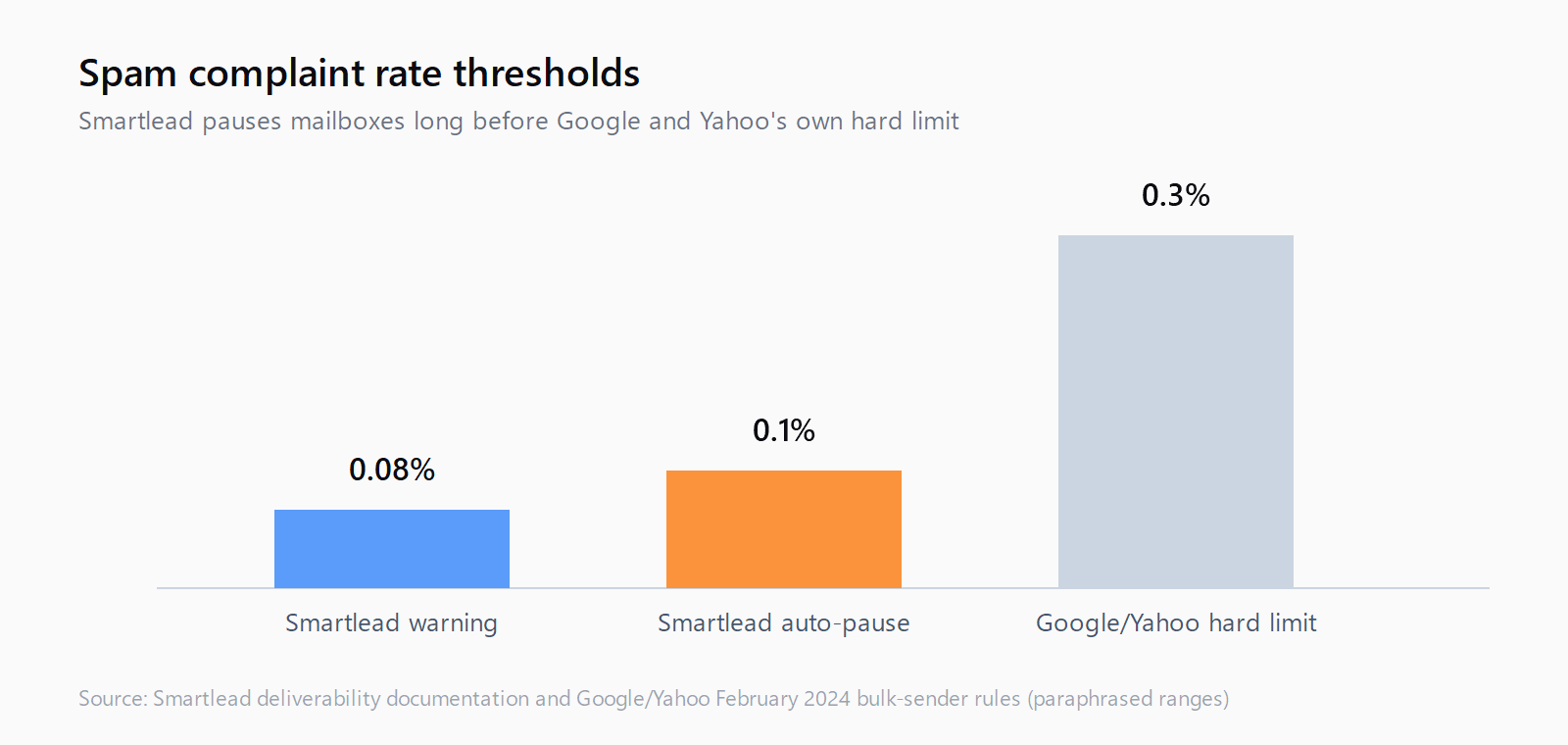
The 0.1 percent line isn't arbitrary. It's the threshold Google and Yahoo effectively set with their February 2024 bulk-sender rules - authenticate with SPF, DKIM, and DMARC, keep spam complaints under 0.3 percent hard-cap, offer one-click unsubscribe, or your mail gets filtered before subject lines matter. Smartlead runs its own guardrail well inside that limit: a roughly 0.08 percent warning and a 0.1 percent auto-pause, checked in its deliverability documentation, so a mailbox gets pulled before it ever touches the provider's own hard limit.
What actually triggers the 0.1 percent auto-pause
Spam complaint rate is the share of recipients who hit "report spam" on your message, not the share who unsubscribe or ignore it. One complaint per thousand sends is enough to cross 0.1 percent, which is a tighter margin than most SDRs assume when they're running a list they didn't personally vet. Satwick Ghosh, who writes on deliverability and outbound for Smartlead's blog, ranks it as the single highest-weighted signal in the platform's reputation scoring model, ahead of bounce rate and authentication, in a table from his 2026 sender-reputation guide:
Spam complaint rate | Very high | Share of recipients who hit "report spam" | Under 0.1%, hard limit 0.3% [...] Spam trap hits | Very high | Emails sent to known trap addresses | Zero
That pairing matters. A spam-trap hit and a spam complaint often arrive together, because both come from the same root cause: a stale or purchased list with addresses nobody vetted recently. Before you touch warmup settings, pull the campaign's bounce log and cross-reference which sending account tripped the pause - if it's one mailbox out of a pool, the fix is narrower than if the whole domain is affected.
Stop sending and diagnose before you touch warmup
The instinct is to fix the number fast. Resist it. Ghosh's guide is explicit that the first step after a pause is to stop sending entirely, not to immediately reduce volume and keep going - continuing to send while the reputation is degraded just adds more data points to a bad trend line Gmail and Outlook are already watching, as of this writing in mid-2026.
Diagnosis has three checks, run in this order: Google Postmaster Tools for the domain's reputation tier (high, medium, low, bad) and its own spam-rate readout; an MXToolbox blacklist scan on both the IP and the domain; and a review of the last 30 days of bounces for a spike that lines up with when the complaints started. Most of the time the cause is one of three things - a list pulled from somewhere other than a verified source, a mailbox that had warmup disabled after a pool bounce and kept sending anyway, or a volume spike where a rep ramped a new mailbox from a handful of emails a day to full sequence load in under a week.
This is the kind of failure mode that sits right at the seam between list quality and sending infrastructure, which is exactly where a lot of outbound tooling breaks down (I believe more reputation damage traces back to unverified lists than to anything about the sending platform itself). We think about that seam a lot at Leadex, because the same discovery-to-enrichment pipeline that builds a prospect list is the thing that determines whether it's clean going in - Leadex's Exa-backed search returns up to 100 results per call, and every row carries the source URL, so a bad list is traceable back to where it came from instead of showing up as an anonymous spike in Postmaster three weeks later.
Re-warm on a 14 to 21 day stabilization schedule, not a same-day resume
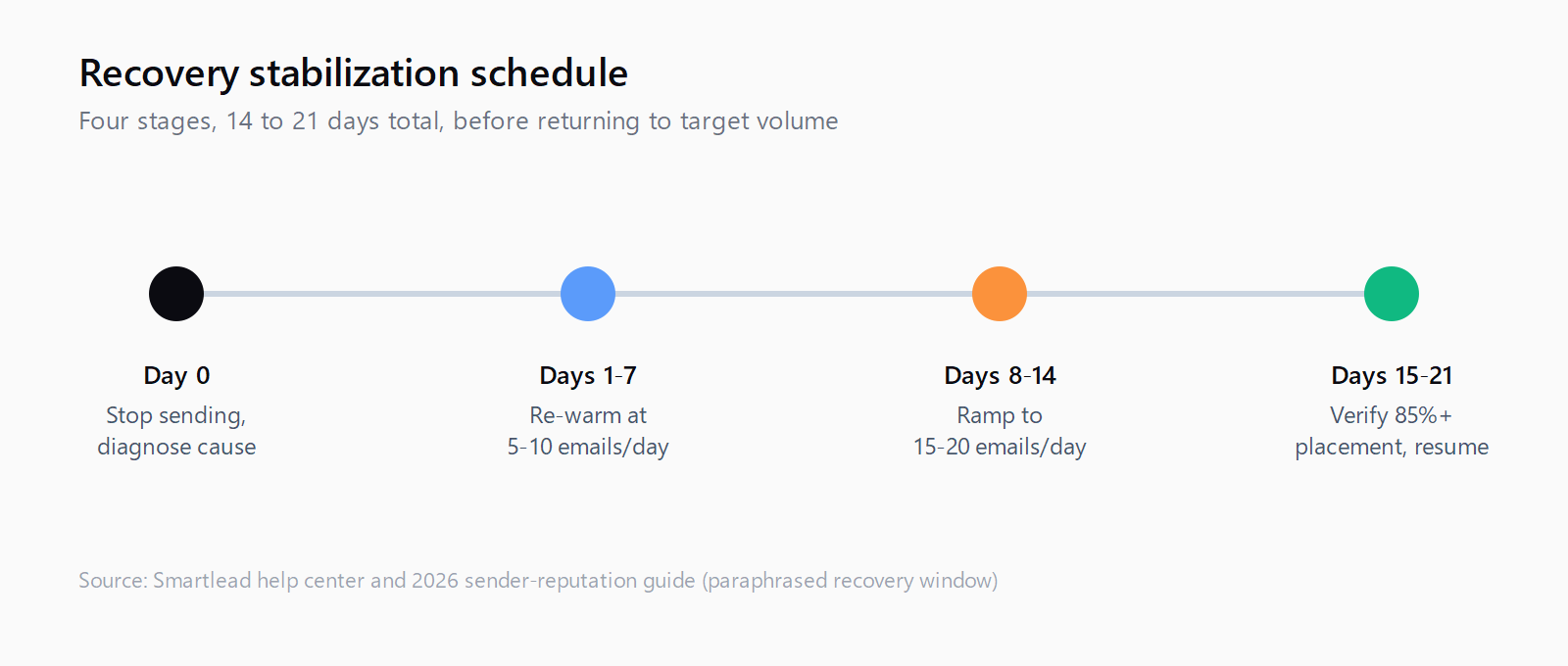
Once the root cause is fixed - list scrubbed, bad mailbox pulled from the pool, volume spike identified - the rebuild is a warmup exercise, not a switch flip. Smartlead's guidance is to drop back to 5 to 10 emails a day per mailbox and hold there, and its help center's stabilization window runs 14 to 21 days before the account is considered recovered. The 2026 playbook rounds this to "two to four weeks depending on the damage," which is the same range with more room for a domain that took a harder hit.
Hold the reduced volume for the full window even if the spam rate reads clean after day four or five (!) - a few clean days at 5 emails a day tells you very little about what happens at 40. Ramp gradually inside the window rather than jumping straight from 10 to full volume the moment it lifts: something like 5-10 for the first week, 15-20 for the second, and back to target volume only in week three if Postmaster is trending up the whole time. Watching daily instead of weekly during this window is worth the extra five minutes - a relapse caught on day two costs you almost nothing, a relapse caught on day twelve resets the clock.
Fix DMARC and confirm inbox placement before resuming full volume
Authentication is the piece teams skip because it feels unrelated to the spam-rate number itself, but a DMARC policy still sitting at p=none means you're not actually enforcing anything - you're monitoring. Escalating to p=quarantine, and eventually p=reject once the reports confirm no legitimate mail is failing, closes off a class of spoofing and lookalike-domain abuse that erodes the same domain reputation you're trying to rebuild. This is the same authentication gap that shows up as a hard bounce rather than a spam complaint on the Microsoft side - if you've hit Gmail's 550 5.7.26 DMARC bounce on cold-email subdomains, it's the same root fix.
Before resuming target volume, run a placement test through SmartDelivery rather than trusting that the spam-rate number alone means you're clear - Smartlead's own recovery checklist calls for confirming 85 percent or better primary-inbox placement across major providers before a mailbox goes back to full sequence load. A domain that reads "clean" on complaint rate but still lands 60 percent in Gmail's spam folder hasn't actually recovered; it's just not generating complaints yet at reduced volume. If this is a domain built specifically for outbound rather than a legacy inbox, the whole recovery is faster and more predictable when the sending infrastructure was set up on dedicated subdomains from the start - shared reputation with a marketing or transactional domain turns a mailbox-level problem into a company-wide one.
FAQ
How long does it take to recover sender reputation after a Smartlead spam-rate pause?
Smartlead's own guidance puts it at 14 to 21 days of reduced-volume warmup (Smartlead rounds it to "two to four weeks" for harder cases), assuming the root cause - bad list, disabled warmup, or a volume spike - was fixed before the re-warm started.
What triggers Smartlead's spam-rate auto-pause?
A sending account's spam complaint rate crossing roughly 0.1 percent, which is the share of recipients who mark a message as spam rather than the share who unsubscribe or ignore it. Smartlead's threshold sits inside Google and Yahoo's own 0.3 percent bulk-sender hard limit as an early warning.
Should I resume full sending volume as soon as the pause lifts?
No. Resuming at full volume immediately is the most common reason the spam rate spikes again within days. Ramp gradually across the full stabilization window instead.
Does fixing DMARC actually affect spam complaint rate?
Indirectly. A DMARC policy stuck at p=none doesn't stop spoofing or lookalike-domain abuse, which erodes the same domain reputation that spam complaints damage. Escalating to p=quarantine or p=reject closes that gap.
How do I confirm my Smartlead sender reputation has actually recovered?
Run an inbox placement test through SmartDelivery and confirm at least 85 percent primary-inbox placement across major providers before resuming target volume - a low complaint rate at reduced sending volume doesn't guarantee the same holds true at full volume.