
How to Prevent Clay Table Drift From Corrupting CRM Records
A concrete workflow for stopping Clay table sprawl from silently overwriting CRM fields: one master table, stable-ID writes, and an audit trail before drift sets in.
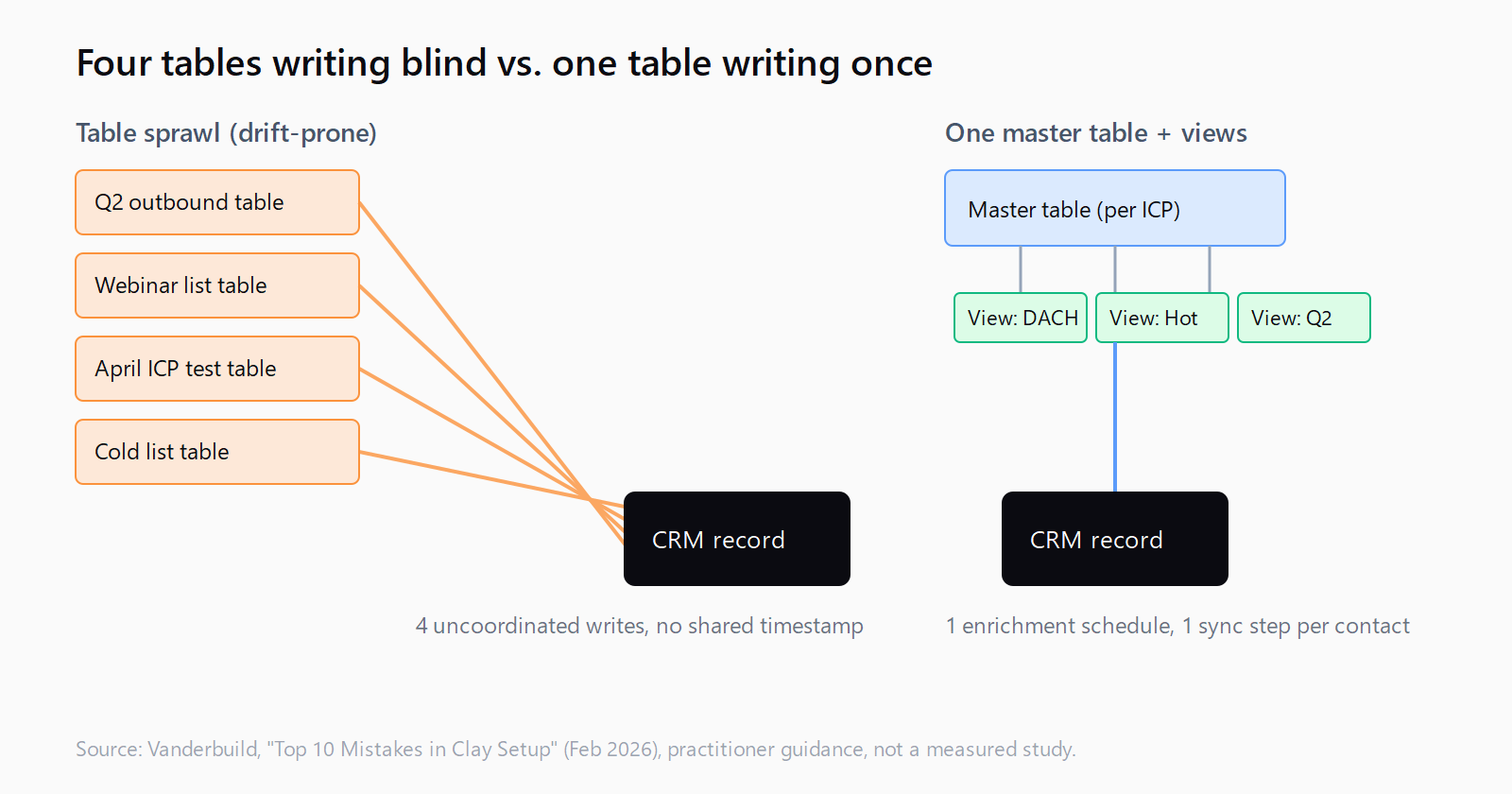
Ask anyone running a Clay-heavy GTM stack how many tables they have open right now and the honest answer is usually "I'm not sure." A table for the Q2 outbound push, another for the webinar attendee list, a third someone spun up in April to test a new ICP and never closed. Each one enriches contacts and pushes fields to the CRM on its own schedule. None of them know the others exist. That's the setup that produces what Mateusz Sekta, founder of the Clay agency Vanderbuild and the #2 finisher globally at Clay Cup 2025, called "data drift" in a February 2026 writeup - the same contact enriched multiple times by multiple tables, each write silently overwriting whatever the last one left behind. As of mid-2026, with Clay workspaces routinely running dozens of tables across a single GTM org, that failure mode has gone from an edge case to the default outcome of not thinking about it.
The failure is quiet by design. Nothing errors out. A webhook fires, a HubSpot property updates, the sync log shows a clean 200. It's only weeks later, when a rep calls a number that's two jobs stale or a sequence addresses someone by a title they left in Q1, that anyone notices the CRM has been drifting the whole time.
Creating endless tables leads to "data drift" and duplicate enrichment costs. [...] Keep one master table per market motion (ICP or campaign theme), then use Clay filters and views to slice it for execution. [...] Key habit: if you can express it as a filter, it should not become a new table.
Why Clay tables drift into conflicting CRM writes
The mechanism is simple once you see it. Every new Clay table is a fresh enrichment run with its own waterfall, its own timestamp, and usually its own CRM-sync step at the end. If two tables both touch the same contact - which happens constantly once a company has more than one active campaign - each table treats itself as authoritative. There's no cross-table memory of what a different table already wrote last month. The CRM record becomes a merge of whichever table happened to run most recently on that field, not the most accurate value available.
This compounds because enrichment providers themselves disagree. One waterfall step might resolve a title from LinkedIn, another from a stale Apollo cache, a third from a Clearbit-style firmographic call. Run the same contact through three tables over three months and you can watch a job title cycle through three different values, each one plausible, none of them checked against what's already sitting in the CRM.
Collapsing table sprawl into one master table
The fix that shows up across practitioner writeups is unglamorous: stop treating every campaign idea as a reason to spin up a new table. Sekta's guidance is to keep a single master table per ICP or market motion, then use Clay's saved filter views - "ICP Fit = High + Geo = DACH + Intent = Hot," for example - to slice that one table for execution. A new segmentation idea becomes a view, not a table. That single change removes the root cause of drift, because there's only one enrichment schedule and one CRM-sync step per contact instead of three or four running independently.
This is also where a 5-step waterfall earns its keep - a well-ordered waterfall on one master table gets you a high match rate on the first pass, which removes the temptation to spin up a "let me just try a different table" workaround when a lookup comes back empty.
Deduplicating before enrichment, not after
Master table or not, the second failure mode is enriching the same person twice inside the table itself - a re-imported CRM view, a re-uploaded CSV, a Sales Navigator search that overlaps last month's. Deduplicate at the domain or email level as the literal first workflow step, before any enrichment column runs, not as cleanup afterward. Enriching a duplicate twice doesn't just burn credits (I've written before about credits burned on failed waterfall lookups that return nothing at all) - it produces two enrichment events for one contact with two different timestamps, which is exactly the condition that lets a stale value beat a fresh one to the CRM.
Keying CRM writes to a stable ID and refusing blind overwrites
The paragraph that matters most in Octave's writeup on Clay-to-CRM syncing is the one about identity: Clay should pull contacts from HubSpot using the real HubSpot Object ID and match back to that same ID on write, "if a HubSpot ID is missing for a record, Clay will not update it, preventing junk data from entering your system." Matching on name-plus-company or email alone is how two different "John Smith at Acme" records merge into one corrupted contact. hs_object_id sync errors are the visible symptom; silent field overwrites are the invisible one, and they're worse because nothing tells you they happened.
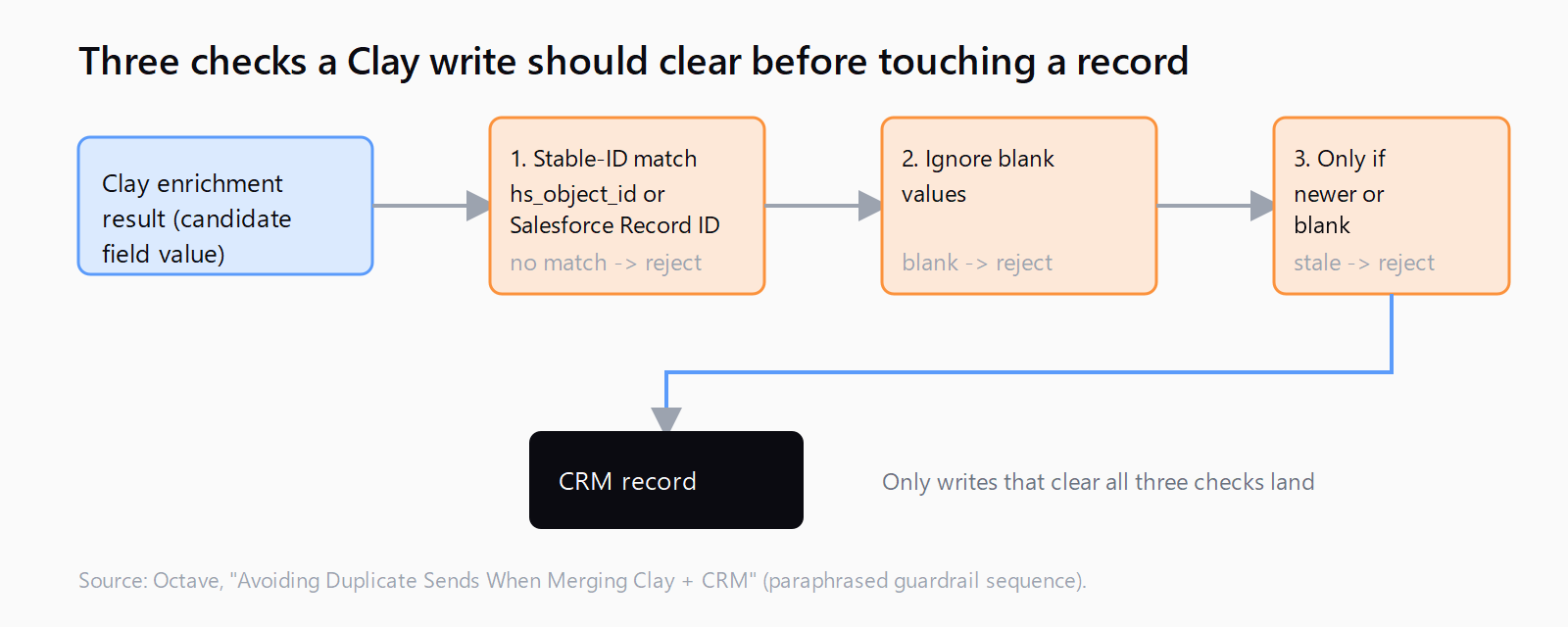
Layered on top of stable-ID matching, Clay's "ignore blank values" toggle stops a failed lookup from wiping out a good value with an empty one, and a simple "only update if the existing field is blank, or the new value is newer" rule stops a stale waterfall result from beating a value someone verified by hand three days ago. Neither rule is exotic (!) - they're closer to what any database migration would insist on - but Clay tables get built fast, under deadline, and this is the step teams skip first.
Auditing drift after it happens
Even a disciplined setup benefits from an audit trail, because drift that's already in the CRM won't announce itself. Add a Last_Enriched_Date and Source columns to the master table and mirror them into the CRM as hidden properties. When a rep flags a wrong title or phone number, that pair tells you which table wrote it and when, instead of forcing a guess across four campaigns. It's the same instinct as keeping a changelog - cheap to add, useless until the one day it saves you an afternoon of manual reconciliation.
This is exactly the kind of seam Leadex is built to sit in. Leadex skips the table-proliferation problem structurally - there's no separate table per campaign to forget about, because a research brief runs once, the agent shows a plan preview you approve before it touches the web, and enrichment routes through your own connected Apollo or HubSpot key rather than a chain of Clay waterfall columns nobody remembers configuring. That's a different tradeoff than Clay's - Clay's reusable column stacks are the better fit for a team running the same enrichment shape on a rolling basis, and Leadex is built for the ad-hoc brief that doesn't want spreadsheet maintenance - but if table sprawl is the thing quietly rotting your CRM, it's worth noticing which side of that tradeoff you're actually on.
None of this is really a Clay problem, to be fair - Apollo, Cognism, or a homegrown enrichment script with unsupervised CRM writes would drift the same way. Clay just makes it easy to spin up the fifth table before lunch, which is exactly why the discipline has to be a workflow rule and not a tool setting you configure once and forget.
FAQ
What exactly is Clay table data drift?
It's the gradual corruption of CRM fields that happens when multiple Clay tables enrich and sync the same contact independently, each write overwriting the last with no shared record of which value is actually correct or current.
How do I know if my CRM already has drift from Clay?
Look for fields that changed value with no matching activity log entry, contacts with conflicting titles or company names across different views, and any property last modified by an integration user rather than a person. A Last_Enriched_Date column retrofitted onto existing records will surface the worst offenders once a few weeks of new writes land on top of it.
Does deduplication alone fix data drift?
No. Deduplication stops you from enriching the same contact twice inside one workflow, but drift comes from separate tables writing to the CRM independently. You need both: dedupe within each table, and consolidate tables so there's only one enrichment source of truth per contact.
Will Clay's "ignore blank values" setting stop overwrites on its own?
It stops one specific case - a failed lookup returning blank and erasing a good value. It won't stop a second table pushing a different, non-blank value that's simply wrong or stale. You still need stable-ID matching and a master-table structure to close the rest of the gap.
Is this specific to Clay, or does it happen with any enrichment tool?
Any tool that writes to a CRM without a shared identity key and an ownership rule can produce the same drift - Apollo, Cognism, and custom scripts included. Clay's low friction for spinning up a new table just makes the failure mode more common in practice.