What Lavender's Ora AI Sales Agent Actually Automates at $500/Month
Ora writes, researches, and sends cold email on its own - here's exactly what the $500-per-agent price tag covers, and what it still doesn't do.
Lavender built its name on the 90+ email score that grades a cold email before you hit send. Ora is a different product entirely: instead of scoring what you wrote, it writes the email, researches the prospect first, and can send the whole sequence without you touching it. Launch pricing for the 2026 product, per Lavender's own product page, is $500 per agent per month.
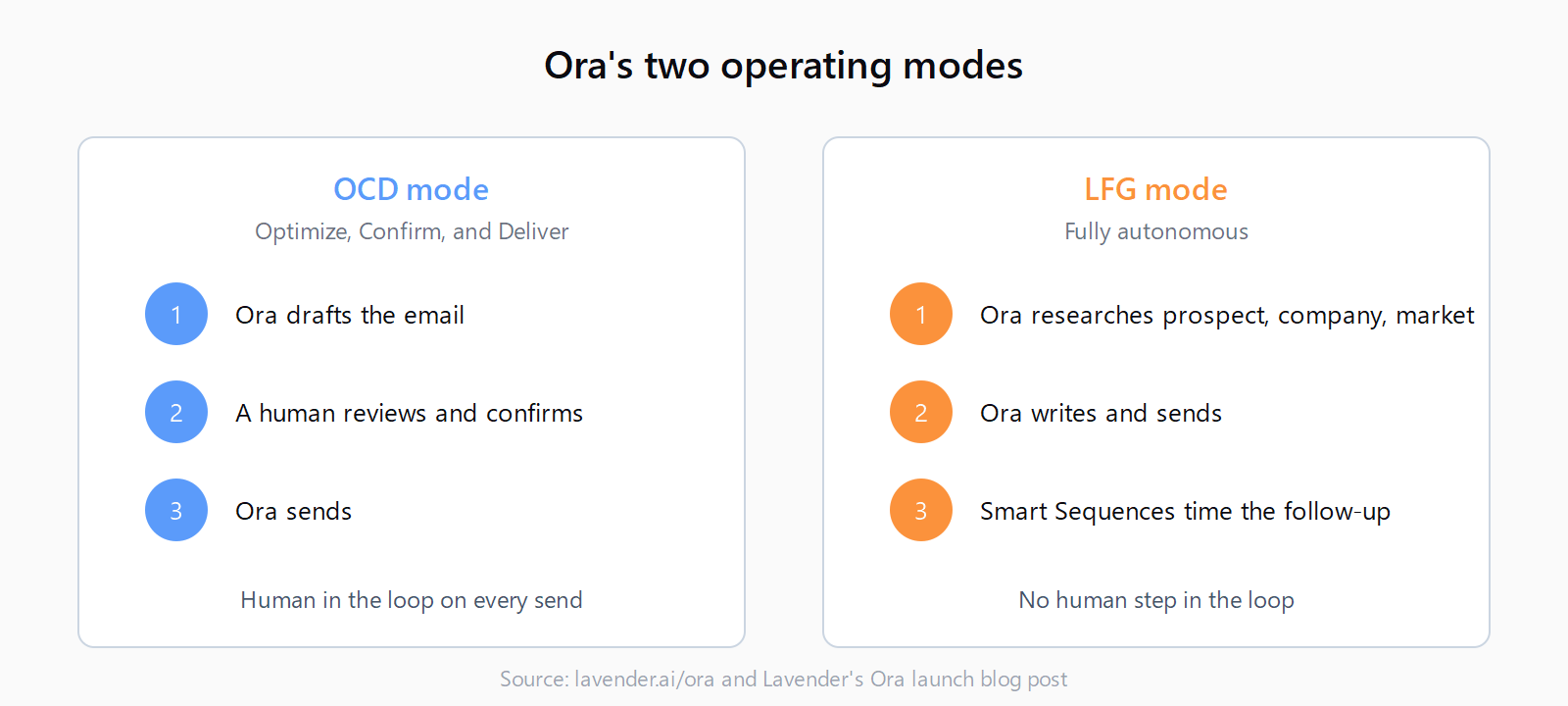
What that $500 buys is specific enough to write down. Each agent covers 1,000 emails a month to 4,000-plus contacts a year, trained on what Lavender describes as billions of sales emails, and it runs in one of two modes: "OCD mode" (Optimize, Confirm, and Deliver), where a human reviews each draft before it goes out, or "LFG mode," where Ora researches, writes, and sends on its own using what Lavender calls Smart Sequences - follow-ups timed off new research or trigger events rather than a fixed cadence. Building an agent is free; the meter starts at launch, month to month, no annual commitment.
The onboarding sequence, as Lavender describes it, is three steps: upload a lead list, train the agent, then give it instructions. Training means pointing Ora at your existing inbox and "the right resources" so it can learn what a good email from your team looks like, and you're meant to check its understanding before turning it loose - a calibration step that sits between "upload a CSV" and "let it send." Instructions after that are conversational: "talk to it like you would a rep," per the product page, rather than configuring a sequence builder field by field.
The research step is the part worth reading closely, because it's the whole pitch. Ora looks at three things per prospect: the person ("their psychology, their background etc."), the company (what it does, who it serves, what's going on right now), and the market (trends and key events), then layers that against your own first-party and custom data. Here's Lavender's stated reason for why this needs a dedicated model rather than a scraper:
Anyone can pull data. We use ACI, Augmented Communication Intelligence, to distill it to what matters. [...] Rather than generating a single draft, Ora creates multiple email versions scored for quality, accuracy, and personalization.
That's a real distinction from most "AI SDR" copy generators, which take a prompt and a name field and output one email. Ora scores several candidates against each other before anything reaches your inbox for review, or your prospect's inbox in LFG mode. Lavender also reports SOC 2 certification and GDPR compliance for the product, with regular penetration testing - reasonable table stakes for a tool that's reading a company's inbox and CRM to write outbound on its behalf, though these are Lavender's own claims, not a third-party audit result I could independently verify.
The security framing gets its own dedicated post from Lavender, which is a little unusual for a product launch and (I think) a tell about who's asking the hard questions before signing a contract. The company's blog post lists four constituencies by name - the business protecting its data, the seller who wants clean output without embarrassing errors, the security team worried about compliance exposure, and the customer whose data is being processed - and frames security as something built in from Ora's inception rather than "an afterthought," their word. Whether that framing survives contact with a real security review is the kind of thing you find out during procurement, not from a launch post, but naming the audience this explicitly is itself informative about who Lavender expects to push back.
Here's the part that actually matters if you're comparing this to other AI sales agents: Ora's first onboarding step is "upload your lead list." CSV or a Salesforce connection, then Ora trains on your inbox and existing resources. There is no discovery layer - no "find me 200 Series B fintechs in the Nordics" step. You bring the list; Ora writes and sends against it. That's a narrower claim than "autonomous AI sales agent" initially suggests, and it's worth separating from tools that also do the finding, like 11x.ai's Alice, which folds prospecting into the same agent loop.
I'd also flag the volume math before anyone budgets against it (I think this is underdiscussed in the coverage I've seen). $500 for 1,000 emails a month works out to $0.50 per send before any per-seat email infrastructure or deliverability tooling on top - a meaningfully different unit economics conversation than a $29/month coaching seat that scores unlimited drafts. Whether that's a fair price depends entirely on whether LFG mode's autonomous sequencing replaces a full SDR's email workload or just a slice of it, and Lavender's own numbers - an "over 20% reply rate" average and "20+ hours per week" saved - are self-reported, not independently audited.
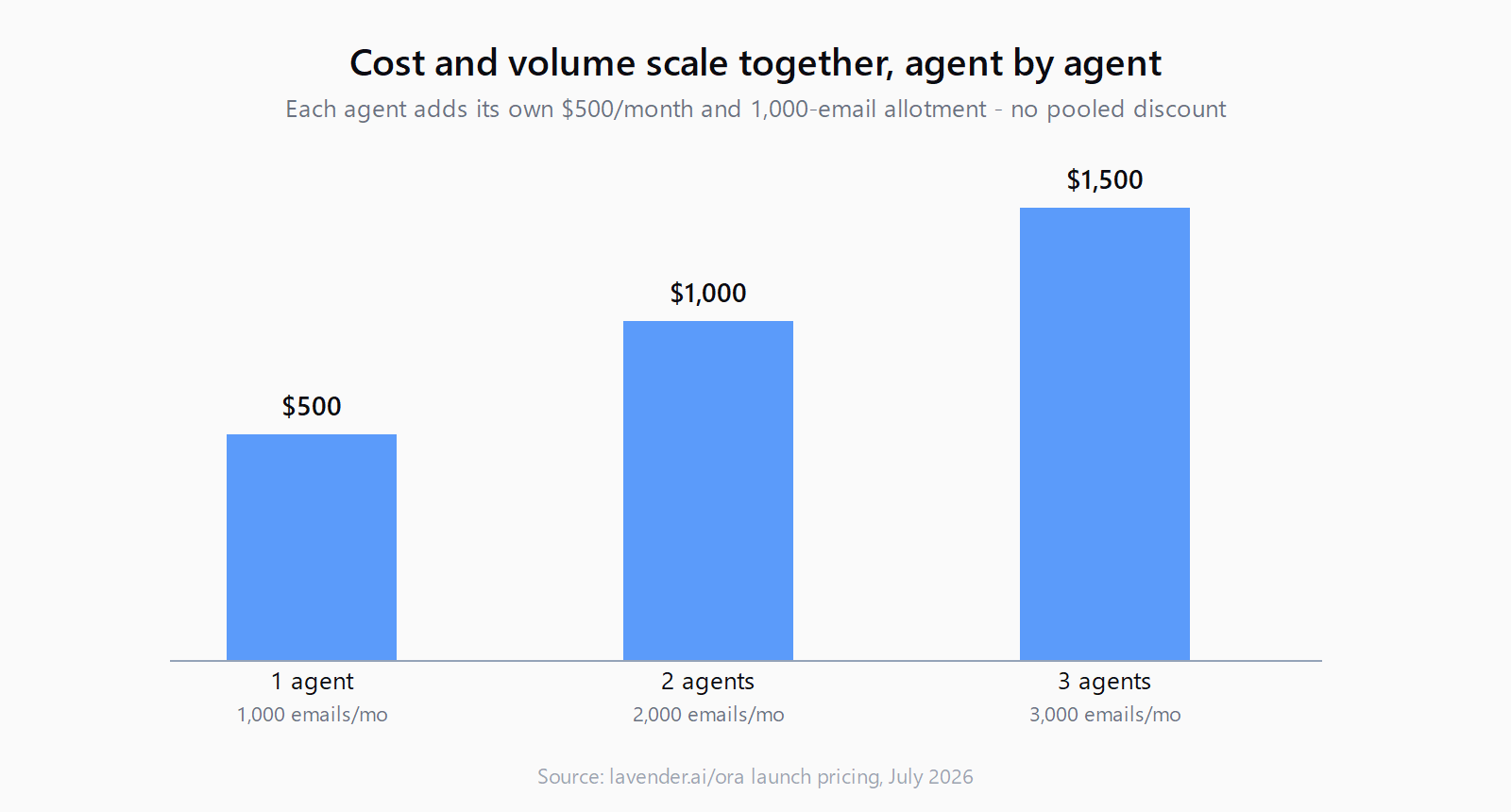
Multiple agents, per the pricing page, scale volume and cost together rather than sharing a pool - each additional agent at $500/month adds another 1,000 emails and 4,000-plus contacts, not a discount tier on the first agent's allotment. That matters for a team weighing Ora against a human SDR's list: two agents running LFG mode in parallel gets you to 2,000 sends a month at $1,000, which starts to look like a meaningful chunk of what a junior rep sends manually in a month, minus the phone calls, LinkedIn touches, and objection handling a rep does that Ora doesn't attempt.
This is exactly the seam Leadex sits on the other side of. Ora automates the write-and-send half of outbound once you already have a list; Leadex is built for the step before that - describe an ICP in a chat, approve the research plan, and the agent "typically completes in under 60 seconds" per batch when it enriches company data for that list. Pair the two and you've covered both ends of the pipeline without touching a filter UI at either stage.
Third-party coverage (I found this on a vendor directory rather than an independent outlet, so treat it as a data point, not a verdict) describes Ora as "still centered on email-led outbound" and "in active development" as of mid-2026 - a fair characterization given the product has no multichannel layer yet. That's the same gap that shows up across most of this category, which is why it's worth reading against what autonomous AI SDRs still cannot handle before assuming LFG mode replaces a full-cycle rep.
The other thing "still in active development" tends to mean in practice: the feature set you evaluate this month may not be the feature set you're billed against next quarter. That's not unique to Ora - most of the AI SDR category launched in the last eighteen months and is iterating in public - but it's worth asking a sales engineer directly which parts of the pitch are shipped versus roadmap before signing a monthly contract, even one without an annual lock-in. "No annual commitments" cuts the downside if a feature doesn't land, but it also means the pricing itself is early and may move once Lavender has real usage data to price against.
None of that is a knock on the core idea. Splitting "research the prospect" from "write the email" from "decide when to follow up" into a single agent loop is a sensible design, and scoring several draft candidates before one reaches an inbox is a genuinely better default than most single-shot generators ship with. The open question is narrower than "does autonomous outbound work" - it's whether a $500/month, 1,000-email agent beats the alternative you're already paying for, whether that's a junior rep, a cheaper sequencing tool paired with a human writer, or a different AI SDR that also handles the list-building Ora explicitly leaves to you.
Whether Ora is worth $500 a month per agent depends on how many of those 1,000 monthly sends you'd otherwise pay a human or a cheaper tool to write. For a team already running Lavender's coaching product and wanting to hand off the actual drafting on a defined lead list, the pricing at least maps cleanly to a number you can test against your own reply rate before renewing.