
Do Lavender AI Emails Improve Replies? How to Judge the Evidence
What Lavender's benchmark proves, what it leaves open, and how to evaluate reply quality without confusing a higher email score with revenue.
Lavender's published benchmark is evidence that better-scoring emails and higher reply rates occur together. It does not establish that buying Lavender will cause your team to book more meetings. That distinction is the useful starting point for a buyer asking whether the tool improves cold email or simply makes everybody sound alike.
Our earlier guide covers using Lavender's email score. The buying question here is broader: which observable outcome would justify the subscription for your team?
Does Lavender's benchmark prove a reply-rate lift?
The March 30 benchmark report describes a sample of 231,818 cold emails analyzed as of February 4, 2026. Automated replies and bounce notifications are excluded, but positive and negative replies are included. The report compares segment averages with results for emails scoring at least 90. These are vendor observations, not a randomized purchasing experiment.
That leaves several explanations open. A rep who writes a high-scoring email might also choose better accounts, know the buyer's problem, or spend longer on research. The score could be useful while sharing credit with those choices. The published comparison cannot tell a buyer how much of the observed difference would survive if the same team kept everything else unchanged.
A negative reply also counts differently depending on your decision. It might tell you that an address reaches a real person, which helps diagnose a delivery problem. It might also tell you that the message annoyed someone who will never buy. Adding those events together is reasonable for a response metric; using that total as a revenue forecast needs another step.
I would therefore separate the evidence into three questions: whether the message gets a response, whether the response expresses relevant interest, and whether that interest becomes a conversation the sales team wants. Those are proposed evaluation categories. They are not three outcomes the benchmark has independently proven. A purchasing decision becomes easier when each category has its own answer.
The skeptical reading is that a vendor chose a score its own product rewards and then showed that score in a flattering light. The more generous reading is that a large observational dataset can still expose writing habits worth testing. Both readings can be true. You do not need to dismiss the report to refuse a causal interpretation.
Why can a readable email still sound robotic?
A message can be short, grammatical, and completely interchangeable. My practical test is to replace the prospect's company with another company in the same category. If the reason for writing still works unchanged, the research has probably contributed little. This is a judgment about the message, not a claim about Lavender's scoring algorithm or a guaranteed route to replies.
Consider a hypothetical outreach draft to a finance leader. Saying that growing companies need better reporting provides almost no reason to contact this particular person. A recent public description of a reporting migration gives the writer something specific to discuss. Even then, the observation must support the offer. Finding a fact and attaching an unrelated pitch is still a weak email.
A useful review asks more of the writer than a style pass can accomplish. Before accepting a suggested rewrite, I would check whether the observation remains accurate and whether the buyer could reasonably connect it to the proposed conversation. Removing an awkward sentence is helpful. Removing the reason this recipient belongs on the list changes the substance of the email.
CRM context can help with that review. Lavender's February 19 HubSpot integration announcement says CRM data is available inside its extension and identifies Teams plans as the supported tier in that announcement. Confirm present entitlement before buying. Access to context is useful; it does not guarantee the writer interprets that context correctly.
This is where Leadex fits into the discussion: it handles audience research through a chat brief and an approved plan before producing a contact list. A writing coach addresses a later decision. Keeping the discovery brief next to the draft gives a reviewer a concrete reason to challenge personalization that sounds plausible but has no support in the research.
A reply-rate win can still lose the buying decision
Here is a hypothetical comparison, not Lavender customer data. Two groups each contact 1,000 eligible people. The coached group receives 60 human replies, including 12 interested replies, and produces six accepted meetings. The existing-workflow group receives 45 replies, including 15 interested replies, and produces eight accepted meetings. Exclude automated responses consistently before doing this comparison.
| Measure | Coached group | Existing workflow |
|---|---|---|
| People contacted | 1,000 | 1,000 |
| Human replies | 60 / 6.0% | 45 / 4.5% |
| Interested replies | 12 / 1.2% | 15 / 1.5% |
| Accepted meetings | 6 / 0.6% | 8 / 0.8% |
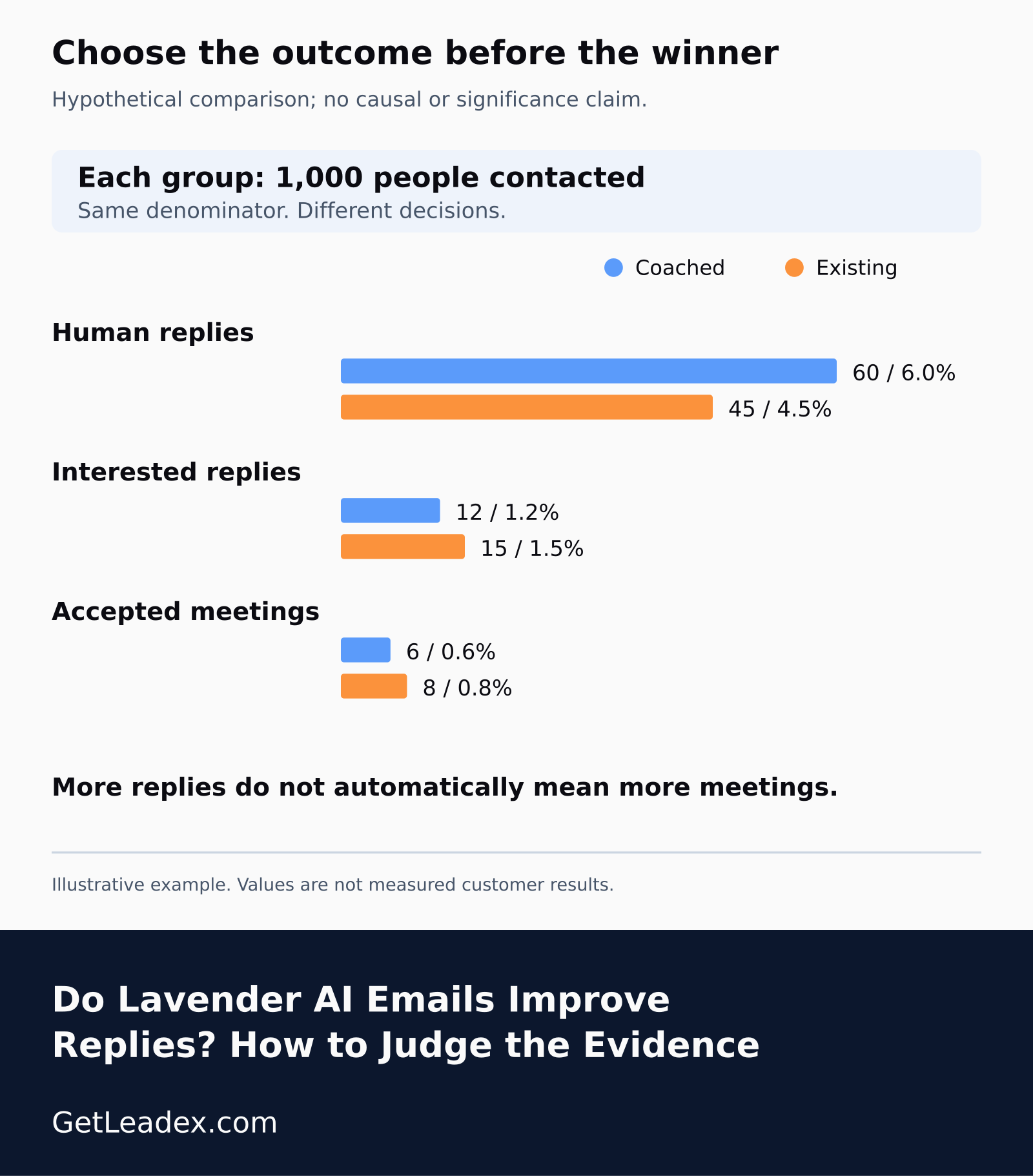
The coached group wins on total response rate. It loses on the two measures closer to a sales conversation. That does not demonstrate that the coach harmed performance: these made-up counts establish neither statistical significance nor causation. They demonstrate why the buying decision needs a defined outcome. A spreadsheet containing only the first rate would give the manager a different impression from the complete record.
For an actual pilot, save one row per contacted person with group assignment, send date, response classification, and meeting outcome. Count each person once for the chosen observation window. Decide in advance how a reply such as "ask again next quarter" will be classified. Otherwise the enthusiasm of the person evaluating the tool can quietly become part of the measurement.
Check whether the rewrite preserves a reason to write
Consider these illustrative drafts. The weak version says, "Noticed your team is growing. We help finance teams improve reporting." Replace the company name and the message still works. The more specific version says, "Your public hiring page lists a finance-systems role supporting a reporting migration. Are you evaluating reconciliation tools during that work?" It earns its specificity only if that public evidence exists and the offer really concerns reconciliation.
After accepting an AI rewrite, compare the two versions for factual accuracy, the recipient's connection to the observation, and the proposed next step. A smoother version that removes the migration reference may lose the reason for contacting that account. A version that adds an unsupported claim about the buyer's budget is worse even if it sounds more personal. Keep the original evidence next to the revision when reviewing these examples with reps.
What would a fair team evaluation measure?
I would start with a written decision rule before anyone sees a result. Define a positive reply, decide who labels ambiguous responses, and specify whether the purchase is meant to improve outcomes or reduce editing time. A team may reasonably pay for coaching that makes new reps faster. It should describe that benefit directly instead of relabeling it as proven pipeline growth.
For a comparison, assign eligible prospects to coached and existing-workflow groups in a way that avoids letting reps choose the easier accounts for one side. Keep the offer, audience definition, sending setup, and observation period comparable. This is a suggested experiment design, not a vendor feature. Record exceptions rather than quietly removing inconvenient sends after the results arrive.
Count the people contacted as well as the responses. A few replies look impressive in a screenshot without a denominator. Keep raw counts beside rates, distinguish positive from negative responses, and record follow-up differences. If one group gets more attempts, it has received a different treatment. You can still learn from it, but the answer concerns the whole workflow.
Review the actual messages alongside the spreadsheet. Ask someone who did not write them to identify unsupported claims and passages that could fit any account. Label those issues before checking which group won. That review helps catch an apparent improvement that depends on exaggerated familiarity or incorrect details. A response bought with a false claim is an expensive kind of success.
Small samples deserve a cautious decision. One extra interested buyer can move a small percentage substantially, and buying cycles may outlast a short pilot. Keep the uncertainty visible rather than converting an early difference into an annual forecast. If the result is inconclusive, decide whether more observation is worth the effort or whether the coaching benefit already justifies the cost.
Save the original draft and the accepted revision when a rep uses the coach. Those paired examples answer a question that a reply dashboard cannot: what changed? A manager can distinguish useful cuts from changes that stripped out evidence or made the request less clear. Keep the comparison small enough that someone actually reads it. If the team cannot explain why its preferred revisions are better, a higher score alone provides little guidance for training the next rep.
Which Lavender product are you evaluating?
The email coach and an autonomous sending product create different comparisons. Our earlier coverage of Lavender's Ora sales agent explains that product boundary. Do not treat evidence about scored emails as evidence that an autonomous workflow will choose the right prospects, handle replies appropriately, or produce the same commercial result.
Write down the exact product and workflow in the pilot record. Include who approves messages, where account context comes from, and what happens to objections. That makes the result useful to the next person reviewing the purchase. Otherwise, a good experience with a coach can become an unsupported recommendation for a different product carrying the same company name.