
How to Fix Apollo Bounce Rates With Waterfall Accuracy Mode
Apollo's waterfall enrichment defaults to a coverage-first mode with no data validation. Here's how to switch to Maximize Accuracy and segment catch-all domains to get bounce rate under 5%.
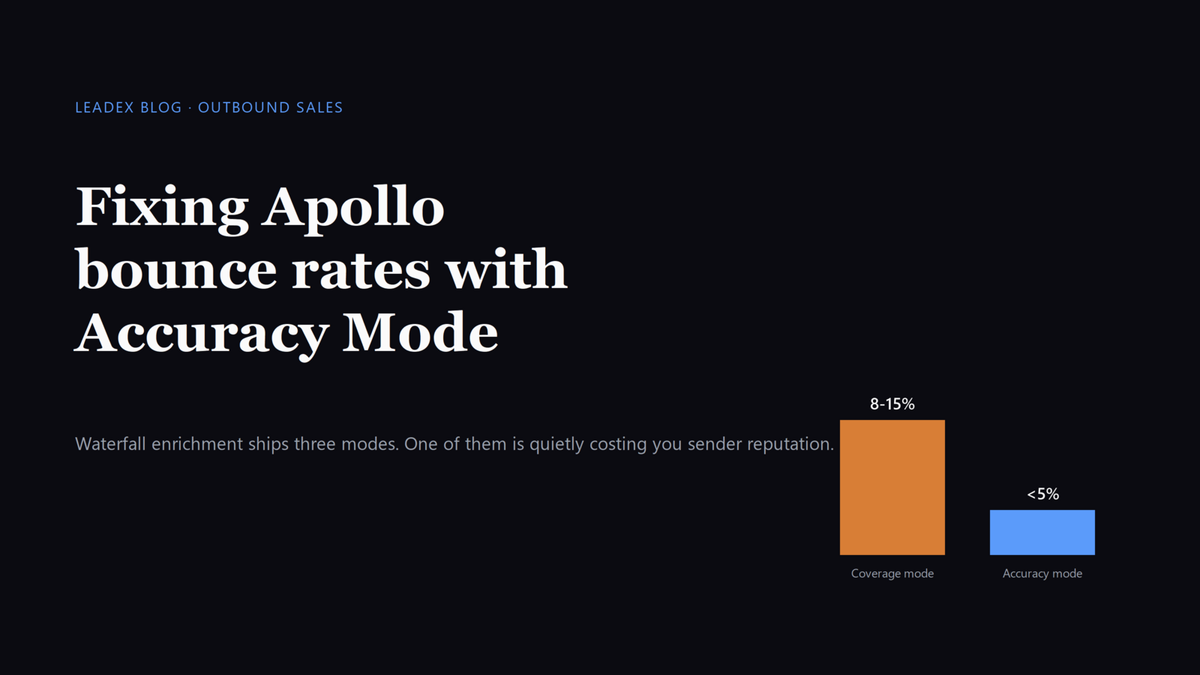
If you pulled a list from Apollo this quarter and watched bounce rate climb past 8%, the default waterfall enrichment setting is very likely the reason, not your list-building process. Apollo ships email verification tiers and a waterfall enrichment system with three selectable modes, and most workspaces are left on whichever one Apollo defaults new integrations to - which prioritizes coverage and credit cost over accuracy, not the other way around.
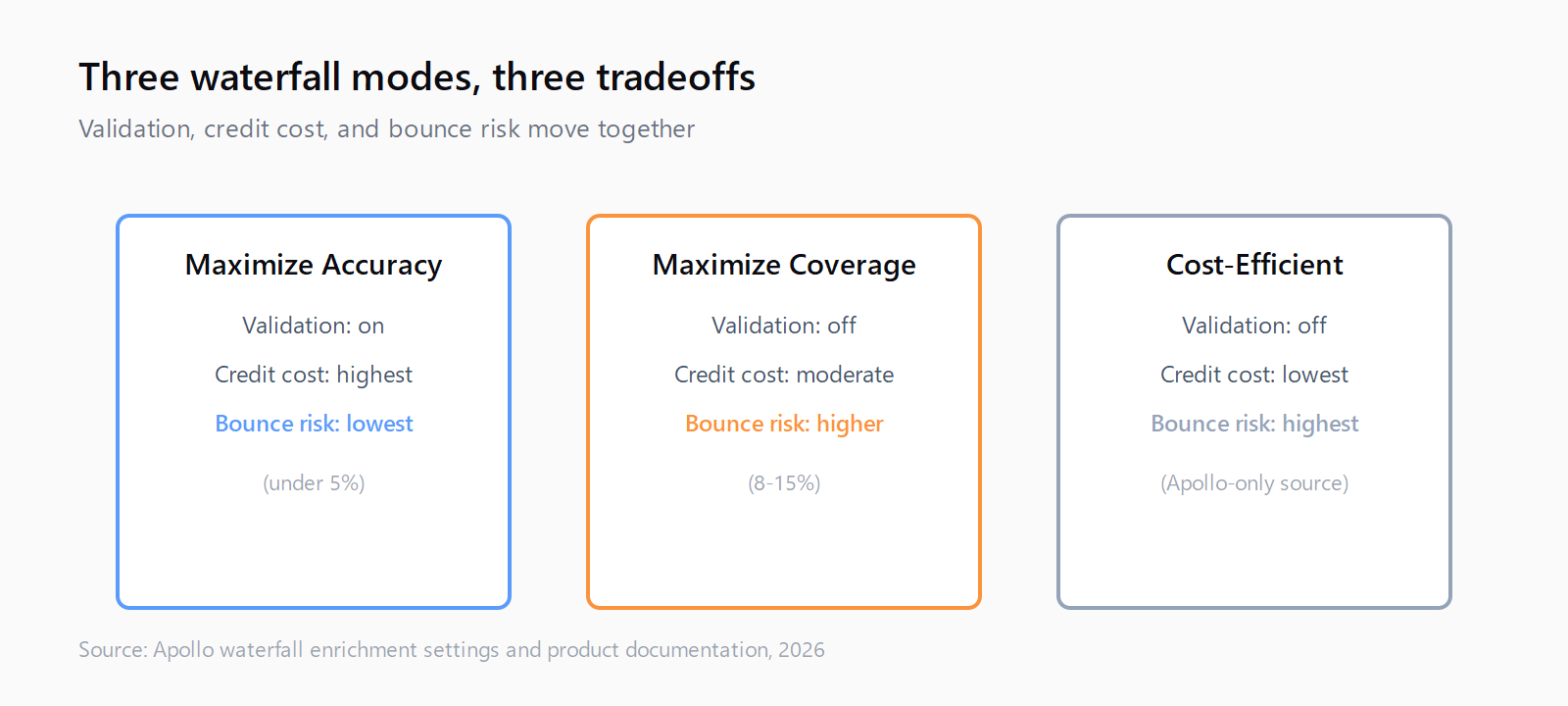
Apollo's waterfall enrichment product page queries "dozens of data providers one after another" for an email or phone number, moving to the next source only when the current one comes back empty or low-confidence. Underneath that pipeline sit three modes: Maximize Accuracy, which turns on data validation and tests candidate emails against real-time signals before returning them; Maximize Coverage, which adds more providers to the chain without validating what comes back; and Cost-Efficient, which keeps Apollo as the sole source. A workspace running Maximize Coverage or Cost-Efficient gets more rows filled in, faster, at a lower credit cost - and a materially higher share of those rows are addresses that were never confirmed to exist.
Why bounce rates spike on the default waterfall setting
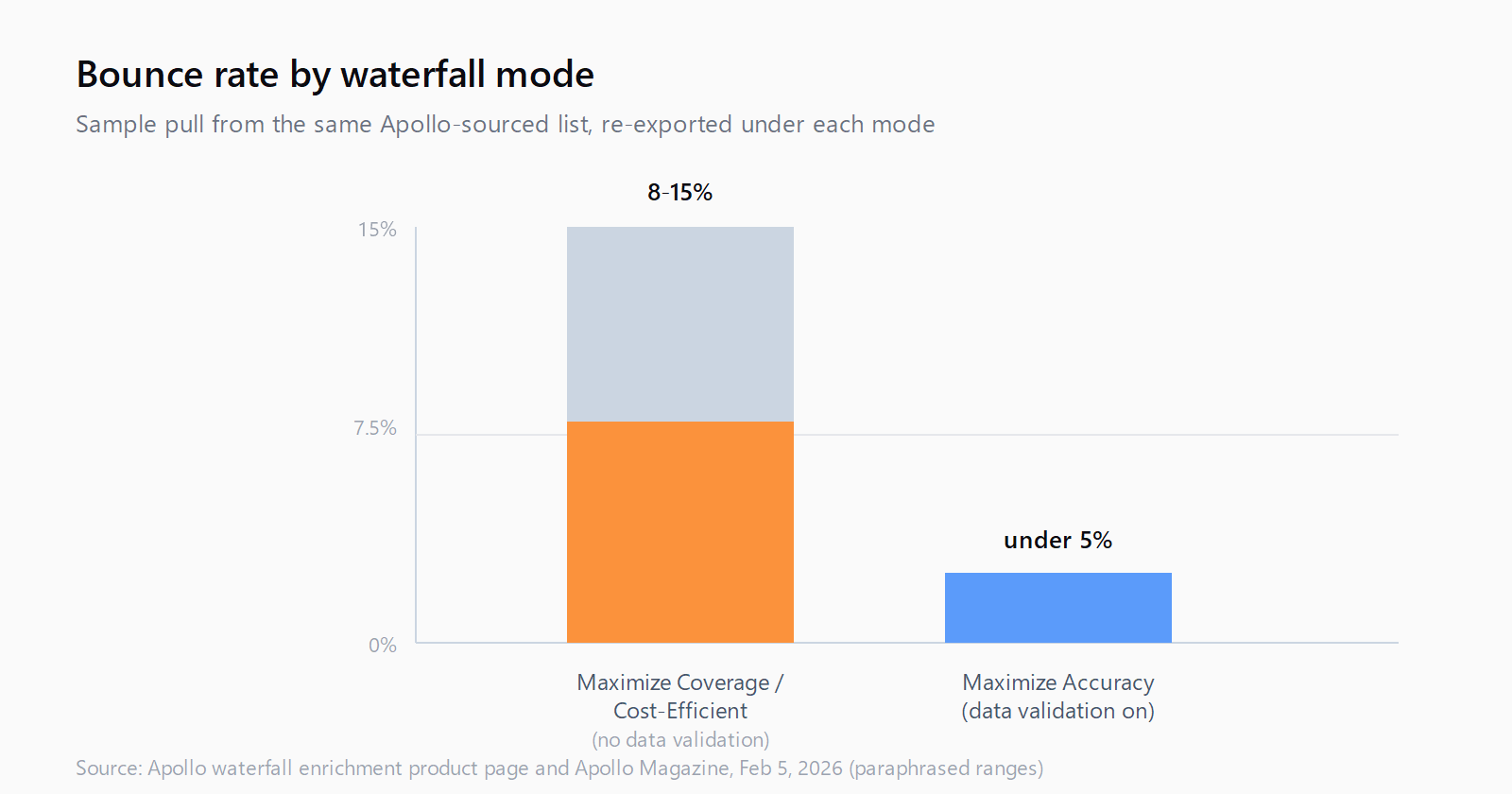
Apollo's own numbers make the gap explicit. The waterfall product page cites a 45% lower email bounce rate when the built-in data validator is enabled, based on two months of beta customer usage - the validator being exactly the toggle that Maximize Accuracy turns on and Maximize Coverage skips. Xier Dang, writing on the Apollo magazine on February 5, 2026, put a number on what "good" looks like once the fix is in place:
You should measure your bounce rate before implementing waterfall enrichment and then measure it monthly after implementation. You should see bounce rates drop to under 5 percent. Anything above 8 percent indicates either poor data validation or sources that are not refreshing frequently enough.
That 8% line is a useful gut check. If a sample pull from Apollo bounces in the 8-15% range, the workspace almost certainly has data validation off somewhere in the waterfall chain (I've seen teams assume Maximize Coverage is the "safe middle option" between accuracy and cost - it isn't; it's the coverage-first setting with no validation layer at all).
How to switch waterfall enrichment to Maximize Accuracy mode
The setting lives in the enrichment configuration panel, not in individual sequences, so it applies to every future export rather than needing to be toggled per list. Open the waterfall enrichment settings, find the mode selector, and switch it from Maximize Coverage or Cost-Efficient to Maximize Accuracy. This turns on the data validator Apollo's own bounce-rate figure is based on, and it costs additional credits per contact - Apollo is explicit that validation is the expensive step, which is exactly why it's not the default for every workspace.
Separately from the mode itself, confirm the Data Validation toggle inside waterfall settings is on. Apollo's Use Waterfall Enrichment documentation describes this as testing candidate emails across the connected providers before the record is returned to your list - it's the mechanism, Maximize Accuracy is the mode that turns it on by default for every waterfall run.
How to segment catch-all domains before you send
Maximize Accuracy fixes most of the gap, but not all of it. Catch-all domains - mail servers configured to accept any address at the domain, valid or not - pass SMTP-level validation even when the specific mailbox doesn't exist, so no waterfall mode catches every one of them. The workaround is operational, not a setting: tag contacts on catch-all domains during enrichment and route them into a separate, lower-volume sending campaign rather than mixing them into the main sequence.
This matters because a catch-all contact that turns out to be dead still counts as a bounce against your sending domain's reputation, and reputation damage from a small catch-all segment can outweigh the reply-rate upside of including those contacts at all. Segmenting them means a bad guess costs you a handful of sends on an isolated domain, not a reputation hit across your whole outbound program.
How to confirm the fix worked
Pull a fresh sample - Apollo's guidance above suggests treating the pre-fix number as a baseline and re-checking monthly - and compare bounce rate on the new export against the old one. If the new list is still landing above 8%, check three things in order: that Maximize Accuracy is actually saved (workspace-level settings sometimes revert on re-authentication), that the Data Validation toggle wasn't left off inside a specific saved search or export template, and that catch-all domains from the new pull are being routed to the segmented campaign rather than the main one. Teams that skip the third check are usually the ones who report "I turned on accuracy mode and bounces didn't move" - the mode fixes unverifiable addresses, not catch-all ambiguity.
We think about this constantly at Leadex, because Leadex sits at the same seam Apollo's waterfall system does - discovery on one side, enrichment on the other - just routed through your own connected providers instead of a proprietary database. When Leadex enriches a batch through a connected Apollo key, the accuracy-versus-coverage tradeoff is still yours to set inside Apollo; Leadex doesn't add a second enrichment layer on top, it just moves the researched company and contact rows into the pipeline in the same "typically under 60 seconds" per batch it always runs on, and lets your existing verification settings do the same job they'd do on any other export.
The counter-argument is credits. Maximize Accuracy costs more per contact than Maximize Coverage, and for a low-stakes segment - a cold list you're testing for fit, not a target-account list you're about to hand-write outreach for - the extra spend might not be worth it. The reasonable middle ground isn't "always run accuracy mode," it's running it on lists that are actually going to be sent, and treating anything pulled on Coverage or Cost-Efficient mode as a draft that needs a validation pass before it touches a sending domain. Teams already running a Clay waterfall for the same enrichment job will recognize the tradeoff - it's the identical accuracy-versus-credit-burn decision, just made inside a different vendor's settings panel.
One more thing worth flagging: switching modes doesn't retroactively fix a list you already exported. If a sequence built from a Coverage-mode pull is already live and bouncing, the fix is a re-export on Accuracy mode, not a setting change mid-sequence - Apollo doesn't re-validate rows that already left the enrichment pipeline.
FAQ
What's the difference between Apollo's Maximize Accuracy and Maximize Coverage waterfall modes?
Maximize Accuracy turns on Apollo's built-in data validator, which tests candidate emails and phone numbers before returning them, at the cost of more credits per contact. Maximize Coverage adds more data providers to the waterfall chain to fill in more rows, but skips validation entirely, so it fills more fields with less certainty they're correct.
What bounce rate should I expect after switching to Maximize Accuracy mode?
Apollo's own guidance puts the target under 5%, with anything above 8% signaling either a validation setting that's still off somewhere or a source in the waterfall chain that isn't refreshing frequently enough to catch churned addresses.
Does Maximize Accuracy mode catch catch-all domain addresses?
Not reliably. Catch-all mail servers accept any address at the domain, so SMTP-level validation can't distinguish a real mailbox from a nonexistent one. Segmenting catch-all contacts into a separate, lower-volume campaign is the workaround, not a waterfall setting.
Do I need to re-export a list that's already bouncing to fix it with Maximize Accuracy?
Yes. Switching the waterfall mode only changes future enrichment runs. A list already exported under Maximize Coverage or Cost-Efficient mode needs a fresh export under Maximize Accuracy to get the validated addresses.
Is Maximize Accuracy mode worth the extra credit cost for every list?
Not necessarily. It's worth it for any list that's actually going to send from a real domain. For exploratory or fit-testing pulls that won't be sent, the credit cost may not be justified until the list is promoted to an active campaign.