HubSpot Spring 2026 Spotlight: AEO, Breeze Agents GA, and Smart Deal Progression Explained
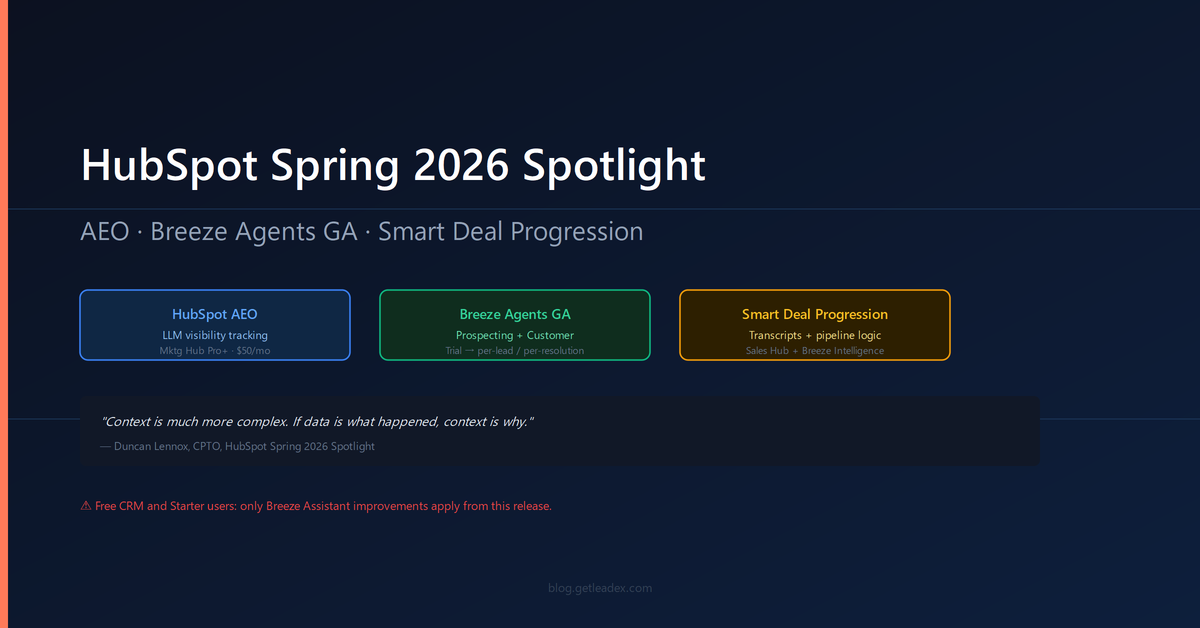
HubSpot's Spring 2026 Spotlight, published April 15, is the company's largest coordinated release in two years by feature count: 100+ updates across AI, marketing, sales, service, and platform, anchored by three headline products — Answer Engine Optimization (AEO), Breeze Agents moving from beta to general availability, and Smart Deal Progression. The feature volume is less interesting than the organizing principle. For the first time, HubSpot gave its releases a unifying concept instead of a category-by-category list, and that concept shapes which features matter and which are noise for a sales and marketing operator.
Context is much more complex. If data is what happened, context is why.
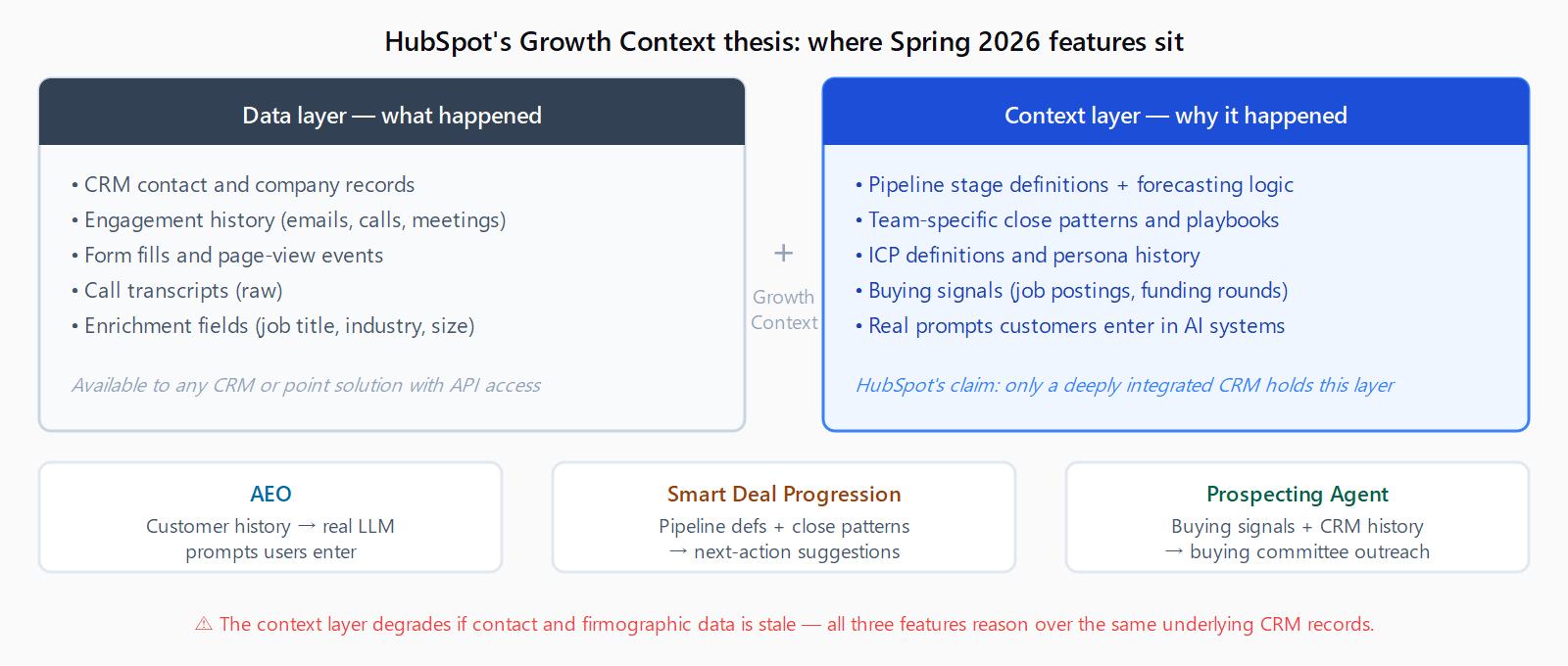
That is from CPTO Duncan Lennox's framing of "Growth Context" at the Spotlight launch. The argument is that the AI investment cycle has maxed out on data access — everyone has the same LLMs, everyone has API access to the same CRM records — and the next differentiation layer is contextual understanding: why a deal stalled, what a specific buyer's committee cares about, what made the last five closed-won deals move in the last 30 days. Growth Context is HubSpot's claim that a deeply integrated CRM knows more of that contextual layer than a bolt-on AI tool reading the same records from the outside. Whether the release delivers on that claim is the question worth examining feature by feature.
AEO is the most genuinely new category in the release. Answer Engine Optimization helps marketers track and improve their brand's visibility in AI-generated responses — ChatGPT, Gemini, Perplexity — rather than in traditional search engine results pages. The feature includes competitor benchmarking (how often a competitor's brand appears in LLM answers to the same prompts) and citation analysis (which sources the LLMs are pulling from when they mention your category). The differentiator HubSpot is leaning on is that AEO uses customer data — form fills, conversation history, CRM behavioral signals — to generate the prompts that real users are likely entering in AI systems, rather than relying on keyword research designed for a different channel. At $50 per month standalone, or included with Marketing Hub Professional and Enterprise, AEO is priced at a point where it is a real line item for a demand generation team but not a serious budget discussion. The tier split is the important callout: free CRM users and Starter-tier customers get no AEO access. If your HubSpot footprint is Sales Hub Starter and Smart CRM, the Spring Spotlight largely does not apply to you.
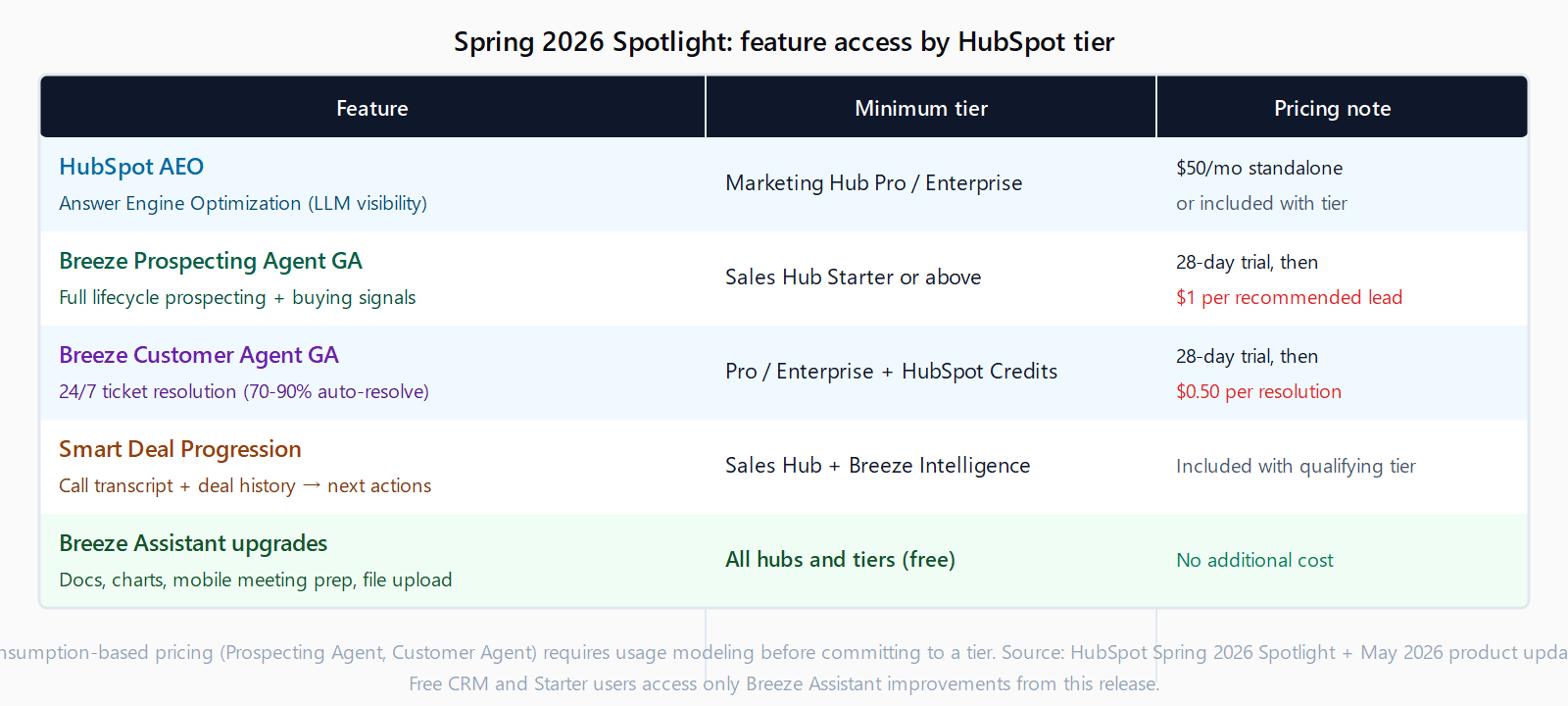
Breeze Agents — specifically the Prospecting Agent and the Customer Agent — moved to general availability at the Spotlight launch after what HubSpot described as a 28-day trial period before billing activates. Prospecting Agent bills at $1 per recommended lead after the trial; Customer Agent bills at $0.50 per resolved conversation. The pricing model is meaningful because it adds a consumption layer on top of seat fees, similar to what Outreach is doing with its Amplify plans and AI credit model. For teams that were evaluating Breeze Agents in beta under the assumption that the feature was bundled with an existing hub seat, the GA pricing requires a fresh budget estimate. The May 2026 updates added practical workflow improvements: company recommendations surfaced in the Prospecting Agent daily digest (the agent identifies buying signals — job postings, funding rounds — and surfaces the company alongside suggested contacts each morning), and the ability to enroll contacts into the Prospecting Agent directly from Gmail and Outlook without switching to HubSpot. The latter closes a workflow gap that field reps frequently hit. For teams already navigating Prospecting Agent ICP configuration after the GA rollout, the enrollment-from-inbox feature is the most practically useful of the May additions. For a deeper look at how the different Breeze products map to seat and tier requirements, see the Breeze Agents tier and seat requirements breakdown.
Smart Deal Progression is HubSpot's direct answer to Gong and Chorus. The feature analyzes call transcripts alongside full deal history — pipeline stage, forecasting category, engagement history, team-specific execution patterns — and surfaces recommended CRM updates, follow-up email drafts, and action items after each call. The difference from a standalone conversation intelligence tool is the same as the Omni argument from Outreach: embeddedness. Smart Deal Progression reads your pipeline definitions, not just the transcript, so the suggested next action reflects where in the funnel the deal sits and what your team's historical close patterns look like for a deal at this stage. It is the contextual layer Lennox described: not just "here is what was said" but "here is what to do next given everything the CRM knows about this account." The autonomous AI SDR limitations documented in early 2026 — disconnection from the system of record, hallucinated context, inability to audit what the agent actually sent — are exactly what Smart Deal Progression claims to fix by staying inside the CRM rather than running in a separate tool.
The pattern across AEO, Breeze Agents GA, and Smart Deal Progression is the same bet that Outreach made with Omni and that Salesforce is making with Einstein: native, governed, system-of-record AI beats best-of-breed point solutions at renewal time because it already has the context. HubSpot's structural argument is stronger than it might appear. The Spring Spotlight included 100+ updates across nearly every part of the platform — Breeze Assistant improvements (document creation, data visualization, mobile meeting prep), TikTok lead syncing graduating from beta, CRM cleanup automation at Enterprise, multi-asset campaign association — and the cumulative effect is that the switching cost of moving off HubSpot is rising with every release cycle, independent of the AI features specifically. The network effect of a platform that knows your email patterns, your call transcripts, your deal history, your ICP definitions, and your enrichment data is real. The question is whether the AI features unlock that context effectively or whether they remain premium-tier additions that most customers never configure correctly.
The tier architecture is where that question gets practical. AEO requires Marketing Hub Professional or Enterprise. Customer Agent requires Professional or Enterprise plus credits. Smart Deal Progression requires Sales Hub with Breeze Intelligence — call transcript analysis at this fidelity is not a feature bundled with Starter. The Breeze Assistant improvements (document creation, mobile meeting prep, data visualization, custom code workflow generation) are the one broad exception: those rolled out across all hubs and tiers in May. If your team is on a HubSpot Starter or free tier and the Spring Spotlight announcement generated internal interest, the honest audit is that Breeze Assistant is what you got, and everything else is a pitch for an upgrade. The consumption model on top of the upgrade makes the total cost harder to forecast. Breeze Agents pricing at $1 per recommended lead and $0.50 per resolved conversation is transparent at the unit level and opaque at the annual level until you model your expected lead volume and ticket count against the credit tier. That modeling is the step most teams skip, and the Outreach experience with Amplify suggests it becomes a CFO conversation six months into the contract when the consumption numbers come in above the budget estimate.
The data layer is where the Growth Context thesis either holds or falls apart. Smart Deal Progression, Prospecting Agent, and AEO all reason over the data already in HubSpot — contact records, engagement history, firmographic fields, enrichment signals. If those inputs are stale or sparse, the contextual output degrades accordingly. HubSpot shipped a Data Studio enrichment update in May that makes contact and company data enrichment a first-class action inside the Report builder, and auto-generate field mapping suggestions for external data syncs. But none of that solves the problem of contact-level job title and firmographic freshness at the rate that a continuous enrichment pipeline does. For teams that want to bring their own provider data into HubSpot without routing every lookup through HubSpot's credit system, Leadex handles BYOK enrichment at the provider level — keeping that cost outside the HubSpot consumption model while keeping the contact records current enough for the AI features to reason over accurately. The Spring Spotlight features are real and in some cases genuinely differentiated. They work at the quality of the data they read from.