
HubSpot Breeze Copilot vs Agents vs Intelligence: Tier-to-Bottleneck Map
HubSpot's Breeze splits into three products at three price gates. Here's the map of which tier solves which bottleneck so you don't buy the bundle by accident.
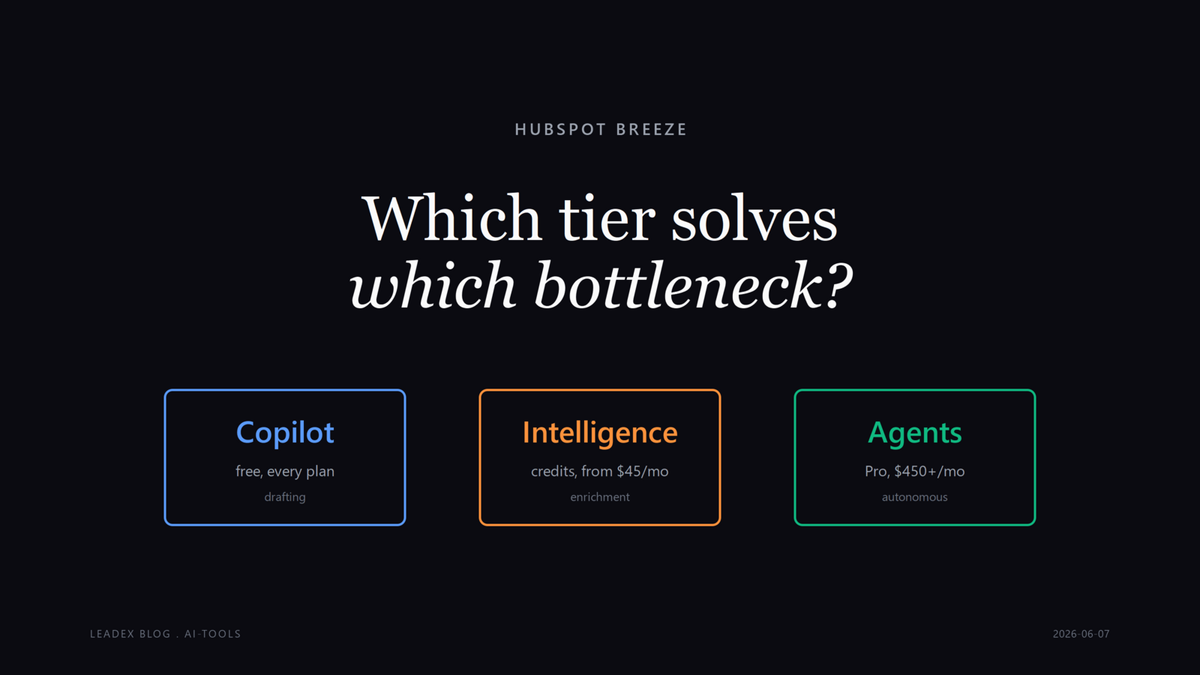
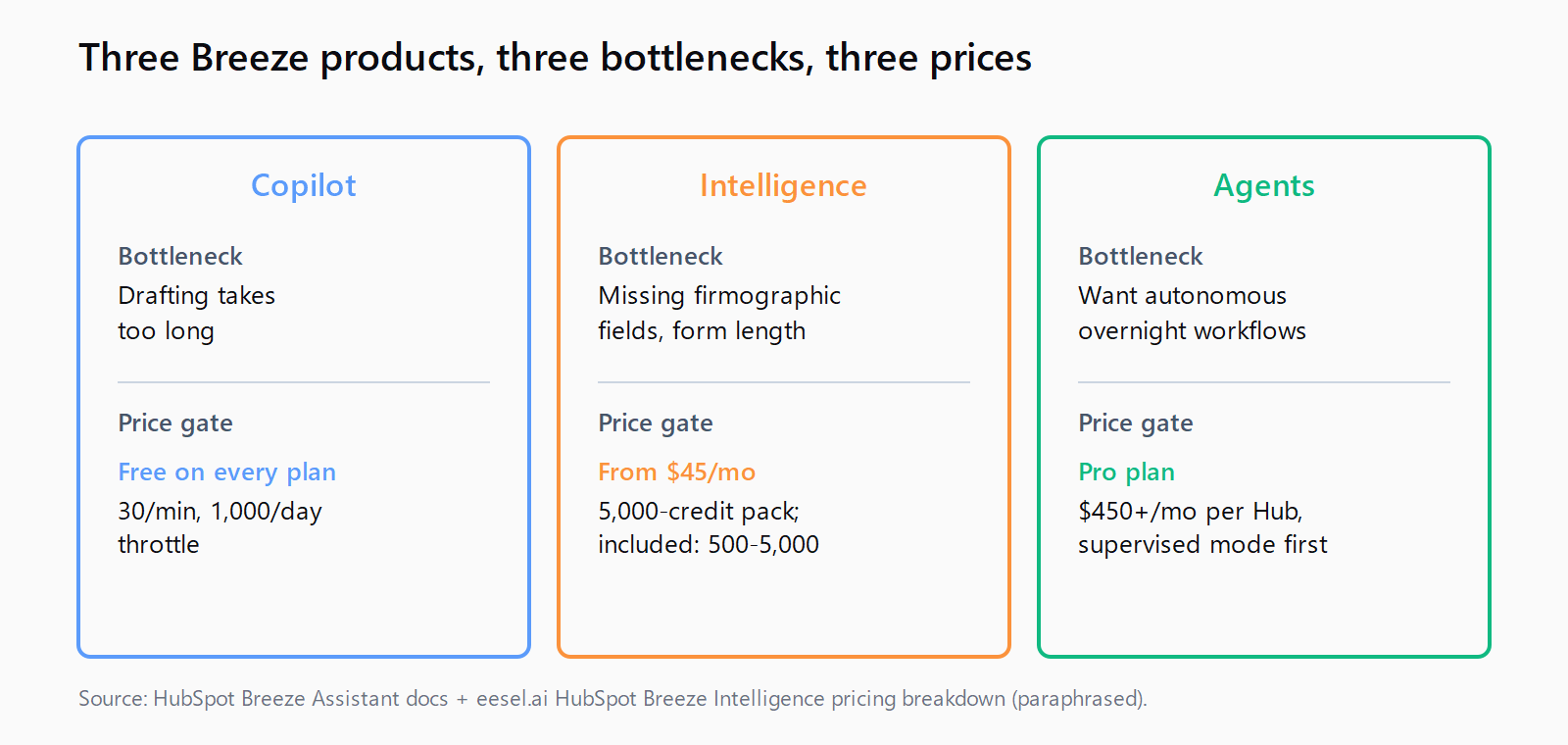
HubSpot's Breeze line is three products with three different price gates, and the most common buying mistake I see is teams asking "should we upgrade for Breeze?" without realizing they're asking about three separate purchases. Breeze Copilot (formerly Breeze Assistant) is the conversational AI inside the CRM, available on every plan including Free. Breeze Intelligence is the data-enrichment surface built on the Clearbit acquisition, priced in credit packs starting around $45 per month for 5,000 credits. Breeze Agents - the Prospecting Agent, the Content Agent, the Customer Agent - are autonomous workflow products gated to Professional plans at $450+ per month. Three completely different things.
This post is the tier-to-bottleneck map I wish HubSpot's own pricing page showed. If your problem is "drafting an email faster," you do not need to upgrade. If your problem is "filling in missing firmographic fields on 4,000 contacts," you need credits and not seats. If your problem is "having an autonomous agent draft outreach overnight," you need a Pro license. I'll walk through each tier, what it actually covers, where it falls short, and the audit move that keeps you from buying the wrong one. The companion piece on auditing Breeze Prospecting Agent drafts is the next stop once you've decided Agents are worth it.
What Breeze Copilot actually does (free)
Breeze Copilot - HubSpot still calls it Breeze Assistant in the help center, the rename is gradual - is the conversational AI panel that sits inside every HubSpot view. It drafts emails, generates blog post outlines, creates quotes and products, summarizes records, lists records matching ad-hoc criteria, and can research companies and competitors from inside the chat. From HubSpot's own documentation:
"Breeze Assistant is a conversational assistant that supports sales, marketing, and service teams in HubSpot." [...] "Breeze Assistant content generation is limited to 30 times each minute and 1,000 times each day."
The important thing here is the second sentence (!). Copilot is not metered by seat, by credit, or by request count - it's metered by the 30-per-minute and 1,000-per-day throttle, which is generous enough that no individual contributor will hit it. HubSpot's "Use Breeze Assistant" docs list it as available on "All products and plans" with a note about feature-gated exceptions. Translation: if your team is on the Free tier, Copilot is already turned on, and a sales rep can use it to draft a personalized email in chat without your CFO seeing a line item. This is the tier most teams already have access to and don't use, which is a different problem.
What Copilot is not: a research agent, a workflow runner, or a database. It cannot pull a list of "Series A fintechs in France whose Head of Engineering posted about hiring in the last 90 days" - that's an open-web research task, not a CRM query. It cannot fill in a missing "employee count" field on 4,000 records. And it cannot run overnight, because it requires a human in the chat to drive it. Those are the gaps the other two tiers exist to fill.
What Breeze Intelligence covers (the Clearbit inheritance)
Breeze Intelligence is what HubSpot built after the Clearbit acquisition. It runs automated data enrichment on contacts and companies, tracks buyer intent, and powers the "form shortening" feature that lets visitors fill out fewer fields because Intelligence backfills the rest from the Clearbit-derived dataset. It is metered in credits, and that's where the buying decisions get noisy.
The eesel.ai pricing breakdown documents the included credit allocations: Starter gets 500 credits per month, Professional gets 3,000, Enterprise gets 5,000. Above that, top-up packs run from "5,000 credits/mo: $45/mo" up to "100,000 credits/mo: $900/mo." Credits reset monthly. There's an auto-upgrade flag turned on by default - HubSpot calls it a service-continuity feature, the practitioner read is that it's a billing trip wire if your usage spikes unexpectedly. Watch the auto-upgrade toggle on day one.
One credit equals one enrichment of one contact or company record - so 3,000 credits is enough to enrich about 3,000 records per month if you spend them cleanly, or far fewer if you re-enrich the same records on every form submission. Most teams I talk to underspend their included credits and then panic-buy a 5,000-pack the month they actually need to enrich a list. The correct move is the opposite: spend the included credits proactively on the records that matter, and treat the pack purchase as the rare event. The data-freshness audit pattern applies the same way it does for ZoomInfo - the enrichment is only as good as the recency of the underlying dataset.
What Breeze Agents actually do (and what plan you need)
Breeze Agents are the autonomous-workflow products: Prospecting Agent that drafts outreach overnight against your ICP, Content Agent that drafts campaigns, Customer Agent that handles support tickets, and a growing roster of others. The defining feature is that they run without a human in the chat. They are also the most expensive tier - gated to HubSpot Professional plans, which start around $450/month per Hub.
This is also the tier where the "supervised mode" guidance matters most. Agents draft work into review queues; a human approves, edits, or rejects each item. Run them in supervised mode for the first 30 days no matter how confident the vendor's onboarding rep sounds. Review the audit cards (HubSpot's audit-trail UI for agent actions) weekly. Only flip to autonomous mode on the workflows where the approval rate is above 90% across 200+ items - because the failure modes of an unsupervised agent are not "produces lower-quality work," they're "produces lower-quality work at full speed and emails 4,000 contacts before anyone notices."
The tier-to-bottleneck map
The buying decision is one question: what specifically is broken right now?
If the answer is "writing things takes too long" - emails, follow-ups, blog drafts, summaries - you already have Copilot, and the upgrade conversation is not about Breeze. It's about training the team to use the Copilot panel they currently ignore. If the answer is "we have 4,000 contacts with blank employee-count and revenue fields" or "we want forms to be shorter without losing data," you need Intelligence credits, not seats. Start with the included tier allocation, audit credit burn for 30 days, then size the top-up pack against actual usage rather than HubSpot's recommended starting point. If the answer is "we want an AI to draft outreach against our ICP without an SDR in the loop," you need Professional plans plus Prospecting Agent - and you also need a review queue discipline you probably don't have yet.
The trap is teams who buy all three tiers because the sales motion bundles them. Buying all three means paying for capacity you do not have the workflow maturity to use. Pick the dominant bottleneck, buy the tier that solves it, and revisit in six months once you have actual usage data.
Where Leadex sits relative to Breeze
Breeze Intelligence is excellent at filling firmographic gaps on records already in HubSpot. It is not designed to discover the records in the first place against an unstructured ICP that the Clearbit-derived dataset doesn't categorize. That's the upstream gap Leadex closes. Describe the ICP in plain English in chat ("Series A fintechs in France whose Head of Engineering posted about hiring in the last 90 days"), the agent browses the open web, dedupes, enriches via your connected Apollo or HubSpot key, and pushes the result back into HubSpot - "company enrichment typically completes in under 60 seconds" per batch. Once the records land in HubSpot, Breeze Intelligence runs second-pass enrichment on the fields the open-web research couldn't fill. The two products sit on the same pipeline; they're not substitutes.
FAQ
Is Breeze Copilot really free?
Yes, on every HubSpot plan including the Free tier. The throttle is 30 generations per minute and 1,000 per day per user, which is more than enough for a typical individual contributor. Feature-gating exists on certain advanced capabilities (image generation in marketing materials, for instance) but the core conversational interface ships on Free.
How much does Breeze Intelligence cost on top of HubSpot?
Included allocations: 500 credits/month on Starter, 3,000 on Professional, 5,000 on Enterprise. Top-up packs start at "5,000 credits/mo: $45/mo" and scale to "100,000 credits/mo: $900/mo." One credit equals one enrichment. Credits reset monthly and do not roll over.
What's the difference between Breeze Copilot and Breeze Agents?
Copilot is interactive - a human asks, Copilot drafts, the human edits. Agents are autonomous - they run on a schedule or trigger, do work into a review queue, and the human reviews after the fact. Copilot is on every plan; Agents require Professional ($450+/mo per Hub).
Should I turn off Breeze Intelligence auto-upgrade?
Probably yes, at least for the first 60 days. Auto-upgrade is HubSpot's default to prevent service interruptions when credit usage spikes, but it also means you can land a surprise invoice if a single bad import burns through your included allocation. Turn it off, watch credit burn for two months, then make a deliberate decision about whether to flip it back on.
Do I need Breeze Agents if I already have an SDR?
It depends on whether your SDR is bottlenecked on writing or on volume. If they spend most of their day in HubSpot drafting outreach manually, Prospecting Agent in supervised mode can multiply their output. If they're already automated and the bottleneck is list quality, Agents will multiply the noise rather than fix it - build the list first.