
How to Use Apollo's Email Verification Tiers to Keep Sequence Bounce Rate Below 3%
Apollo bounces above 3% trigger spam penalties within a week. Filter sequences to Verified + Likely to engage; route Risky through a second-pass verifier.
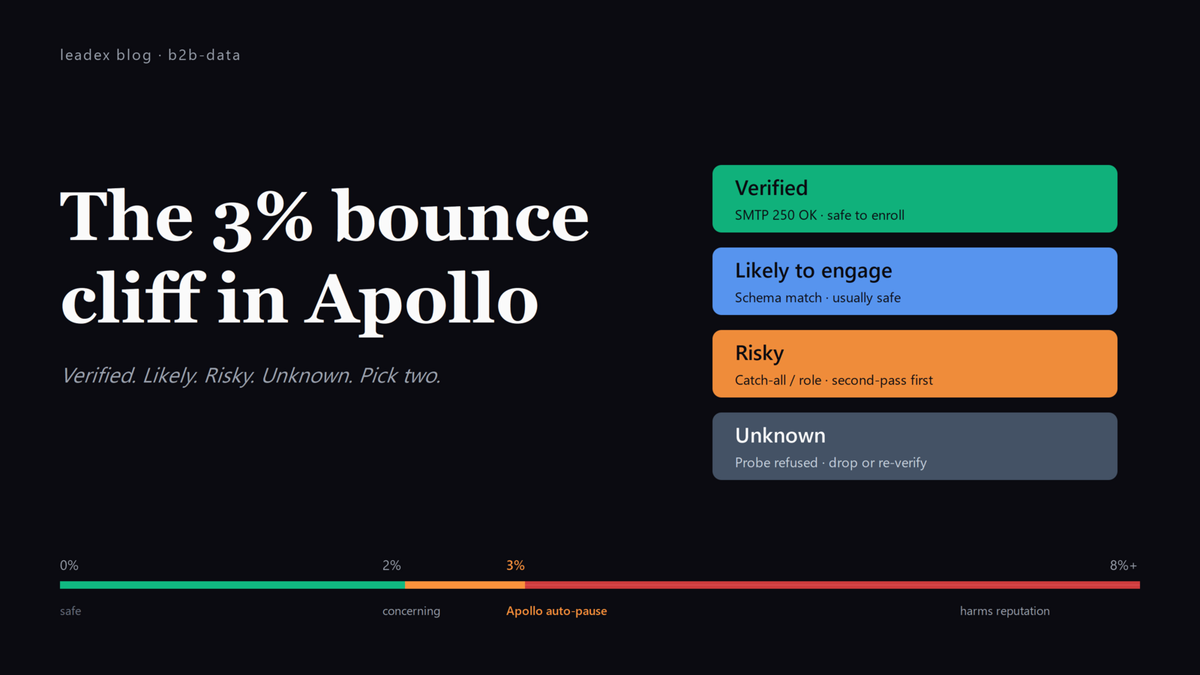
If a cold sequence in Apollo crosses 3% bounces, Gmail and Outlook quietly start scoring future sends as suspicious within the same week. The single biggest lever for staying under that line is the four-letter status Apollo stamps on every contact - Verified, Likely to engage, Risky, Unknown - and the depressing fact that most teams enroll all four without filtering.
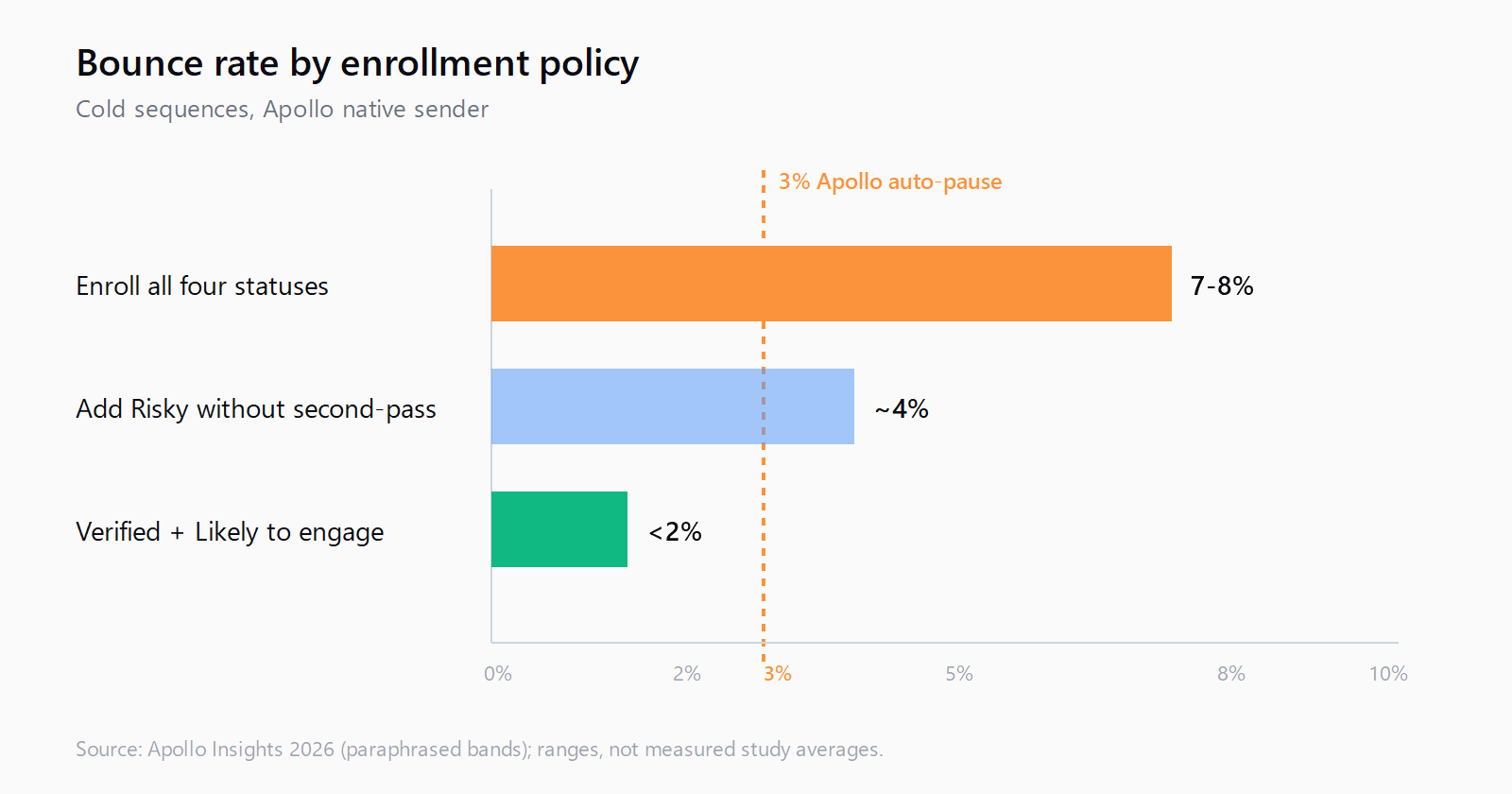
Apollo's own Email Deliverability Best Practices article lays this out plainly, as does the 2026 Apollo Insights piece on bouncing. The Insights post puts numbers on it: "a bounce rate above 2% is concerning and above 5% actively harms sender reputation". The 3% threshold sits in the middle - Apollo's automated bounce alerts default to it, and that's the line where the spam-filter penalties engage. Cold campaigns sent without filtering average 7-8%, which is to say: well past the harm line, on day one.
Run email verification on every new list before loading it into sequences. [...] Any contact list older than 60 days should be re-verified. Business email addresses experienced a 3.6% decay rate in a single month (November 2024) - far above the traditional 1.5-2.0% monthly baseline.
Re-verify every 60 days is the part most teams skip. A list built in March, enrolled in May, will silently shed 7-8% of its addresses to job changes and domain churn before you notice. The Apollo status field is point-in-time; it's not a subscription to ongoing checking.
How Apollo's four verification tiers actually behave
The statuses map to confidence bands from Apollo's verification provider chain. Verified means the address responded to an SMTP probe with a 250 OK and didn't trip any catch-all heuristic - safe to send. Likely to engage means the address pattern matches a known schema for the domain and the domain itself accepts mail, but no live probe was confirmed - usually safe, occasionally bounces. Risky is the catch-all bucket: catch-all domains, role accounts (info@, sales@), addresses with mixed signals from the provider waterfall. Unknown means Apollo couldn't even classify - typically because the domain refused the probe or the address never got a real verification run.
The instinct is to send to all four because Apollo charges credits to discover them and you want the credits to count for something. The math doesn't work: enrolling Risky and Unknown contacts is the single largest driver of elevated bounce rates in Apollo sequences. If 30% of a 1,000-contact list is Risky and 10% is Unknown, you've baked in roughly 12-15% of those contacts bouncing - a 4-6% sequence-wide bounce rate before any other variable.
How to filter before enrollment, not after
The fix is to gate sequence enrollment on status at import time, not to clean up after Apollo's auto-pause fires. Inside Apollo's Search filters, the Email Status facet has the four values as a multi-select - default to Verified and Likely to engage only, save the search as a list, and route sequence enrollment from the list rather than from the raw search. Risky contacts stay in the database for future re-verification; Unknown contacts get either dropped or routed to a second-pass verifier (NeverBounce, ZeroBounce, Million Verifier) and only re-imported if the second pass returns Verified.
Apollo's bounce alerts, set in the sequence Settings panel, default to pausing at 3% cumulative bounce rate. Leave that default on. The alert is the safety net, not the strategy - if it fires, you've already shipped a few hundred bounces and the domain reputation hit is already on its way. The filter at enrollment is the actual control surface.
Apollo's documented behavior also includes a one-click unsubscribe header requirement for senders exceeding 5,000 messages per day from one domain, lifted from Gmail and Yahoo's February 2024 bulk-sender rules and Microsoft's May 2025 5.7.515 enforcement. Apollo's sequence settings have a checkbox for it; turn it on if your team is anywhere near the threshold. Failing to set the header doesn't bounce mail - it gets rejected with a 550, which counts as a bounce in Apollo's reporting and against your domain.
The counter-take: Risky often delivers, so why filter?
Some operators argue that a chunk of Risky addresses deliver fine - Apollo's catch-all classification is conservative because catch-all domains do return 250 OK to SMTP probes even for non-existent addresses, so Apollo defaults to caution. The argument goes: you're throwing away addressable pipeline by excluding Risky.
The argument is partially right and entirely beside the point. A Risky address that delivers still costs you no more than a Verified one; a Risky address that bounces costs you the whole domain's reputation for two weeks. The asymmetry is fatal. The right move isn't to enroll Risky directly through Apollo - it's to second-pass them through a verifier that actually probes the catch-all (some do, with varying ethics), and only enroll the ones the second pass returns clean. Apollo's mailbox is where you spend reputation; the second-pass verifier is where you spend dollars to protect it.
Where Leadex fits in the verification pipeline
This is exactly the seam between discovery and enrichment that Leadex was built for. The traditional flow - Sales Navigator finds the company, Apollo gives you the contacts, a verifier scrubs them, a sequencer fires - has four tools and four bills. Leadex collapses discovery, multi-source enrichment, and dedup into one chat-driven agent, then hands the cleaned list to your existing sequencer. The agent's plan preview shows which verification step ran on which contact set, with URLs and timestamps per row, so the bounce-rate post-mortem starts from auditable provenance rather than "Apollo said it was Likely to engage." The pattern looks similar to what we wrote about in staying under Gmail's spam-complaint ceiling inside Apollo - the same upstream-control principle, applied earlier in the pipeline.
The 60-day re-verification rule and why nobody runs it
The Apollo Insights number worth quoting again: 3.6% of business emails decayed in a single month in late 2024. Even if you front-load filtering by status, a list that sat in a saved search for 90 days has shed roughly 10% of its addresses to people changing jobs, companies rebranding email domains, and IT teams retiring shared inboxes. The status field doesn't update on its own - it reflects the verification that ran when the contact was last enriched.
The hygiene loop most teams skip: every 60 days, run the saved list back through Apollo's verification (or a second-pass verifier) and rebuild the segment. The cost is a few hundred credits; the upside is keeping the cumulative bounce rate inside the 3% Apollo alert band instead of crossing it from the bottom. We covered the broader version of this in auditing data freshness before a vendor renewal - same arithmetic, different vendor.
The kicker: Apollo's Search filter exposes a "Last Verified" field that almost nobody surfaces. Sort the saved list by it descending, and you'll find the bottom decile is contacts last verified more than 180 days ago. Those are the ones bouncing your sequence. If you're not filtering by Email Status at enrollment, you're at least filtering by recency - and if you're not filtering by either, the 3% line will find you faster than your domain admin's vacation calendar.
FAQ
What is a safe bounce rate for Apollo sequences in 2026?
Under 3% cumulative is the practical ceiling. Apollo's own bounce-alert default fires at 3%, and Apollo Insights notes that anything above 2% is concerning while above 5% actively damages sender reputation. Most cold campaigns without filtering land at 7-8% - well past the harm line.
Should I send to Apollo "Risky" status contacts?
Not directly through Apollo's sequencer. Risky often contains catch-all domains and role accounts; running them through a second-pass verifier like NeverBounce or ZeroBounce and only enrolling the ones that come back clean is the right pattern. The reputation hit from one bad batch lasts weeks; the verifier costs cents per address.
How often should I re-verify an Apollo contact list?
Every 60 days, per Apollo's deliverability guidance. Business email addresses decayed at 3.6% per month in late 2024 - a list aged 90 days has typically lost 10% of its delivery surface to job changes and domain churn.
Does Apollo automatically pause sequences when bounce rate gets too high?
Yes, if you leave the default alert on. The setting lives under sequence Settings and defaults to a 3% cumulative threshold. Treat the auto-pause as a safety net, not a strategy - by the time it fires, the reputation damage is already in motion. The real control is filtering at enrollment.
What's the difference between Apollo's Verified and Likely to engage statuses?
Verified means a live SMTP probe returned a 250 OK with no catch-all flag. Likely to engage means the address matches a known schema for the domain and the domain accepts mail, but the live probe wasn't confirmed (often because the provider refused it). Both are safe to enroll; the gap is confidence, not deliverability.