
How to Stay Under Gmail's 0.3% Spam Complaint Ceiling on Apollo Sequences After Bulk-Sender Enforcement
Gmail's 0.3% spam-complaint ceiling moved from soft throttle to permanent reject in Nov 2025. Apollo doesn't enforce the operational guardrails - here are the four thresholds to set manually, the daily Postmaster check, and the one upstream fix that matters more than any in-sequence knob.
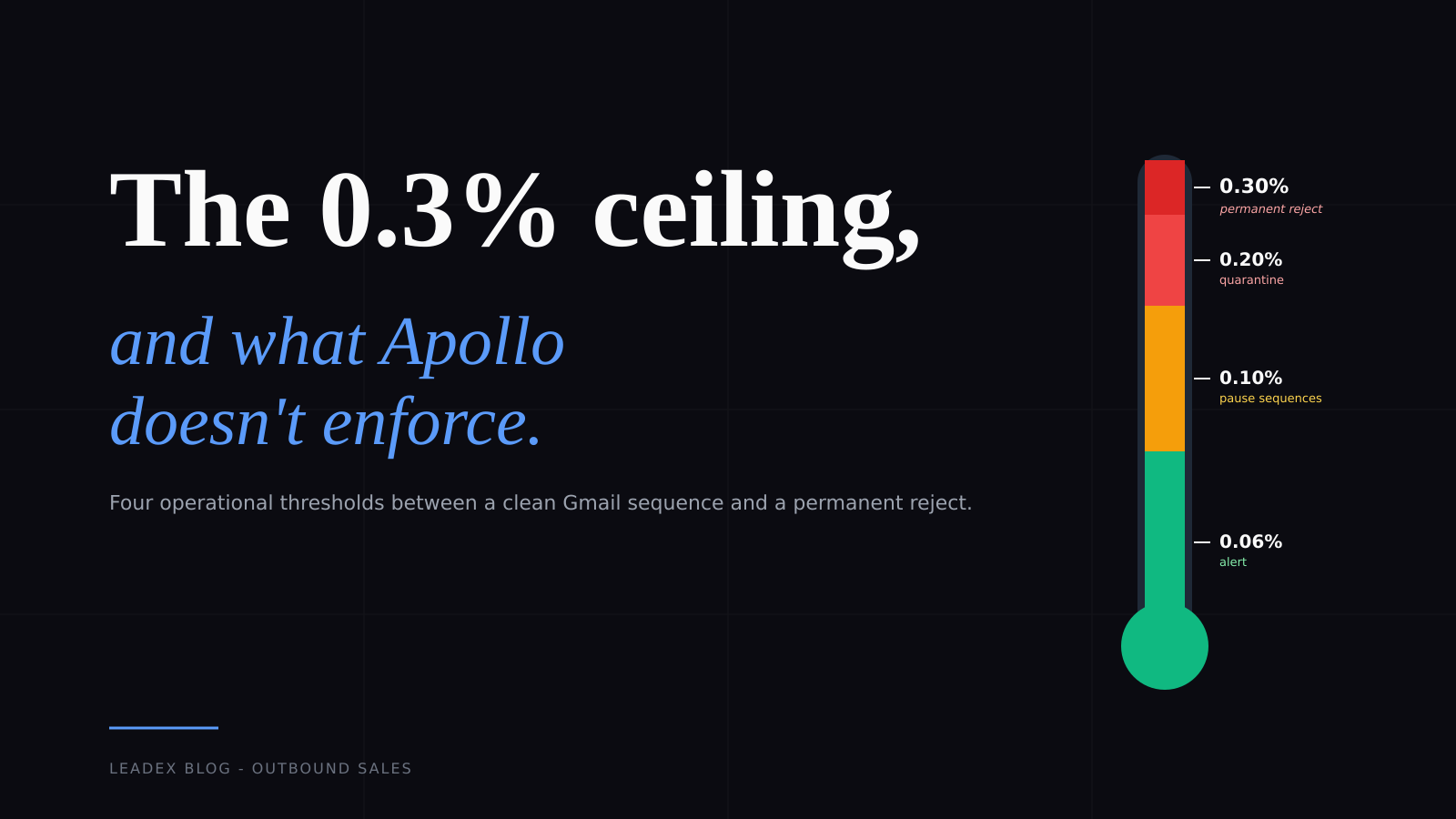
Since Gmail's bulk-sender requirements went live in February 2024, the 0.3% spam-complaint ceiling has been the line every cold-email operator was technically supposed to stay under. In practice, through 2024 and most of 2025, crossing it meant a soft throttle - your reply rate quietly dropped, your domain reputation degraded over weeks, and you usually noticed only when someone audited the pipeline. In November 2025 that changed. Gmail switched from soft throttle to permanent 5.7.x rejection - your messages bounce, full stop, the moment Postmaster Tools logs a "Fail" on Compliance Status.
Apollo's sequence defaults don't enforce the operational guardrails that keep you under the ceiling. The tool will warn you when your complaint rate climbs, but the warning fires after deliverability has already collapsed - it's a smoke alarm, not a circuit breaker. Below is the set of settings to change inside Apollo, the daily Postmaster Tools check that catches the trend early, and the one upstream fix that matters more than any of the in-sequence knobs.
What the 0.3% ceiling actually means in 2026
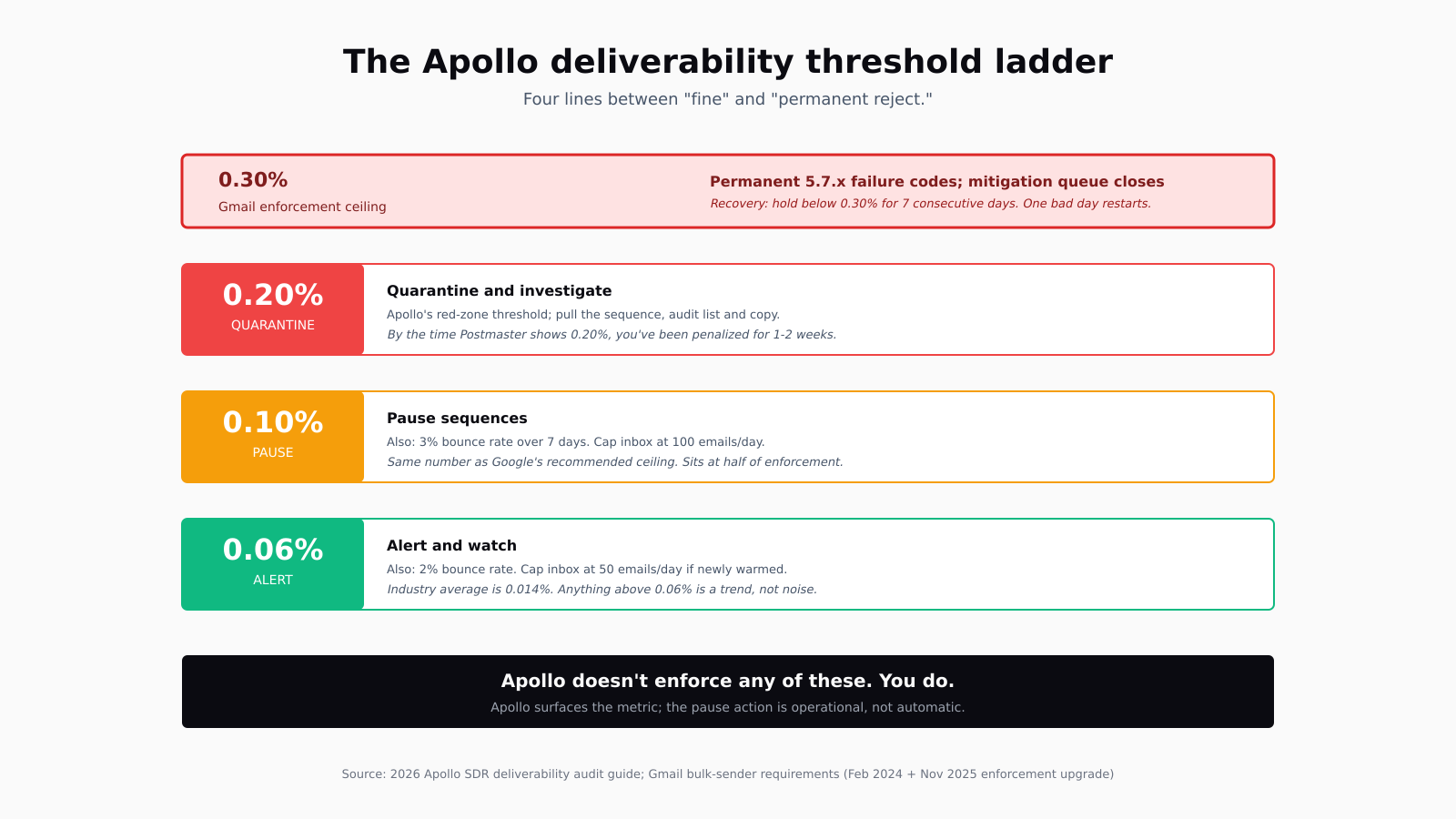
Two numbers, both important. The first is 0.1% - Google's recommended maximum complaint rate, the speed limit. The second is 0.3% - the enforcement threshold where the engine cuts out. Between them you're driving on a warning; above the second one, your mail starts getting permanent failures with 5.7.x codes, and Gmail's mitigation queue closes to you until you maintain rates below 0.3% for seven consecutive days. One bad day resets the clock.
Yahoo applies the same 0.3% headline number but calculates the denominator differently - emails delivered to inbox, not total delivered - which means the same sending behavior shows a higher complaint rate in Yahoo Sender Hub than in Gmail Postmaster. Microsoft hasn't published a specific number but reserves the right to take "negative action" for authentication or hygiene breaches, so the operational answer is: treat 0.3% as the ceiling everywhere. Industry averages sit at 0.014%; Mailgun's internal AUP cuts senders off at 0.08%. The legitimate-B2B sequence almost never goes near 0.1% on its own - the rates that cross into the danger zone are usually a symptom of bad list quality, not bad copy.
Apollo's defaults don't enforce the guardrails - set these manually
Apollo's own deliverability team, in their 2026 audit guide for SDR teams, names a four-tier control system. None of these are on by default in a new Apollo sequence; you have to wire them in yourself.
Per-inbox daily cap of 50-100 emails. New or recently-warmed domains stay at 50 and step up over four weeks; established domains with clean DMARC history can run 100. Anything above that on a single inbox compounds spam risk because volume spikes themselves degrade reputation. Apollo's mailbox-level send setting is per-account, not per-sequence - the trap is launching three sequences against the same inbox without subtracting the overlap.
Bounce-rate auto-pause at 3% over a rolling 7-day window. Apollo will not pause a sequence automatically when bounces climb; the rule has to be operational. Pull a daily bounce report from the Apollo dashboard, and if any sequence crosses 3%, pause and audit the list before resuming. Above 5% you're already getting downgraded by every inbox provider.
Spam-complaint tiers from Apollo's own guide: alert at 0.06%, pause sequences at 0.10%, quarantine and investigate at 0.20%. The pause threshold sits twice as low as Google's recommended ceiling - that's deliberate. By the time Postmaster Tools shows 0.20% you've already been deliverability-penalized for a week or two; the corrective action lags the signal. Setting the pause at 0.10% restores the margin.
List verification before sequence activation. Hard bounces are a deliverability tax you pay for every invalid address that should have been caught upstream. Apollo's built-in verifier catches the obvious ones; for cold lists pulled from a third-party database, run a second pass through a dedicated verifier before the sequence ever sends. The same logic applies if you've been auditing AI-generated outbound drafts before they send - the verifier catches the addresses the AI agent invented or merged incorrectly.
The Postmaster Tools check that catches the trend early
Once a day, ten minutes. Pull Domain Reputation, IP Reputation, Spam Rate, Authentication, and Delivery Errors from Google Postmaster Tools, and the equivalent panes from Yahoo Sender Hub Insights (launched October 2025) and Microsoft SNDS. The trend you're watching for is not the daily number - daily numbers bounce around at low volume - but the seven-day moving average.
There's one paradox worth knowing about. As your reputation degrades, more of your mail gets auto-filtered to spam before recipients can see it, which means fewer recipients are in a position to mark it as spam manually. So your visible complaint rate can drop while your actual deliverability is getting worse. A declining complaint rate in Postmaster Tools paired with a declining inbox-placement rate is the textbook bad-trend signature - the spam rate looks like it's improving because nobody's reading the mail. Watch both panes together.
Yahoo's panel runs on a 24-48 hour data lag, so if you're sending to a Yahoo-heavy ICP, that's the window in which damage compounds invisibly. Pull the Sender Hub Insights number every morning, but treat anything sent in the last two days as not-yet-counted.
Authentication: the table-stakes that block enforcement
The Feb 2024 bulk-sender rules made three things mandatory: SPF, DKIM, and DMARC alignment to the From: domain, plus a one-click List-Unsubscribe header (RFC 8058 compliance, honored within two days). The November 2025 enforcement upgrade didn't add new requirements - it just turned the existing ones from advisory to hard-fail.
Two upgrades worth making now if you haven't already. First, advance your DMARC policy from p=none (monitoring only) to p=quarantine (untrusted mail goes to recipient spam folders, not yours). You can step to p=reject later, but quarantine is the floor for a 2026 cold-email operation - p=none is essentially "I'm aware I should publish DMARC" and inbox providers know that. Second, if you're running a high-volume sequence, split sends across separately-warmed sending domains. A single .com burning out blocks all your traffic; three rotated subdomains let one burn while the other two keep delivering, and the cost is one DNS update per subdomain at setup.
The upstream fix: list quality beats every in-sequence knob
The dirty secret of the 0.3% problem is that it's downstream of who's on the list. Practitioners consistently report that the difference between a sequence hitting 90%+ deliverability and one stuck at 70% is data quality, not copy or cadence - bad data is what fills the complaint-rate column. A list with 12% catch-all addresses, 4% role accounts, and a handful of spam traps will hit 0.3% no matter how clean your DMARC stack is, because the addresses themselves are wrong.
This is the seam where Leadex sits: every row produced by a Leadex research run includes a verified contact and a timestamped signal that explains why this person is on the list this week. The verifier knocks out the catch-all and spam-trap addresses before the sequence sees them; the signal column gives you the persona-anchored detail that keeps the email out of spam-complaint territory in the first place, the same one I argued for in Lavender's structural sub-scores. The Apollo guardrails above are necessary; a clean list is what makes them work.
If you're already running on Apollo and considering a switch, the Apollo alternatives ranked by use case piece walks through which tools surface per-mailbox sending data natively (so you're not building the dashboard yourself) and which don't. The 0.3% ceiling is the same everywhere; the visibility into it isn't.
FAQ
What spam complaint rate triggers Gmail to start blocking my Apollo sequence?
0.3% is the hard ceiling - cross it and Gmail returns permanent 5.7.x failure codes on messages, not just spam-folder routing. The recommended ceiling is 0.1%, and Apollo's own guide says pause sequences at 0.10% so you keep a margin before enforcement kicks in. Recovery requires holding the rate below 0.3% for seven consecutive days; one bad day restarts the clock.
Does Apollo automatically pause sequences when the spam rate climbs?
No. Apollo will warn you and surface the metric in dashboards, but the pause has to be an operational rule you enforce - check Postmaster Tools daily, and pause any sequence above 0.10% complaint rate or 3% bounce rate over a rolling 7-day window. The auto-pause behavior some operators expect from Apollo isn't there.
How many emails per day can a single Apollo inbox send safely?
50-100 per inbox per day in 2026, depending on domain age and DMARC history. New or recently-warmed domains start at 50 and step up over four weeks; established domains with a clean Postmaster Tools record can run 100. Above that on a single inbox you're stacking volume risk on top of complaint-rate risk, and the two compound.
Is the 0.3% rule different for cold email versus opt-in marketing email?
No. Gmail's bulk-sender requirements apply identically once a domain sends 5,000+ messages per day to personal Gmail accounts, and the classification doesn't reverse when you scale back. Cold email starts at a disadvantage because recipients didn't opt in, so the same threshold is harder to hold - which is why list quality matters more than copy quality.