
Gmail and Yahoo Now Permanently Reject Non-DMARC Bulk Mail (Nov 2025): What Cold Email Operators Have to Change
In November 2025, Gmail flipped bulk-sender enforcement from 4xx temporary deferrals to 5xx permanent rejection. What the new SMTP error codes mean, why p=none is no longer survivable, and the sharp counter-take on what authentication actually catches.
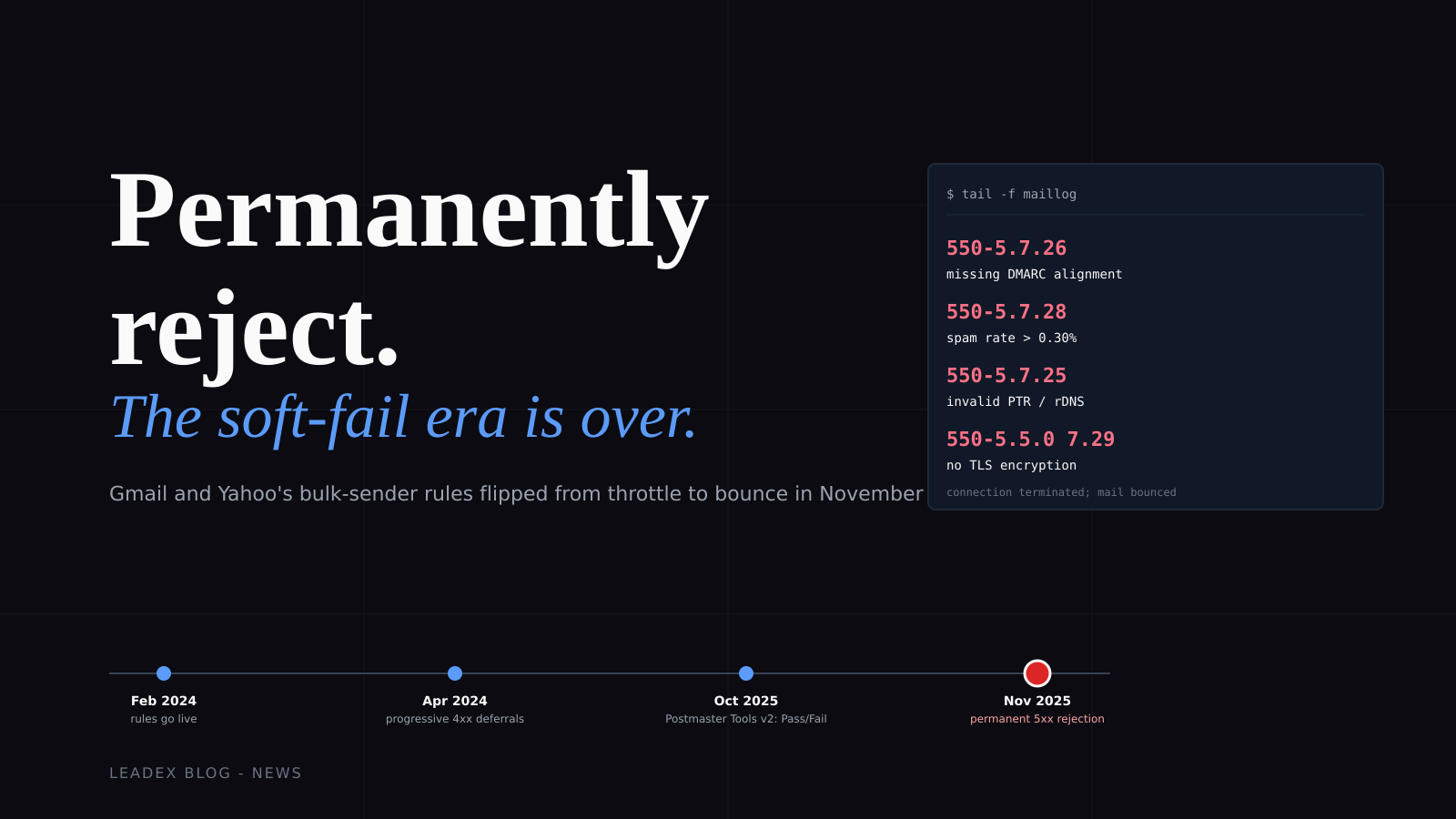
In November 2025, Gmail quietly flipped a switch that's been telegraphed for almost two years. The bulk-sender requirements that went into effect February 2024 - SPF, DKIM, DMARC alignment, one-click List-Unsubscribe, and a spam-complaint rate under 0.3% - had been enforced through 2024 and most of 2025 with 4xx temporary deferrals, which slow your mail down but don't kill it. Last month that became 5xx permanent rejection. Your mail server now gets a hard bounce with a specific code (5.7.26 for missing DMARC alignment, 5.7.28 for spam rate above 0.3%, 5.7.25 for invalid PTR, 5.5.0 7.29 for missing TLS) and Gmail does not retry, defer, or route to spam - it returns the message to your queue, full stop.
The 5000-message-per-day threshold for "bulk sender" is unchanged from the original 2024 announcement, but Yahoo has matched the upgrade and Microsoft pushed its own version of the same rules in May 2025 with error code 550 5.7.515. Apple is the last consumer-mail provider not currently enforcing at the SMTP level. The practical effect for anyone running a cold-email operation that sends to consumer inboxes - which is most B2B SDR work, because most B2B email addresses route to Gmail under the hood - is that the soft-fail era is over.
Messages that fail to meet the sender requirements will experience disruptions, including temporary and permanent rejections. [...] Compliance Status [in Postmaster Tools v2] uses binary evaluation - Pass or Fail. Previous "reputation scores" no longer provide protection.
That's PowerDMARC's distillation of the Gmail policy update, and the binary thing is the part that should make operators sit up. Through 2024 and 2025, Postmaster Tools showed a Domain Reputation gauge running from Bad to High, and you had room to drift around in the middle - a sender at "Medium" was technically non-compliant in places but still delivering. The October 2025 Postmaster Tools v2 rewrite replaced that gauge with a Pass/Fail Compliance Status panel, and if any of the underlying checks Fail, all of your mail is at risk on the next day's send. There's no longer a yellow zone you can operate inside.
The data Google published alongside the enforcement upgrade is striking. A two-year retrospective on the mandate reports 265 billion fewer unauthenticated emails reached Gmail in 2024 versus 2023 - a 65% decline - alongside a 35% reduction in holiday-season phishing year-over-year. 2.5 million domains newly implemented authentication in the first 60 days after enforcement began. By any measure of "did the policy work," the answer is yes; the mail that used to come from spoofed lookalike domains is mostly gone.
The counter-take is sharp, and it's worth holding alongside the headline numbers. Cloudflare's threat-intel analysis from earlier this year found that 89% of spam now blocked at the inbox carries valid SPF, DKIM, or DMARC credentials. Attackers adapted to the new floor by registering lookalike domains, configuring them with full authentication, and sending phish from them - the auth check passes because the auth is real; the sender is the problem, not the headers. (I believe) the honest read of the two-year data is that Gmail killed off the lowest 65% of trivially-detectable bad mail, which is a real win, but did not put a meaningful dent in the sophisticated half. "Authentication is necessary but insufficient" is the line that captures it. The policy is upstream from the actual signal you want, which is intent.
The second sharp edge is that the SPF/DKIM/DMARC stack catches a particular shape of attack - sender-domain spoofing - and is mostly silent on the shape attackers have moved to, which is account-takeover plus legitimate-ESP abuse. A compromised Mailchimp or HubSpot account sending phish through a properly-warmed sending IP will pass every authentication check the bulk-sender rules require, because the credentials are real and the sender's auth stack is correctly configured. Gmail's compliance gate doesn't have a knob for "this account was just sold on a credential dump"; that signal lives in behavioral telemetry that no inbox provider currently exposes to the receiver. Which is to say the operational ceiling for what Gmail's enforcement can fix has more or less been reached, and the next round of inbox protection is going to need different machinery.
For cold-email operators specifically, three things change in the new regime. First, your DMARC policy needs to be at p=quarantine or higher; p=none records (which 63% of DMARC-publishing senders still use, per the same retrospective) are monitoring-only and offer no protection against your domain being used in a spoof - and inbox providers know that, so a p=none record reads to Gmail's compliance check as "this sender doesn't actually want enforcement." Step it up to quarantine and let mail from misaligned sources go to recipient spam folders. Second, the spam-complaint ceiling went from "you'll get throttled" to "your mail bounces," and the operational guardrails for it - per-mailbox caps, bounce auto-pause, list verification - are the same ones I walked through for the 0.3% spam-complaint ceiling on Apollo sequences the other day. Third, the new Compliance Status pane in Postmaster Tools v2 is the canary; check it daily and the moment it flips to Fail, pause sends until you've fixed the underlying check. Looking at the 5xx bounce volume in your own mail server logs is the same signal, often a day earlier. The same checking order applies to AI SDR senders - 11x's six-step Alice debugging guide covers the sending-side analogue of this triage.
The piece nobody is talking about is that the rule effectively raises the cost of running a sloppy outbound program by an order of magnitude, and that cost gets borne by the legitimate-but-careless operator more than by the actual bad actors. A spam ring that's willing to register fresh lookalike domains every week was already going to do that work; a B2B SaaS company that's running a cold sequence from a single warmed domain with a p=none DMARC record and 0.18% complaint rate is now one bad week from a hard bounce wall. The shift redistributes pain toward the marginal compliant sender. That's the right policy outcome - the threshold is set there because the user-experience cost of one phishing inbox dwarfs the user-experience cost of a B2B SDR's email getting throttled - but it's worth naming.
This is also the seam where the prospecting layer matters more than the sending layer. Leadex sits before the sequence: every research run produces a CSV with a verified contact and a timestamped signal explaining why each row is worth writing to this week. The verified contact means you're not sending into the catch-all and spam-trap addresses that pump up the bounce and complaint columns; the signal means each email has a specific reason to land in someone's inbox rather than reading as the generic blast that gets reported. Both move you away from the 0.3% wall before you ever push the send button. The same logic was at play in the read I did of Lavender's structural sub-scores around spam triggers - the score measures the wrapper; the prospect list measures whether the email has anything specific to say. Both matter, but the upstream one is doing more work.
What I'm watching next is whether Microsoft's enforcement (live since May 2025 with the 550 5.7.515 code) catches up to Gmail's volume of bulk-sender mail this year - Outlook.com is the second-largest consumer mailbox in most B2B ICPs and the second wall to hit. And whether Apple, which currently relies on Mail Privacy Protection plus iCloud Hide My Email rather than SMTP-level enforcement, joins the rejection regime in 2026. The trend line is clear; the only question is timing. (For anyone evaluating sending tooling against this backdrop, Apollo alternatives ranked by use case covers which platforms surface the Postmaster Tools v2 data natively and which ones still leave you to check the dashboard yourself.)