
How to Filter ZoomInfo Intent False Positives Before Routing to SDRs
52% of sales professionals report ZoomInfo intent false positives. Here's how to filter WebSights IP misattribution and broad-topic noise before routing signals to your SDRs.
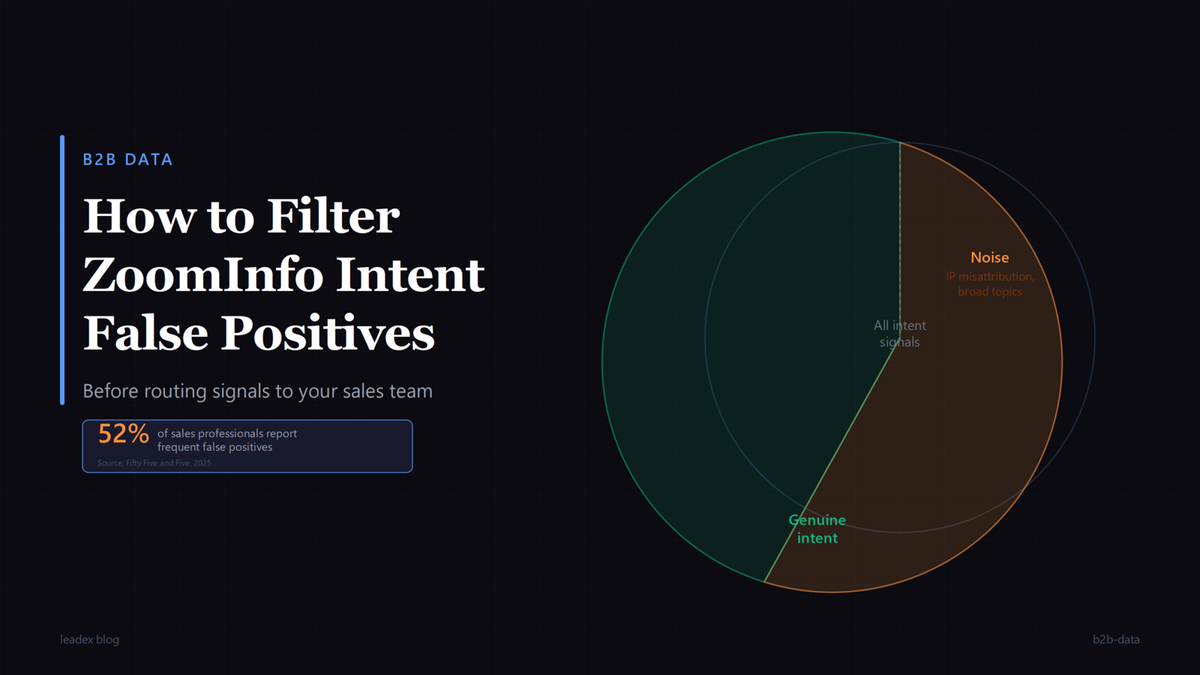
If you've already run the ZoomInfo data freshness audit before your renewal, the next problem on the list is almost certainly this one: the intent signals themselves. A clean contact export doesn't help you if the accounts flagged as "in-market" weren't actually researching you - and with ZoomInfo intent, a meaningful fraction of them weren't.
The numbers are documented. Fifty Five and Five surveyed sales professionals using ZoomInfo intent and found that 52% report frequent false positives, with 29% citing misattributed IP data as their key challenge. Those stats come from practitioners, not competitor marketing.
Two failure modes drive this, and they compound each other. The first is IP misattribution: ZoomInfo's WebSights feature identifies companies by matching IP addresses to known corporate networks. Since remote work normalized, employees on home ISPs and VPNs generate signals that get attributed to the wrong company - or return no match at all. The second is topic breadth: teams tracking 50 broad terms like "cloud security" or "sales automation" fire a signal on anyone who reads content adjacent to their category, not just buyers in an active evaluation cycle. Both problems are structural to how IP-based and bidstream intent collection works.
52% of sales professionals report frequent false positives that require manual validation. A Reddit user put it more bluntly: "False flags accounted for over 90% of the intent." [...] The signal-to-noise ratio is lower than ZoomInfo's marketing suggests.
Neither failure mode is a defect you can file a support ticket for. The fix is filtering and validation on your end - and it's more tractable than it looks.
How to narrow your ZoomInfo intent topic list
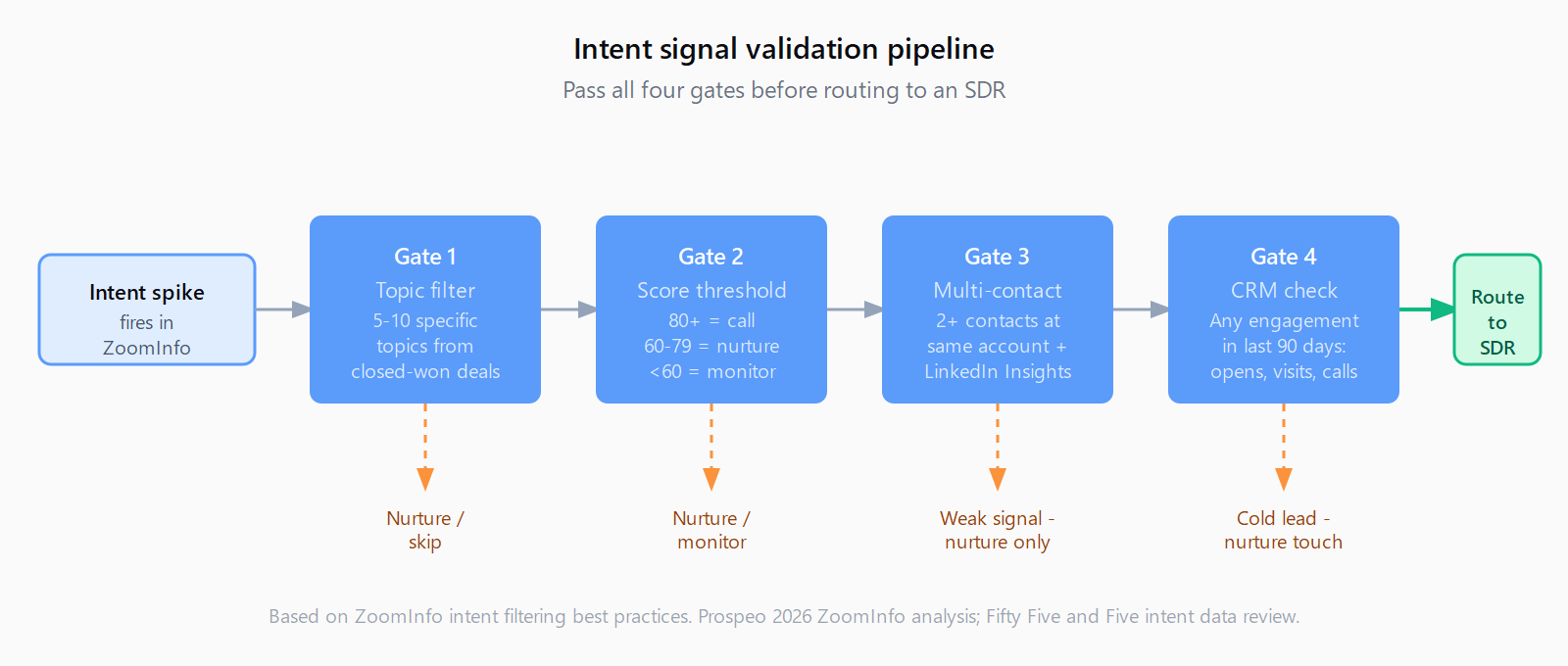
The fastest lever you have is topic count. Pull your last 20 closed-won deals and identify 5 to 10 topics those accounts were researching before they converted. Specific strings like "HIPAA-compliant CRM software" or "outbound sequence deliverability" outperform broad category terms like "healthcare software" or "sales automation" because they narrow the signal pool to accounts that match your buyer's actual research behavior - not everyone who reads an article that happens to mention your category.
ZoomInfo's Guided Intent feature automates this: it reverse-engineers the topics that preceded historical wins and recommends a starting set. If you haven't configured it, you're picking topics by intuition, which almost always skews too broad. The Prospeo 2026 analysis of ZoomInfo's signal quality makes the case plainly: a content marketer researching "account-based marketing" for a think-piece produces the same signal as a VP Revenue actively evaluating an ABM platform. Narrow topics don't eliminate that overlap, but they reduce it substantially.
One note while you're in the topic settings: ZoomInfo's underlying contact data has its own freshness limitations, which the data freshness audit can help you quantify separately. Intent signals firing on contacts who left the company six months ago are a different problem from false positives, but the two together drive up the wasted-call rate in a way that's hard to attribute to either cause individually.
How to filter IP misattribution from WebSights
You can't change how WebSights resolves IP addresses. What you can do is layer additional gates before a signal becomes a routed lead.
Score thresholds are the starting point. Don't treat every account above 50 as a priority. The practical breakdown most teams land on: 80 and above gets immediate outreach, 60 to 79 enters a nurture sequence, below 60 gets monitored but not actioned. The 80+ gate filters most transient signals because a single employee clicking an ad rarely pushes an account above 80 without multiple contacts from that account showing activity across multiple days.
The multi-contact requirement adds a second gate. One signal from one contact at a 500-person company is much weaker evidence of purchase intent than two or three contacts from the same account spiking on the same topic within the same week. ZoomInfo's filtering lets you set a minimum contact count as a condition - it's usually turned off by default.
LinkedIn Insights tag cross-confirmation is the most reliable first-party layer available without paying for an additional data source. If your Insights tag is installed, any account showing ZoomInfo intent that also had LinkedIn members visit your website in the past 30 days is materially stronger evidence than intent alone. The combination requires two independent signals before an account clears your SDR queue. ZoomInfo's own intent activation documentation describes this layering approach, (I believe it's underused because it requires the marketing team to configure the Insights tag separately from the sales team's ZoomInfo setup, and that handoff rarely gets completed).
How to validate intent before routing to your sales team
The step that separates teams with good ZoomInfo intent ROI from teams with poor results is a CRM lookup before the SDR gets involved.
For each account clearing your topic and score thresholds, pull the CRM record and look for any engagement in the last 90 days: email opens, reply threads, website visits logged through your marketing automation, previous calls, or any content download from a known contact at that account. An account showing ZoomInfo intent and having touched your owned properties is a warm lead. An account with a 90+ intent score and zero CRM history could be a legitimate cold lead, a research signal from a non-buyer, or an IP misattribution - and those three possibilities warrant very different outreach. A 30-second CRM check lets you sort them before burning an SDR's time.
Act on qualifying signals within 48 hours. Intent signals decay fast - the Prospeo analysis notes that response rates drop roughly 40% when outreach lags more than two business days behind the initial spike. If your process can't route a qualifying account to a rep the day the signal fires, the filtering improvements above produce less value than they should. Build the routing automation before investing further in signal quality (!)
This is the tradeoff we wrote about in the Leadex vs ZoomInfo comparison - ZoomInfo's intent infrastructure is most valuable for enterprise teams with the operational maturity to validate signals against first-party data, while the cost floor ("at least an order of magnitude" above open-web alternatives) makes the unvalidated version a poor fit for teams under 10 reps. The validation work described above is exactly what makes the product perform as advertised. It's also work most buyers don't budget for at signing.
When the signal source itself is the problem
If you've narrowed topics, set score thresholds, required multi-contact signals, and wired up the CRM cross-reference - and you're still finding more than 40 to 50% of routed accounts produce zero engagement after three touches - it's worth asking whether the signal source is the right fit for your ICP.
Bombora's consent-based co-op produces fewer false positives than bidstream-based models because the signals come from first-party publisher relationships rather than IP inference. The Fifty Five and Five analysis found that only 19% of users saw ZoomInfo's daily refresh as significantly better than Bombora's weekly cadence - meaning the daily update frequency isn't enough of a differentiator to justify the extra noise overhead for most teams. Cognism bundles Bombora-powered intent with phone-verified EU contacts, which is worth considering if your market is EMEA-heavy - we covered the specifics in the Cognism vs ZoomInfo EMEA comparison.
For teams where third-party intent data doesn't clear the ROI bar, the alternative worth revisiting is first-party signals you already own: pricing page visits in your analytics, high-value content downloads from known accounts, and marketing-automation-tracked web sessions from contacts already in your CRM. First-party signals are noisier in volume but cleaner in attribution, and they don't require a five-figure annual contract to keep flowing.
FAQ
Why does ZoomInfo intent fire on companies that aren't actively evaluating?
Two mechanisms: IP misattribution and broad topic selection. WebSights resolves company identity from IP addresses, which worked better when most employees were on corporate networks. Remote work and VPN adoption have made the match significantly less reliable since 2022. Broad topic terms like "cybersecurity" or "marketing automation" fire on anyone reading adjacent content, not just buyers in an active purchase cycle. Both are structural to how ZoomInfo collects signals - the mitigation is filtering on your end via narrow topics, score thresholds, and first-party confirmation.
How many intent topics should I track in ZoomInfo?
Five to ten highly specific topics outperform fifty broad ones. Start with your last 20 closed-won accounts and identify the topics those accounts were researching before they signed. ZoomInfo's Guided Intent feature can automate this reverse-engineering. Avoid generic category terms - prefer phrases that name a specific pain, integration, regulation, or tool ("outbound sequence deliverability," "DKIM DMARC setup," "sales intelligence API").
What CRM data should I cross-reference against ZoomInfo intent before routing to SDRs?
Any engagement in the last 90 days: email opens or replies, website visits tracked via marketing automation, content downloads, previous calls, or any open or closed deal record on that account. An account with a ZoomInfo intent spike and recent CRM engagement is a confirmed warm lead. High-scoring intent with zero CRM history is ambiguous - route to a nurture sequence rather than immediate SDR outreach until a confirming first-party signal appears.
Does ZoomInfo WebSights work reliably if my prospects use VPNs or work from home?
Not reliably. IP-to-company matching assumes employees are using corporate network IPs. With remote work and widespread VPN usage since 2022, a significant portion of WebSights signals either misattribute to the wrong company or return no company match. The LinkedIn Insights tag cross-confirmation approach - requiring a known company member to also visit your website - adds a first-party layer that WebSights alone can't provide.