
Lusha Coverage Gaps in EMEA and APAC: Multi-Provider Stack
The US and UK numbers look fine. It's when the territory expands — a DACH prospect list, a Singapore pilot, a batch of accounts in the Nordics — that Lusha starts returning gaps: missing phone numbers, email addresses that bounce, contacts that simply don't appear in the database. The problem is not Lusha's data quality in the markets where Lusha is strong. It's that coverage is geographically uneven in ways the platform dashboard doesn't surface until a campaign has already underperformed.
Lusha publishes a 280-million-record database and states GDPR compliance, but its documentation provides limited visibility into how coverage is distributed by region or how phone data is validated outside North America. Teams running EMEA-first outbound encounter this gap empirically: they enrich a batch of German or Dutch accounts and get partial results — email addresses but no direct dials, or no record at all for mid-market companies that everyone in the market knows exist. The fix is not switching providers. It's stacking them in the right order.
Why Lusha coverage drops in EMEA and APAC
Lusha's data sourcing relies on community contributions (users who share their own contact details), third-party directories, and email addresses auto-completed from standard corporate email patterns. That approach works well in markets with dense professional community participation — primarily the United States and Canada. In continental Europe and APAC, the community layer is thinner and the inference layer less reliable because naming conventions, domain patterns, and workplace norms differ from the North American default the model was trained on.
Phone number coverage is the more acute problem. Lusha does not publish a phone-verification methodology for European numbers, and do-not-call list filtering for European markets is restricted to its highest-tier plan. In practice, this means EMEA mobile numbers from Lusha may be unverified and may include numbers on national suppression registers — a compliance problem in markets where TPS/CTPS screening in the UK and equivalent DNC registers in Germany, France, and Belgium are standard requirements for outbound calling campaigns. Sending a cold call sequence to unscreened EMEA numbers is not just a deliverability problem; it's a regulatory one.
We used Lusha for around a year, but didn't receive very good service. The UX wasn't that smooth, and their data quality was poor. Lots of companies we knew existed weren't in their database. [Jack Hooper, Sales Development, Lockton]
The Lockton experience — companies not appearing in the database — is the more common EMEA complaint than bounce rates alone. Lusha may return a record for a VP of Sales in Amsterdam but miss the other four members of the buying committee. In APAC, Apollo.io shows similar phone gaps but is stronger for email coverage, particularly in Singapore, Australia, and India, where its community layer is denser than Lusha's.
How to audit your Lusha hit rate by geography before adding providers
Before adding providers and paying for overlap, run a coverage audit to identify where your stack is actually underperforming. Pull your last 90 days of Lusha exports, segment by country or region, and calculate two numbers per segment: email match rate (contacts with email returned vs. contacts searched) and phone match rate (mobile numbers returned vs. contacts returned). The same data freshness audit approach applies equally well to geographic coverage gaps.
Thresholds that indicate a gap worth filling: email match rate below 60% for a region, or mobile phone match rate below 40%. At those levels, a second provider typically pays for itself in a single campaign. For accounts where you need phone numbers and you're targeting continental Europe, Cognism Diamond Data is the right complement. For APAC and LatAm email coverage, Apollo.io is the right layer. The audit data tells you which half of your territory is the bigger problem so you can prioritize spend accordingly.
A useful sanity check: take a sample of 50 accounts from a territory that's underperforming and run them through both Lusha and the provider you're evaluating. The delta in match rate — phone and email separately — is the clearest data you'll have. Vendor comparison pages will quote you averages; your own accounts in your specific ICP are the only relevant benchmark.
How to add Cognism Diamond Data for EMEA phone coverage
Cognism's phone-verified mobile numbers are manually verified through direct contact, with DNC screening applied across 15 countries including Germany, France, Belgium, the Netherlands, Sweden, Spain, Portugal, Ireland, Croatia, and the UK TPS/CTPS register. This is the specific gap Lusha leaves in EMEA outbound: unverified or DNC-non-screened mobile numbers in markets where compliance risk is real. Cognism fills it at the source, not as a post-processing step.
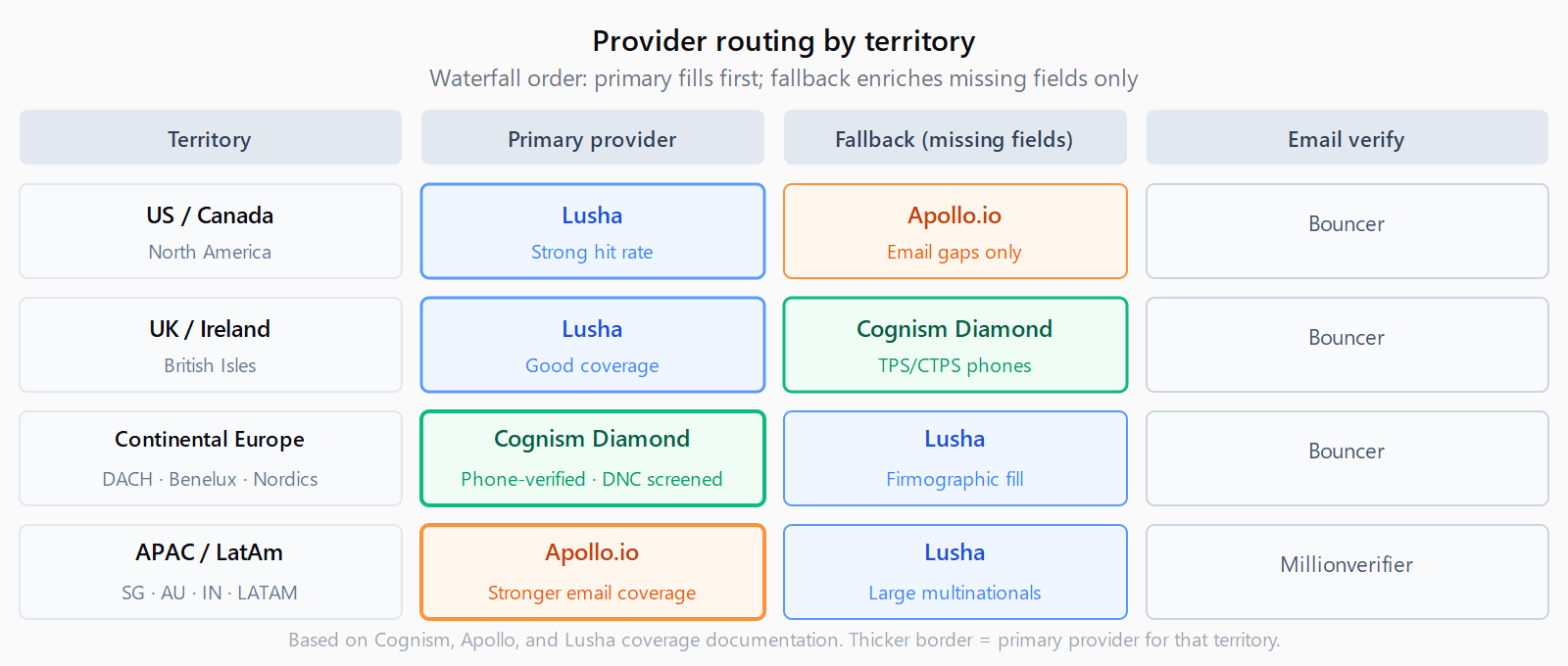
The stack works as a waterfall: enrich first with Lusha for North American and UK contacts, where its hit rate is strongest and cost per record is low. For EMEA accounts where Lusha returns no phone or returns an email-only record, send the record to Cognism. Sparta Global ran this comparison directly: "Cognism brought back three times the number of phone numbers compared to Lusha and more than double the number of contacts." The Cognism enrichment API supports this waterfall automatically — it only fills fields that are missing, so you're not paying for records Lusha already covered.
The markets where Cognism enrichment adds the most: DACH (Germany, Austria, Switzerland), Benelux, Nordics (Sweden, Denmark, Norway, Finland), and Southern Europe (Spain, Italy, France). UK coverage is strong in both Lusha and Cognism, so the incremental phone lift in the UK is smaller — but the compliance case for DNC-screened numbers on calls into UK mobile numbers is still worth the redundancy. For teams targeting enterprise accounts in the DACH region specifically, Cognism's advantage is most pronounced: its research team actively maintains German-market records in a way Lusha's community-sourced model does not.
How to layer Apollo.io for APAC and LatAm email coverage
Apollo's community layer is stronger in Singapore, Australia, India, South Korea, and Japan than Lusha's. The coverage advantage is primarily in email addresses, not mobile phones — Apollo's phone verification methodology for APAC does not match Cognism's rigor for Europe. For APAC mobile numbers, local-market verification services or manual LinkedIn DM outreach are often more effective than any enrichment tool. The Apollo layer in the stack is specifically for email coverage where Lusha returns a blank.
Add Bouncer or Millionverifier as a final email verification step before enrolling any APAC contacts in a cold email sequence. Emails sourced via community-based verification age faster in high-churn tech markets — a contact in Singapore who changes jobs every 18 months has a higher probability of a stale address than an equivalent contact in a German enterprise. Running a verification pass before sequence enrollment costs less than the domain reputation hit from a batch of hard bounces.
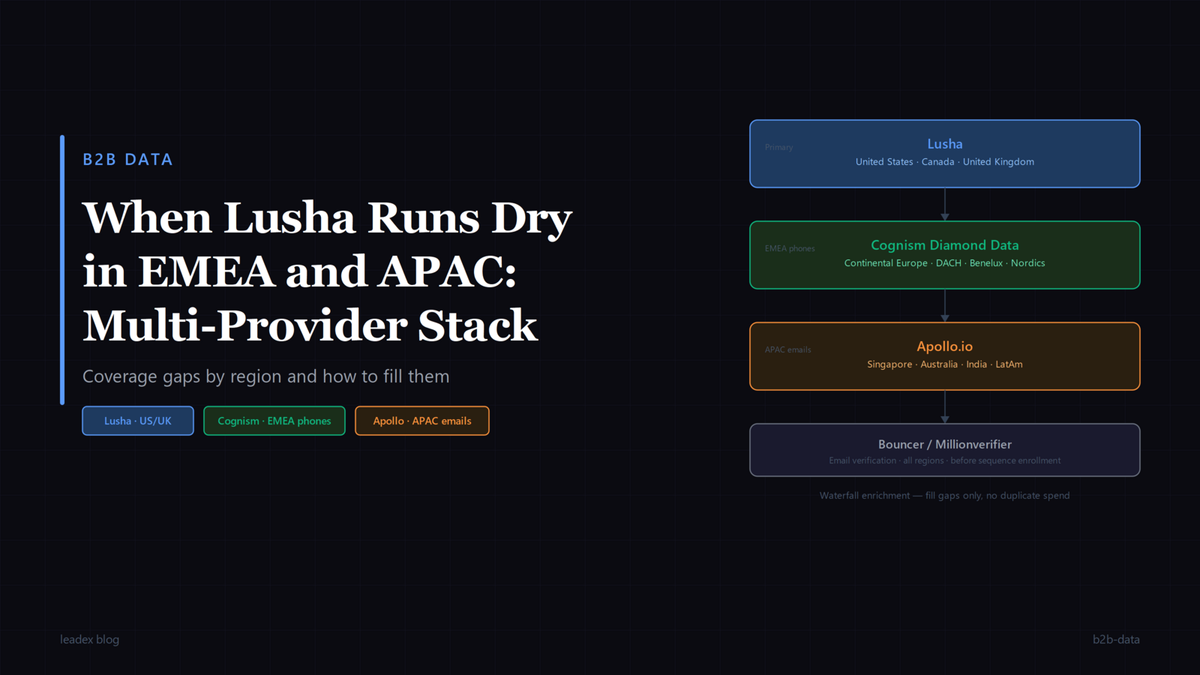
At Leadex, the question we get from teams expanding globally is not "which provider covers everything" — none do — but "how do I route each contact to the right enrichment source." The stack is: Lusha for US, Canada, and UK primary coverage; Cognism Diamond Data for EMEA phone numbers; Apollo.io for APAC and LatAm email addresses; Bouncer or Millionverifier for email verification before any sequence enrollment. Running that waterfall on a freshly built list adds roughly 20 minutes of configuration the first time; after that it's automated.
FAQ
Is Lusha accurate for European contacts?
Lusha is reasonably accurate for UK contacts and some Western European accounts at large companies, but coverage drops significantly in continental Europe — particularly DACH, Benelux, and Southern Europe — and in APAC. Mobile phone accuracy and completeness are the weakest areas, partly because Lusha's DNC list filtering for European countries is only available on its highest-tier plan. Teams running EMEA outbound at scale typically add Cognism Diamond Data as a complement for phone numbers.
What is the best B2B data provider for EMEA phone numbers?
Cognism is the strongest choice for EMEA direct dials specifically. It provides phone-verified mobile numbers with DNC screening across 15 European countries and the UK TPS/CTPS register. ZoomInfo has stronger European firmographic depth but thinner personal phone coverage. For teams that need verified mobile numbers in Germany, France, and the Nordics, Cognism's phone-verified tier is the most reliable option available in 2026.
How do I supplement Lusha for global outreach?
Stack by geography: Lusha first for North America and UK (where its hit rate is strongest), Cognism Diamond Data as a fallback for EMEA phone numbers, Apollo.io for APAC and LatAm email addresses. Add Bouncer or Millionverifier as a final email verification step before any sequence enrollment. This waterfall approach is cheaper than buying a single global provider at the tier required to get full coverage, and it lets you scale spending in each market independently.
Does Lusha work in APAC?
Lusha has APAC coverage primarily for contacts at large multinationals with strong English-language LinkedIn presence. Coverage is thinner for regional SMBs and local-language markets in Japan, South Korea, and Southeast Asia. Apollo.io's APAC email coverage is generally stronger. For phone numbers in Australia and Singapore specifically, running records through Apollo and a local-market email verification service improves deliverability before sequence enrollment.