How to Find Y Combinator Startups by Batch and Stage
Y Combinator's W26 batch closed demo day in March with 196 newly funded companies. The cohort is real; the buying behavior is mostly not. Here is the workflow that actually finds qualified buyers in the YC directory - batch and status filters, enrichment layer, and a stage filter.
Y Combinator's Winter 2026 batch held its demo day on March 24, and the now-traditional flood of "selling to YC startups" threads showed up on Hacker News and r/sales the following week. The pitch is always the same: 196 newly funded companies, all in one searchable list, founders whose emails are one LinkedIn click away. A pre-qualified buyer cohort.
It is a pre-qualified cohort. It is also mostly the wrong one, depending on what you sell. The W26 batch is younger, more Bay Area, and more deep-tech than its predecessors - 64% B2B, about 5% consumer, with a heavy AI tilt across agentic workflows, LLM infrastructure, robotics, and drug discovery. Almost every company is a four-person team with the standard YC deal in the bank and maybe a small angel round on top. That is not the buyer for an enterprise sales platform. It is the buyer for AWS credits and a Notion seat.
The shape of the batch is visible if you skim a few of the standouts. Pocket shipped 30,000 hardware units in five months and is reportedly at $27M ARR at seed. Beacon Health is a Stanford/Harvard MD plus an ex-Amazon Alexa engineer with a $5.4M round from Accel. Synthetic Sciences is two 18-year-olds building "Claude Code for Science." Cardinal already counts 40+ other YC companies as paying customers, which tells you most of what you need to know about who actually buys at this stage (other YC teams, with YC dollars, on a six-week procurement cycle). These are great companies. They are also four-person companies. The buying calculus does not change because the founders are smart.
The useful question isn't "how do I get a list of W26 companies." That list is sitting at ycombinator.com/companies?batch=Winter+2026, formatted as a clean grid, and you can scroll the whole batch in ten minutes. The useful question is which batch and which stage actually maps to your product, and how to enrich the directory output enough to act on it.
The directory itself exposes filters for batch (every cohort from W05 to the current one), industry, status (Active, Inactive, Acquired, Public), region, team size, and whether the company is currently hiring. URL parameters are predictable - ?batch=Winter+2026, ?status=Active, ?industry=B2B, and they stack. Each company card surfaces name, location, batch, one-line description, and team size. Click through and you get the founders, often with LinkedIn links the founders themselves added at application time. About 5,800 companies are listed across all batches. YC Graveyard documented 821 inactive ones at last count, and Jared Heyman's running analysis at Rebel Fund pegs the eventual exit rate at roughly 40% of all funded companies.
That 40% is the number that actually matters for prospecting:
Even though the unicorns are just ~8% of all exits, they represent a whopping ~93% of the cash returned to YC startup seed investors.
- Jared Heyman, Rebel Fund
Heyman is talking about returns to LPs, but the same skew describes the buyer pool. A handful of YC companies will become real software buyers with real budgets. The rest are either pre-revenue and pre-headcount or already gone, with their YC profile pages either delisted or 404ing depending on how cleanly the founder closed things out. The directory does not flag this gracefully - some inactive companies remain in the index with a status badge, others vanish entirely, and a profile page that loaded last month sometimes returns a 404 today because the founder requested removal or the company was quietly archived.
So a useful workflow looks less like "scrape the latest batch" and more like a stacked set of filters across the directory plus a layer of enrichment on top. Pull the directory by batch, restrict to Active status, filter to industries that match your ICP, then leave the freshest cohort alone and start with batches from 18 to 36 months ago - companies past PMF, with headcount over 20, that have raised a Series A. From there, the directory's data ends and the enrichment begins: founder LinkedIn for current title and last-job context, current employee count from LinkedIn live data (the directory's number is usually stale), recent funding from Crunchbase or the company's own press page, and hiring signals from Greenhouse and Workable job-board URLs to spot the ones standing up a sales motion. This is the same shape as prospecting VC portfolio companies from a fund's website, or filtering by funding stage from a press feed - the directory is the seed list, the enrichment is what makes it sales-ready.
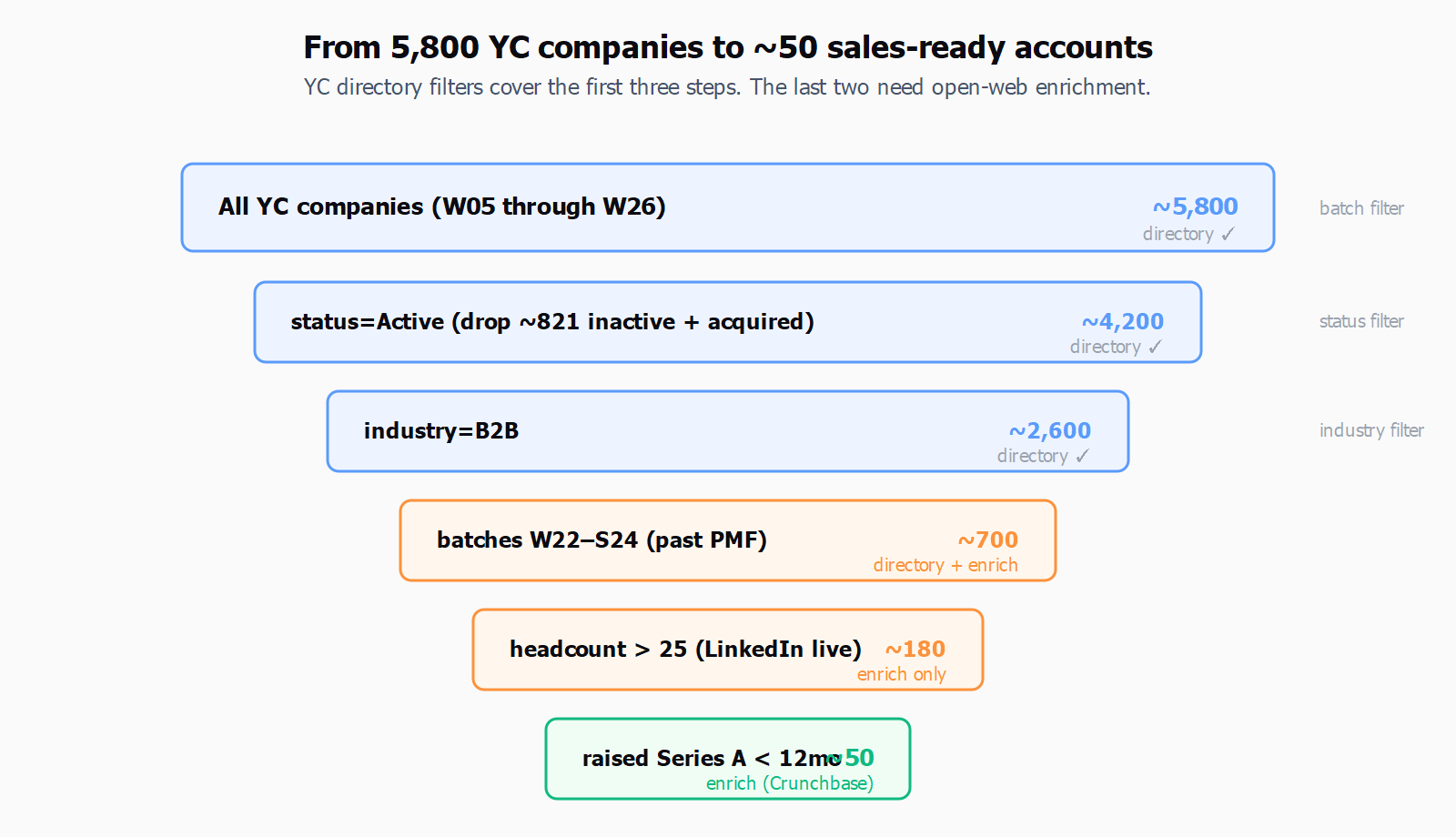
What the directory does not expose is the part that matters most. There is no funding amount, no last round date, no ARR, no investor list, no founder email, and the team-size number is whatever the company entered when they last bothered to update their profile - sometimes a year stale. Two of those gaps (funding and headcount) are exactly the signals that separate a buyer from a four-person hobby project, and you have to fill them in from somewhere else: Crunchbase or the company press page for the round, LinkedIn live count for headcount, the company's careers page or its Greenhouse / Workable URL for whether they are hiring sales (a useful proxy for "ready to buy a sales tool"). None of this is hidden. It is just spread across four sources, which is the entire reason the prospecting tool category exists.
The mechanics are also where most DIY scrapes break. ycombinator.com sits behind Cloudflare with the usual rate-limiting and behavioral-detection rules - sequential page fetches at machine pace get throttled, and a script that hammers 404s while looking for delisted companies will trip the scraper-detection IDs faster than one that walks the directory at human cadence. The polite version is to throttle, set a real user agent, respect robots.txt, and accept that some profiles will simply not load because YC removed them by request. The unofficial scrapers floating around GitHub - corralm/yc-scraper is the cleanest one - handle most of this, but they don't do enrichment, and they don't cross-reference Crunchbase or LinkedIn for the signals that make a YC row actually worth a touch.
This is the kind of multi-source brief Leadex was built for. The YC directory is public, the URL pattern is documented, and any engineer can write the scraper - the value isn't the scrape, it's not having to maintain it when YC ships a redesign, plus the enrichment layer that turns "name, batch, one-line description" into "Series A fintech in W23, headcount 32, hiring two AEs, founder posted about pipeline last week." A brief like find Active YC companies from W22 through S24, B2B, headcount over 25, raised in the last 12 months, founder LinkedIn included is exactly the open-web, multi-source pattern Leadex runs end to end - directory crawl, Apollo enrichment, LinkedIn cross-reference, deduped CSV. Not magic; just the tool you would otherwise build yourself.
The honest counter-take, which most "sell to YC startups" guides skip: the latest batch is almost always the wrong one. A four-person W26 team with $500K in the bank is not buying your $40k/year platform - they are buying Notion, Linear, and AWS credits, and they are spending from runway, not a budget. The teams worth pursuing are the ones two or three batches back that survived the cohort, raised a Series A, hit headcount 30+, and are now making the kinds of newly funded startups tooling decisions you can actually win. The directory's batch filter is the obvious axis; the stage filter you build with enrichment on top is the one that matters.
The same workflow rewrites cleanly for Techstars, a16z's portfolio page, 500 Global, or any accelerator with a public directory and a published cohort schedule. The interesting bit is never the URL - it's the stack of filters and the enrichment layer that converts a public list into a list of buyers.