
How to Find Clients for a B2B Marketing Agency
The top-ranking 'how to find clients for a B2B marketing agency' posts are interchangeable SEO bloat. The honest version: pick a buying signal (just-funded, new-CMO, rebrand, product launch), build a list of companies that just fired it, and reach the marketing leader in the 30-to-60-day window.
Search "how to find clients for a B2B marketing agency" and the first ten results are interchangeable. "Optimize your LinkedIn profile." "Niche down." "Start a podcast." "Ask for referrals." Useful in 2014, table stakes in 2026, and not actually advice - it's a checklist that every agency owner has read four times and that none of them rank for. Meanwhile, per the 2025 State of Digital Agencies survey covered by Paddy Moogan at SparkToro, only 14% of agencies describe their sales pipeline as "healthy," 32% say it's "not very good," and referrals from existing clients are still the dominant source of new business. RSW/US's 2025 Professional Services New Business Survey puts it more bluntly: "the work is out there, but it's taking longer to win and coming in smaller chunks," with 78% of firms saying deals now take up to six months to close.
The honest version of the advice is: pick a buying signal, build a list of companies that just fired it, get to them in the 30-to-60-day window before the work is awarded to whoever the founder's friend recommended. There are four signals that map cleanly onto agency offerings: just-funded (a Series A or B SaaS company that has 18 months of runway and a board demanding they spend it on growth), just-hired-CMO (a new marketing leader in their first 90 days, evaluating every incumbent vendor), just-rebranded (a company that has decided their brand needs work and is now staring at a stale content library), and just-launched-product (a team that needs PR, demand-gen, and a launch microsite by next quarter and has no internal capacity).
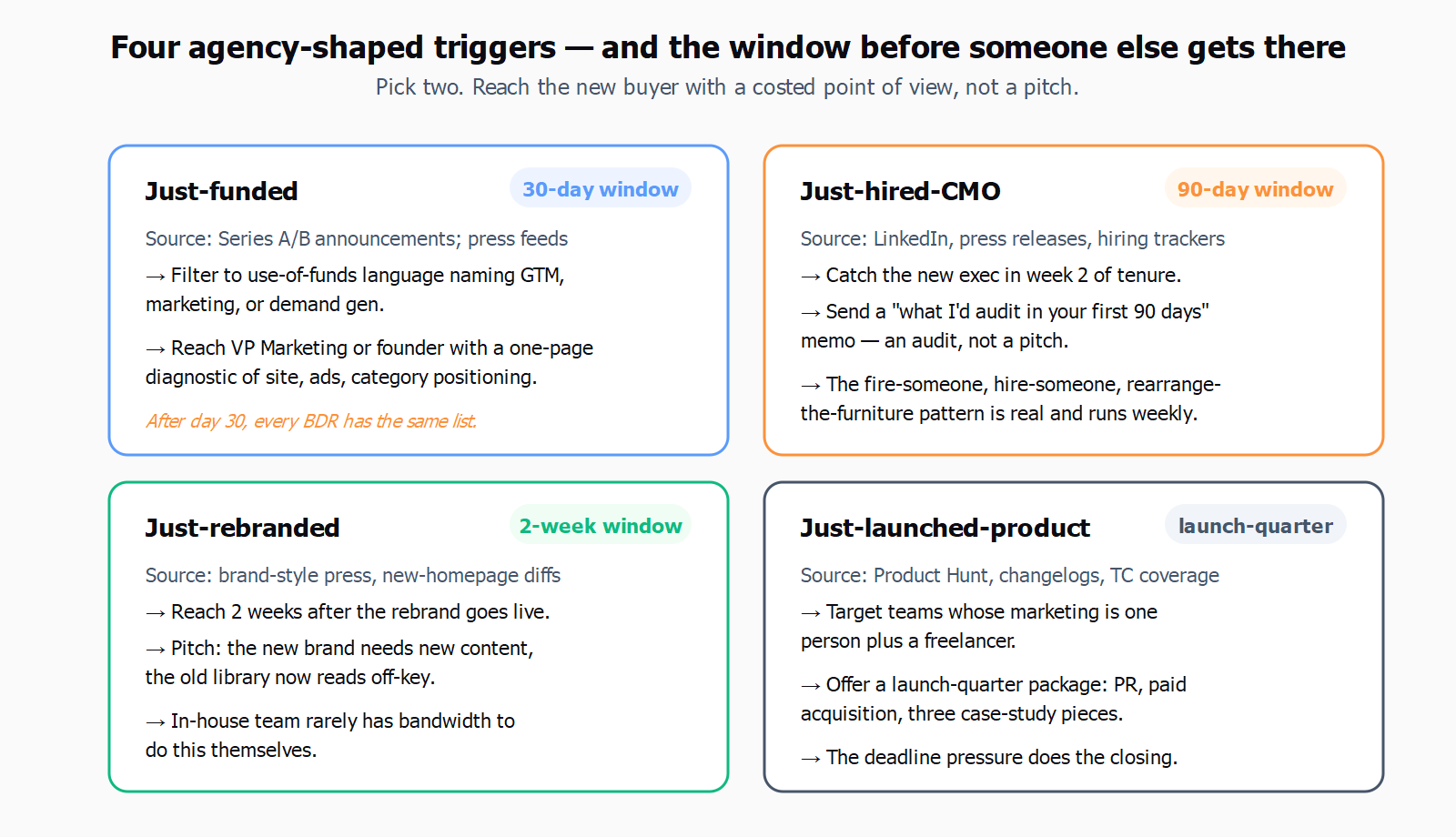
For each signal, the play is three sentences. Just-funded: pull Series A and B announcements from the last 60 days in your vertical, narrow to companies whose use-of-funds language explicitly names "go-to-market" or "marketing" or "demand generation," and reach the new VP Marketing or founder with a one-page diagnostic of their current site, ads, or category positioning. Just-hired-CMO: track new VP Marketing and CMO hires on LinkedIn and in press releases, and write to them in week two with a "here's what I'd audit in your first 90 days" memo - not a pitch, an audit, the kind of thing they'd otherwise have to brief their team to produce. Just-rebranded: monitor for new logo / new homepage / new brand-style press releases, and reach out two weeks later with the observation that the new brand needs new content because the old library now reads off-key, which is true and which the in-house team rarely has the bandwidth to do. Just-launched-product: watch Product Hunt, company changelogs, and TechCrunch product-launch coverage, then offer a launch-quarter package - PR, paid acquisition, and three case-study-grade content pieces - to teams whose marketing function is one person and a freelancer.
Concrete example for the just-funded signal as of this writing: Letter AI, a Chicago AI-native revenue enablement platform, closed a $40M Series B led by Battery Ventures in late February 2026, with stated use of funds to "accelerate go-to-market efforts." That is a company whose VP Marketing - if the role exists yet - is two months from a board meeting where they will be asked what they spent the money on. An agency that shows up in March with a costed proposal and a worked-up category-positioning point of view is in a different league than one that pings them in August once the search has already started. The window is short and the field is crowded for exactly thirty days after the funding press release; after that, every BDR in martech has the same list and reply rates collapse.
Why the new-CMO signal in particular is so under-rated, from someone who actually advises agencies on this:
When a new CEO starts, they have three "jobs" to do: Hire someone, fire someone, and rearrange the furniture. [...] Few of those motivations have much - or anything - to do with your agency and your agency's performance. Yet they impact you.
- Karl Sakas, founder, Sakas & Company
Sakas is writing about losing clients when a new exec lands at one of your accounts. Read it from the other direction and it's the playbook for winning them: every new CMO is going to fire someone, hire someone, and rearrange the furniture - which means somewhere in the world there is, every week, a marketing leader 60 days into a new job who is actively evaluating which agency to bring in. The only question is whether you reach them with a credible diagnostic before the founder's friend's agency does.
Running these queries is the part that tends to break. The four signals are easy to name and tedious to execute - someone has to actually pull the just-funded list, cross-reference it against your ICP, find the marketing leader, write the email. The standard agency answer is to hire an SDR, which works at 20+ employees and is overhead at 5. The other answer is to run the queries from a chat prompt: "every Series A and B SaaS company funded in the last 60 days in martech or salestech, with the VP Marketing's LinkedIn, deduped against my CRM." That is what we built Leadex for. It is not agency-specific - it's a B2B research agent that takes plain-English ICP briefs and returns a deduped CSV - but the four signals above are exactly the kind of multi-source, signal-stacked queries it is good at, and BYOK enrichment means a four-person agency pays the same per-contact rate as a fifty-person one. For agency owners reading this, that's the practical difference between thinking "I should run that signal play" and actually running it on Tuesday.
For more on the signal-by-signal mechanics, the buying-signals taxonomy covers thirty triggers in detail, the prospecting prompts post has copy-paste briefs for each one, and the opening a new office piece walks through one signal end-to-end.
The counter-take, because signals are not magic: a just-funded list without ICP filtering is noise. A $400M Series C announcement from a pharma company is technically a just-funded signal and is also, for a B2B SaaS demand-gen shop, completely irrelevant. The signal tells you when; it does not tell you who. Agencies that get this right combine the trigger with a hard ICP filter (vertical, headcount, GTM motion, geography), and they keep that filter narrower than feels comfortable. The list of "every Series A in 2025" is 1,500 companies and useless. The list of "every Series A in 2025, B2B horizontal SaaS, 30-150 headcount, US East Coast, no in-house brand designer" is forty companies and you can write to all of them by Friday.
Andy Crestodina, who runs Orbit Media on a famously inbound-only motion, said it most economically: "Do not take on clients if they don't fit into your ideal client profile." The same discipline applies to who you reach out to, not just who you accept. Pick two of the four signals - the ones whose buyer behaviour you actually understand, not the ones that sound most exciting. Write the ICP filter narrow enough to fit on a sticky note. Run the query weekly, on the same morning, so the rhythm becomes muscle memory rather than a project. The pipeline shows up not because the advice was clever but because no one else in your category is doing the boring part.