
How to Build Apollo Prospect Lists That Are Not Junk
Stop exporting 10,000-contact junk pulls. Build one saved Apollo Persona, layer hiring recency plus technographics, and work a 200-500 account Tier 1 queue.
I have watched the same Apollo failure mode three times this year: someone types an industry plus a title, exports 10,000 contacts, then spends a week scrubbing companies that were never a fit. If you have done that, you know the feeling behind the thread on why most Apollo searches return garbage. The fix is less glamorous than a new vendor. As of 2026, Apollo gives you saved Personas plus 65+ filters on 240M contacts and 30M companies, and clean lists come from using that stack in a fixed order. This builds on what I wrote about combining three or more buying signals: one filter tells you who exists, stacked signals tell you who to email this week.
The setup from Apollo's docs: build an ICP Persona from function, seniority, industry, and headcount, then layer Technologies Used, job postings, headcount growth, funding, and intent on top, per How to Prospect in Apollo, updated Feb 3 2026. The Apollo prospecting and B2B data page lists 240M+ contacts, 30M+ companies, 98% email accuracy, and 2M+ contributors, with 65+ filters for job changes, new hires, funding, and news. Check pricing before assuming intent or waterfall credits sit in your tier (I believe intent still needs a higher plan).
Begin by building your ICPs and personas to create a targeting framework for your sales organization. The best, most comprehensive targeting frameworks include multiple personas that you can target within an account.
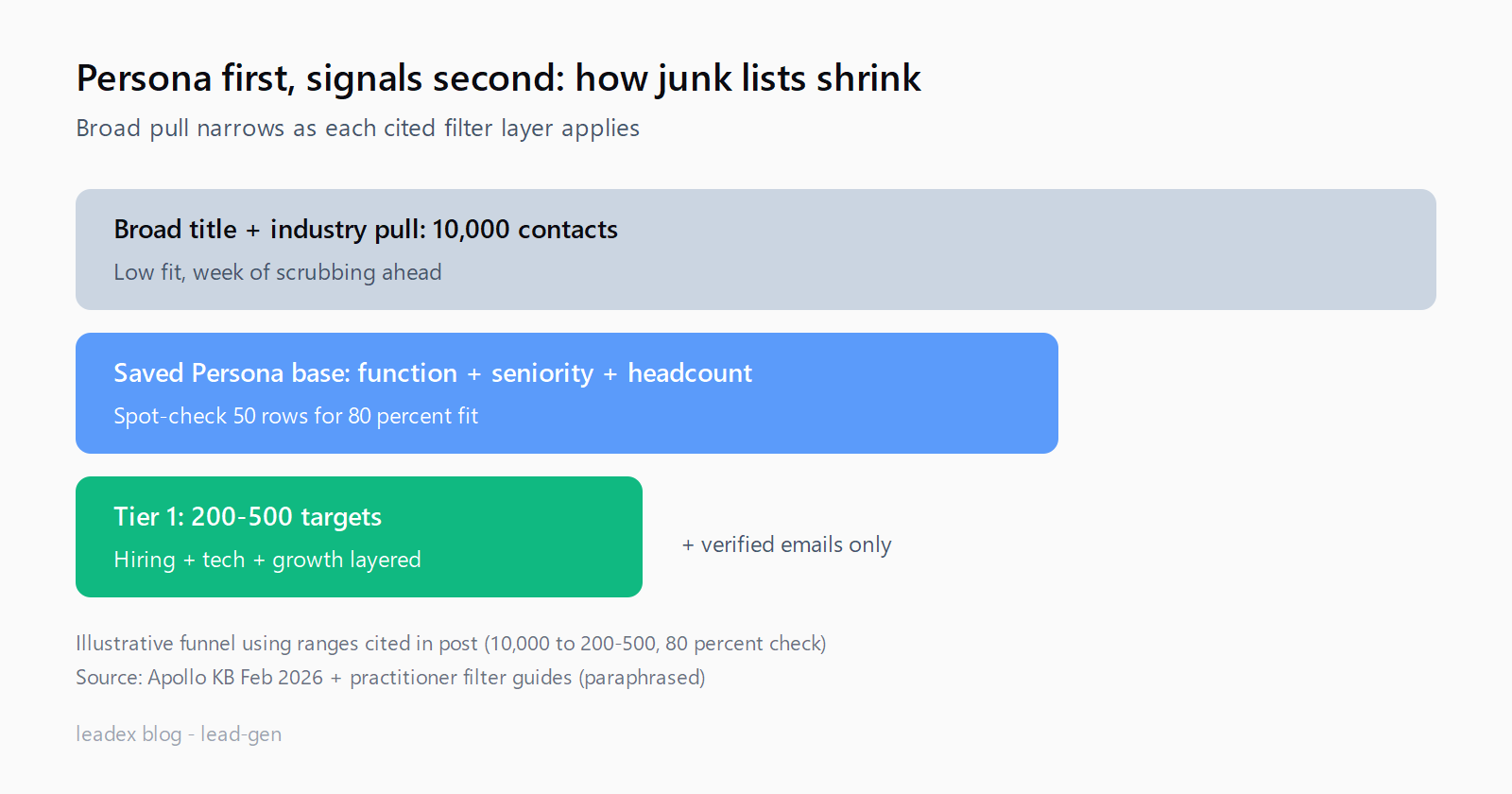
That paragraph is the whole game, in Apollo's words from the February 2026 checklist. Most junk lists skip it and jump to signals, which is like seasoning before picking a dish. Personas are reusable bundles of titles, seniority, function, and firmographics, saved under Search. Get the base to 80% fit on a 50-row check before adding anything time-based. A wrong base plus hiring signals just finds the wrong companies faster.
Build the Persona base before touching signal filters
Do not start with an exact title. "Growth Marketing Manager," "Demand Gen Lead," and "Senior Marketing Specialist" can be one job at three companies, so exact-title search creates false negatives. The AeroLeads advanced filters walkthrough from March 2026 gives the rule I use: start with Job Function plus Seniority, then use Job Title only for keyword inclusion and exclusion. Pick Marketing plus VP and Director, add Growth or Demand Gen as positives, and exclude Content, Product Marketing, or Communications if they never buy. That exclusion box beats any intent topic for list quality.
Add firmographics next: industry, headcount, revenue, geography, company type. Seniority without headcount misleads, since a Lead Engineer at 5,000 people can own more budget than a CTO at 10. I save two personas per motion, buyer and champion, named like "SaaS VP Sales 50-500 US" so every rep loads the same definition. Apollo's Academy prospecting guide suggests grounding this in your last 90 to 120 days of closed deals first. That keeps the persona tied to who signed, not who you wish signed.
Then run the boring QA: eyeball 50 rows and demand 80% fit. If a third are agencies or holding companies you never close, exclude them now, as The Startup Flow guide from June 2026 advises. Watch department headcount too. A Marketing Ops Manager on a five-person team needs different tooling than one on a 200-person team. Boring base, exciting signals later.
Filter hiring posts by recency, department, and seniority
Hiring is the most legible timing layer in Apollo because it is public, fresh, and tied to approved spend. Five open SDR roles say pipeline investment more clearly than any firmographic guess. Filter in Company Search by keyword, department, seniority, and location. Consultant Ahmet Faruk Yilmaz frames it well in his April 2026 Apollo hiring filters guide: "Apollo hiring filters help you find companies expanding a specific function. Treat hiring as a research signal, then verify the role's relevance, timing, and purchasing budget before outreach." That second sentence carries the weight, and I agree with it.
My defaults: keyword matching the function I serve, size and geography clipped to ICP, posted within 30 days, and IC hires split from VP hires. IC hiring usually scales an existing function, while a new VP or Head of builds from scratch, so they need different emails. One Marketing Manager post proves little. Five marketing hires in three months, or a new Head of Sales plus three AEs, is a trend (!). The Asphia guide insists on that seniority split before treating anything as an opportunity.
Recency is where lists rot, since filled roles leave echoes behind. Keep a tight date window for active sends, and use broad "has postings in X department" phrasing for saved searches so the Net New tab keeps growing. Then switch to People Search inside those accounts and pull Persona titles, not the posting title. Postings pick the account, Personas pick the buyer. Keep openers under 80 words and tied to the hire.
Find timing with technographics and headcount growth
Technologies Used answers fit, not timing: what the account runs, and whether you complement or replace it. Filter for HubSpot if you integrate with it, or for a competitor if you displace it, then verify on the site before citing it. Our piece on technographic data providers covers judging coverage, freshness, and match rate, which matters because tech fields decay fast. Never open with a tool the prospect removed last quarter.
Headcount growth and funding corroborate. A Series A plus sales hiring beats either alone. In Apollo that means employee growth percent, department change, and round plus date on top of Persona and hiring. Apollo's Academy guide lists these as signal filters: funding, revenues, hiring volume and roles, and tech used. Treat it as a menu. One or two signals tied to your buyer beats five thin ones.
Intent topics can wait. They cost more and punish broad picks. The AeroLeads guide suggests a score floor near 85 with a 14-to-30-day window, only atop persona filters, which matches my use. Cutting 10,000 contacts to 200 to 500 weekly Tier 1 targets is a feature. Gartner's 2025 finding, cited in Apollo's September 2026 first-60-minutes guide, says 73% of B2B buyers avoid suppliers who send irrelevant outreach. Smaller and relevant beats big and ignored (To be fair, broad TAM pulls still suit mapping, just not sequencing).
Run the verify, save, and Net New loop
Verify before scaling. Apollo claims 98% accuracy on its data page, while catch-alls stay messy in practice. I spot-check 10 to 20 rows, send first to Verified plus Likely to engage, and re-route Risky elsewhere. Our guide to Apollo email verification tiers shows that triage for staying under 3% bounce. Jason Alco, CEO of Popl, put the coverage point bluntly on Apollo's customer wall: "Some providers return a lot of data, but the data just isn't good. A lot of noise, a lot of old company emails. Apollo was consistent, and it kept a high coverage percentage." Coverage without accuracy is faster spam.
Save so the work compounds. Click Save Search, set alerts, and work Net New instead of rebuilding weekly. One list per sequence keeps messaging matched to each persona, with a shared table layout per persona. Connect the CRM and map stages so the Data Health Center shows remaining TAM by persona. Apollo's scoring can reuse the same persona filters with intent weights and a distribution preview. Keep Tier 1 simple: Persona fit plus one fresh signal.
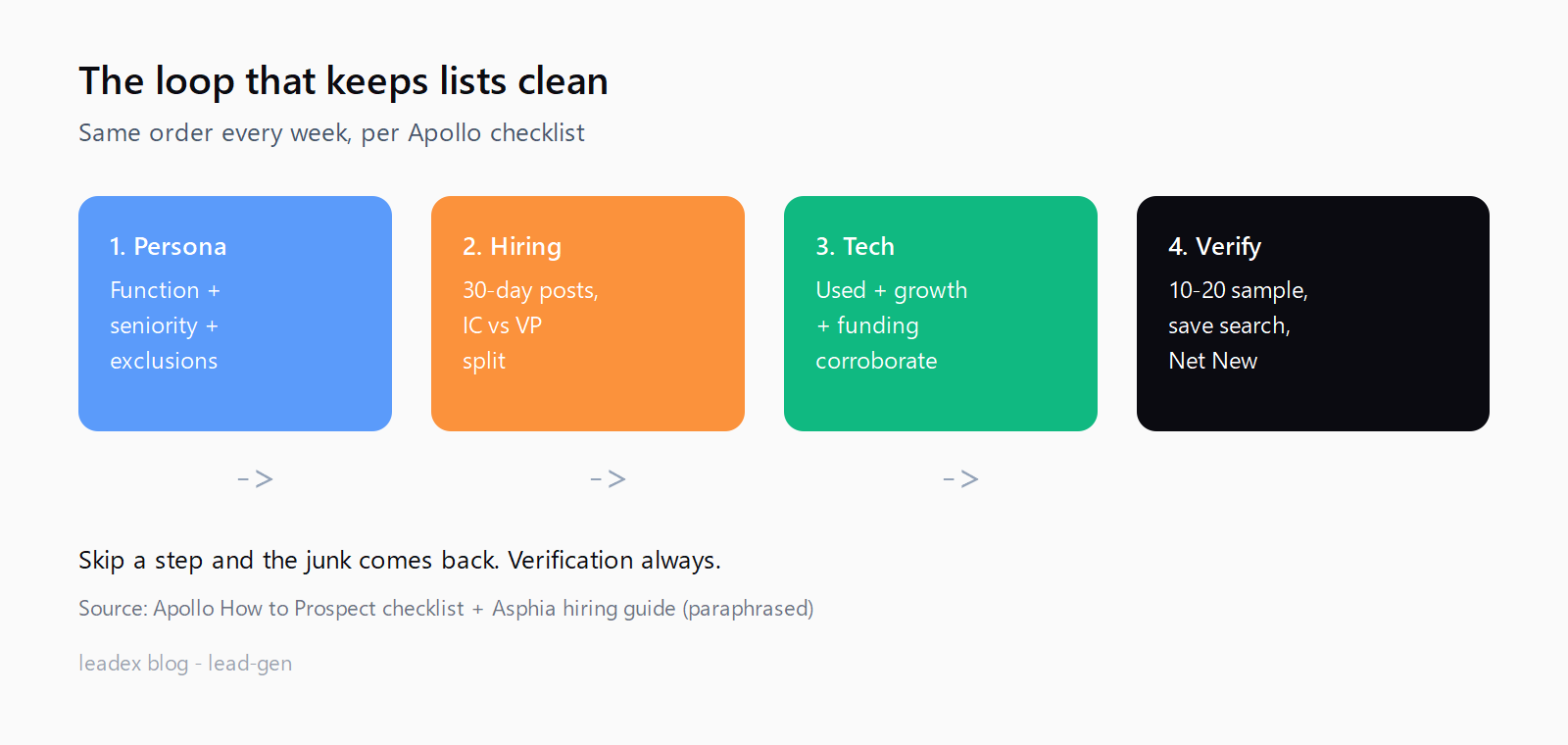
This seam between discovery and enrichment is where Leadex lives. Apollo gives you filters and sequences, while Leadex runs the same brief-to-plan motion from chat: describe the ICP, approve a plan naming concrete sources, and get a deduped CSV where company enrichment typically completes in under 60 seconds per batch. I use Apollo when dropdowns fit the ICP, and chat research when the ICP is unstructured, like Series A fintechs in France whose Head of Engineering posted about hiring in 90 days. Persona first, signals second, verification always.
The part I learned late: the best list next month comes from the saved search you set this week and leave alone. Let Net New fill, work fresh matches, and refresh exclusions monthly. (I once sequenced 400 "VP Marketing" rows that held three affiliate marketers, one podcaster, and a very confused pastor.) Keep the Persona boring, signals fresh, and exports small enough to skim every tenth row.
FAQ
Why do my Apollo searches return garbage?
Broad industry plus exact titles pull adjacent roles and holding companies. Rebuild with Function plus Seniority, add title exclusions, clip by headcount, and check 50 rows for 80% fit before adding signals.
How do Apollo Personas work?
Personas are saved ICP bundles under Search combining titles, seniority, function, industry, and headcount. Build one per buying role and reload it weekly instead of rebuilding filters.
How do I use Apollo hiring filters without chasing stale posts?
Filter by keyword, department, and posted-within-30-days, split IC scale hires from VP build hires, and chase multi-hire trends. Match every hiring account to Persona contacts before sequencing.
How many filters should I stack before the list gets too small?
Persona plus one or two signal layers is the default. Cutting 10,000 contacts to 200 to 500 Tier 1 weekly targets is normal with hiring or technographic filters applied well.
Do I need Apollo intent data or are hiring plus technographic signals enough?
Start with hiring plus Technologies Used plus growth, which are cheaper and clearer than intent. Add intent only atop a proven base, with a high score floor and short window.