
What Are Technographic Data Providers and How to Pick One for Account-Based Prospecting
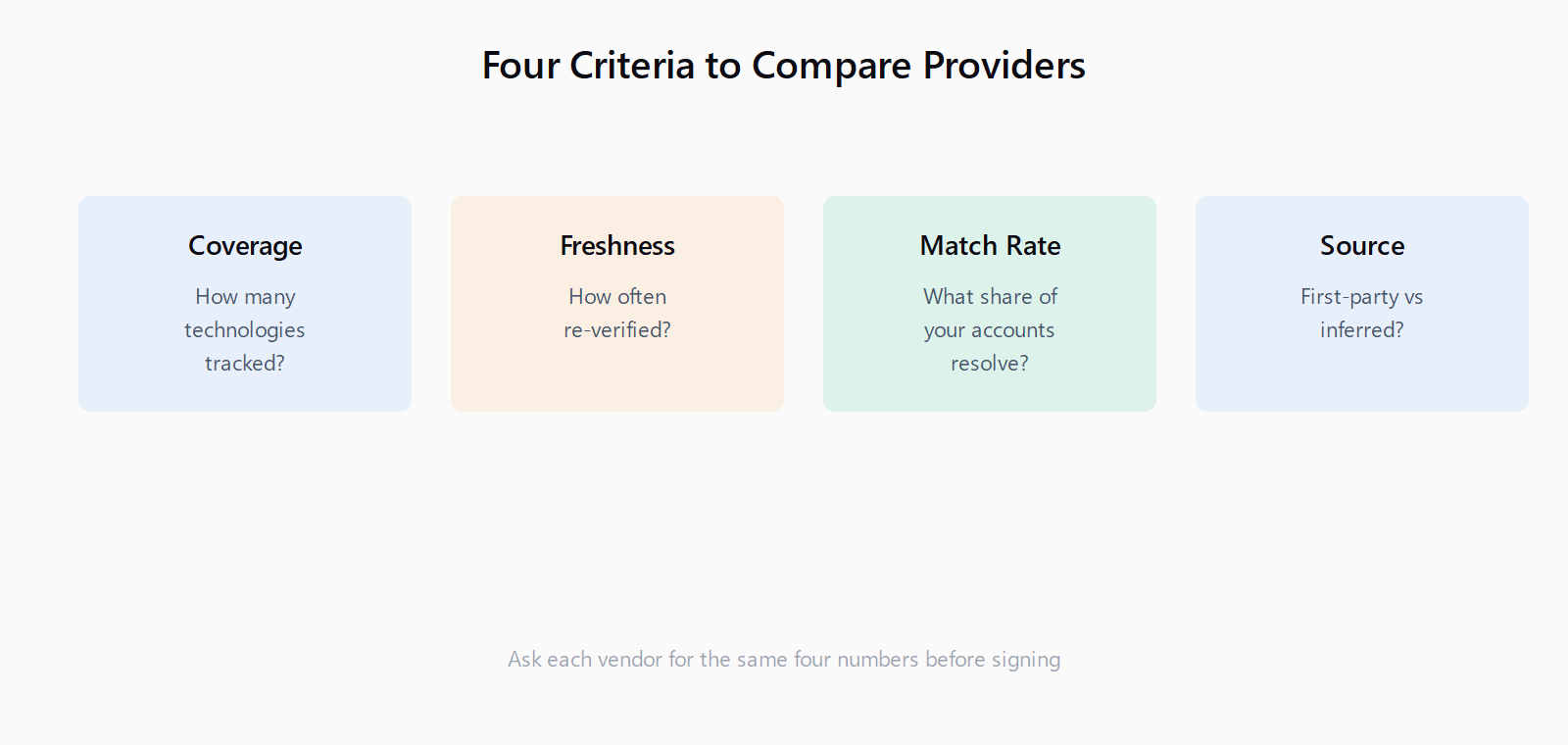
Four criteria to compare technographic data providers: coverage breadth, refresh freshness, match-rate accuracy, and source transparency.
If you sell software, you have probably done a version of this: you open BuiltWith, paste in a prospect's domain, and scroll until you find the line confirming their website runs the product you would like to replace. That detected technology is technographic data, and the quiet industry that collects it has become one of the more useful inputs in account-based prospecting. The problem is that "technographic data provider" now describes three different kinds of companies that answer different questions, and most comparisons treat them as interchangeable.
What technographic data actually is
Technographic data describes what technology a company uses. In B2B that means the software stack - CRM, marketing automation, data warehouse, analytics, cloud provider - rather than the demographic facts (revenue, headcount, industry) that firmographic data covers. The term is older than the industry that sells it: it was coined in 1985 to segment consumers by their relationship to technology, in a study of VCR owners that Wikipedia credits to Dr. Edward Forrest. B2B sales adopted the word decades later for a narrower job: knowing which tools a target account already runs.
The catalogues are large enough that coverage is rarely the differentiator. Cognism says it tracks a catalogue of over 20,000 technologies; BuiltWith claims to monitor 126,000-plus internet technologies with records going back to 1985. Where the providers genuinely differ is not how many technologies they name but how they know a company uses one - and that difference decides which account-based questions the data can answer.
The two ways providers assemble a tech stack
Reading a provider's sourcing documentation is the fastest way to see which of the two models you are buying. The first is direct detection: a crawler reads a company's public website - page source, headers, JavaScript libraries, DNS records - and reports what it finds, usually within days of a change. BuiltWith is the canonical example, and its lead-generation product turns that detection into filtered lists of accounts by technology, spend, and usage history.
The second model is modeled inference. A vendor combines web data with company records, job postings, and vendor-supplied install bases to estimate an organization's stack, including software that never touches a public website. ZoomInfo's capability here is itself an acquisition story: the company bought Datanyze in 2018 in a deal announced as enabling "real-time delivery of technographic data". Cognism describes the modeled approach plainly in its help center:
Technology usage is assessed annually. This means you can see whether a company is currently using a technology or has used it within a given year.
That sentence is the whole category in miniature. A detection tool tells you what a website is running right now. A modeled database tells you what an organization has used within the last year, assembled from evidence like job postings that ask for specific tool experience. Job-posting inference is the piece most buyers underestimate: when a company advertises for a "Segment administrator" or a "Snowflake engineer" before the tool appears anywhere public, that is usually a forward-looking signal that it is adopting the tool, not just using it.
What the collection model decides in practice
The models differ on three axes that map directly to account-based use cases. Freshness: detection tools see a website change this week; modeled databases restate positions on an annual or slower cadence, so a "Salesforce customer" flag can describe a company that migrated to HubSpot six months ago. Visibility: detection only sees the public web, which is why the marketing stack is over-represented and the ERP or data warehouse barely appears; modeled vendors claim to cover behind-the-firewall software precisely because job postings and vendor records leak it. Price and shape: a detection tool costs a few hundred dollars a month; a modeled feed usually arrives inside a five-figure database contract or an ABM platform seat.
Those axes should decide your provider, and most people pick on coverage numbers instead. If your play is competitor displacement - find accounts running the tool we replace - you want the modeled catalogue with its "used within the year" semantics, because it captures the org-wide install base, not just the marketing site. If your play is replatforming windows, you want detection with history, because you are looking for the change itself. If your product integrates with a back-office system no scanner can see, only the modeled vendors can plausibly claim the field at all.
The honest counter-take, which vendors rarely lead with, is that both models leak in opposite directions. Detection over-claims adoption from a single public artifact: a five-person company can run Salesforce's marketing site and appear in a "Salesforce users" list, which tells you nothing about its sales org. Modeled data under-claims recency and over-claims certainty - the annual restatement means the flag describes a point in the past, dressed up as a current attribute. Semir Jahic, CEO and co-founder of Salesmotion, makes the same point about why a stack change matters more than a stack snapshot in his 40-signal buying-signals guide: "Installing a complementary tool signals investment in your category. Removing a tool signals dissatisfaction and an open budget line." A change is a signal; a snapshot is a filter.
That distinction is where technographics earns its place in account-based prospecting. A static stack field is not a buying signal on its own - it is segmentation, a way to narrow the universe. The moment the field changes, or the moment you stack it against something else, it becomes evidence. This is the logic behind the technology-stack category in our buying-signal taxonomy: a new tool install is one trigger, and it becomes predictive when it triangulates with hiring or intent. In that role, technographic data is also a useful antidote to intent noise - if an account shows intent on your category, confirming it actually runs the adjacent tool you integrate with separates a real evaluation from a ZoomInfo intent false positive.
This is exactly the kind of attribute that sits at the seam between discovery and enrichment - the seam Leadex is built to close. A research brief that says "companies running the tool we replace, that posted for a RevOps role this quarter" is a technographic filter and a hiring signal combined into one run, with the enrichment step handled by whatever contact provider you already pay for.
How to pick a provider and test it before you sign
Start by writing down the one account-based question you are trying to answer, because it names the model you need. Then apply a short checklist to any shortlist. Ask what evidence backs the field and whether you can see it: a detection tool should show you the URL and the detected signature, a modeled vendor should at least timestamp the record. Ask what the flag means semantically - "currently running," "used this year," or "mentioned in a job posting" are three different statements that some products display as one checkbox. Ask how often the technology catalogue itself is updated, not just the company records; a vendor whose taxonomy still lists a product as current after a rename is telling you where its maintenance budget goes. And ask whether back-office coverage is real or inferred, because if you sell data infrastructure, the inferred fields are the only ones that matter to you.
Then run the same test we recommended in the Cognism vs ZoomInfo EMEA comparison: take thirty accounts you know intimately - a mix of customers, known users, and known non-users of a specific tool - and check each vendor's flag against what you actually know. The coverage numbers in the sales deck will not survive contact with your real ICP; the error pattern on your thirty accounts will tell you which model's blind spot you can live with. Detection vendors will be right about the website and wrong about the org; modeled vendors will be the reverse, and the flag you care about determines which failure you can tolerate.
The final consideration is where the data lives. A technographic field you can filter inside your existing database or CRM is infrastructure; a technographic dataset you have to export and rejoin yourself is a project. Most teams already own a database with some stack fields - the win is learning which model produced them and what the lag is, not buying a second copy of the same annual snapshot.
The field worth watching next is the freshness arms race. Detection is already near-real-time, and modeled vendors are being pushed toward it by the same buyers who learned to distrust annual restatements. I suspect the winner will be whoever stops selling "uses this tool" and starts selling "adopted this tool, last confirmed on a date," because that is the version that composes cleanly with the rest of a buying-signal stack.
FAQ
What counts as technographic data?
Technographic data describes the software a company runs: CRM, marketing automation, data warehouse, analytics, cloud provider, and similar stack categories. It describes what tools an organization uses, as opposed to firmographic data, which describes what the organization is (revenue, headcount, industry).
What is the difference between firmographic and technographic data?
Firmographic data is demographic data about a business - size, industry, location, funding. Technographic data is about its technology usage - which vendors and product categories it runs. Firmographics tell you whether an account fits your profile; technographics tell you whether your product fits its existing stack.
How do technographic data providers collect their data?
Two models dominate. Detection vendors crawl public websites and report technologies they find in page code, headers, and scripts, usually within days of a change. Modeled vendors combine web data, company records, and job postings to estimate organization-wide usage, including software that never appears on a public site, but they typically restate their records on an annual cadence.
Is technographic data a buying signal?
A static technographic field is segmentation, not a signal. It becomes a buying signal when it changes - a company installing a complementary tool or removing a competitor's product - or when it stacks with other evidence such as hiring and intent. Treat a stack snapshot as a filter and a stack change as a trigger.
Which technographic data provider is best for account-based prospecting?
It depends on the use case. BuiltWith is the reference for real-time detection of website-visible technology. ZoomInfo and Cognism sell modeled organization-wide stack data inside broader databases, and 6sense and similar ABM platforms fold stack attributes into account scoring. Test each against accounts you know before committing, and choose by which model's blind spot you can tolerate.