
How to Cap Follow-Ups at 3 Touches Before Replies Drop
Five-step sequences feel diligent. The data says touches 1-3 earn replies and touch 4 earns spam complaints. Here is the 3-touch audit and rewrite.
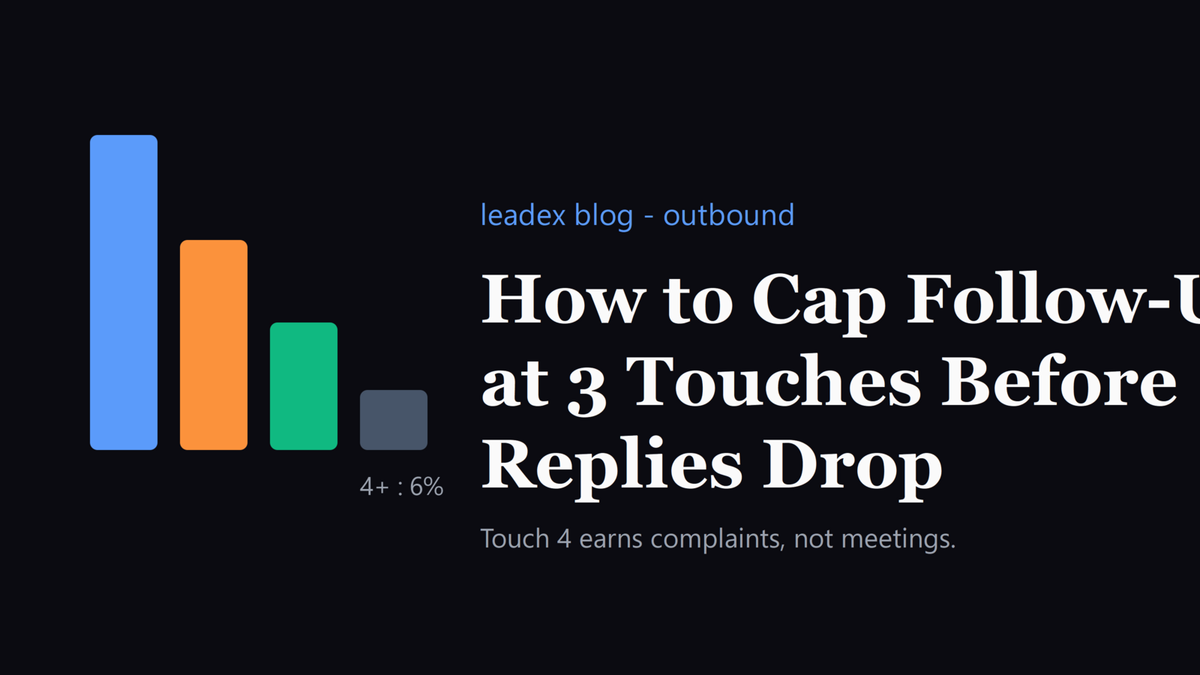
Apollo's follow-up guide from May 2026 reads like a retraction of a decade of sequencing advice. For years the default SDR wisdom was five touches minimum, seven if you were serious. Apollo now says three follow-ups outperform one, and the fourth actively hurts. I have seen this same ceiling from the other side: teams debugging follow-ups firing on weekends discover their sequences were too long before they discover anything else about them.
The numbers behind the retraction are hard to argue with. Sales.co classified 61,770 replies across more than 2 million cold emails sent between 2024 and early 2026 and found the initial message drives 79.4% of all replies at a 1.83% reply rate, while follow-ups manage 1.22% with a lower positive rate (8.90% versus 7.55%). Average reply rates slid from 6.8% in 2023 to 5.8% in 2024, per Belkins. When the baseline falls that far, each low-yield touch costs reputation, not just effort.
Three follow-up emails outperform one, but a fourth touch actively damages reply rates and triggers spam complaints.
That sentence, from Apollo's strategic follow-up guide, is doing two jobs at once. The first half is the familiar diminishing-returns story. The second half is the part most sequence builders ignore: past touch three you are not just wasting sends, you are training spam filters against your own domain (!). SmartReach's 2026 benchmark of 40M+ emails puts the shape on it: 58% of replies arrive on touch one, 24% on touch two, 12% on touch three, and 6% on everything after.
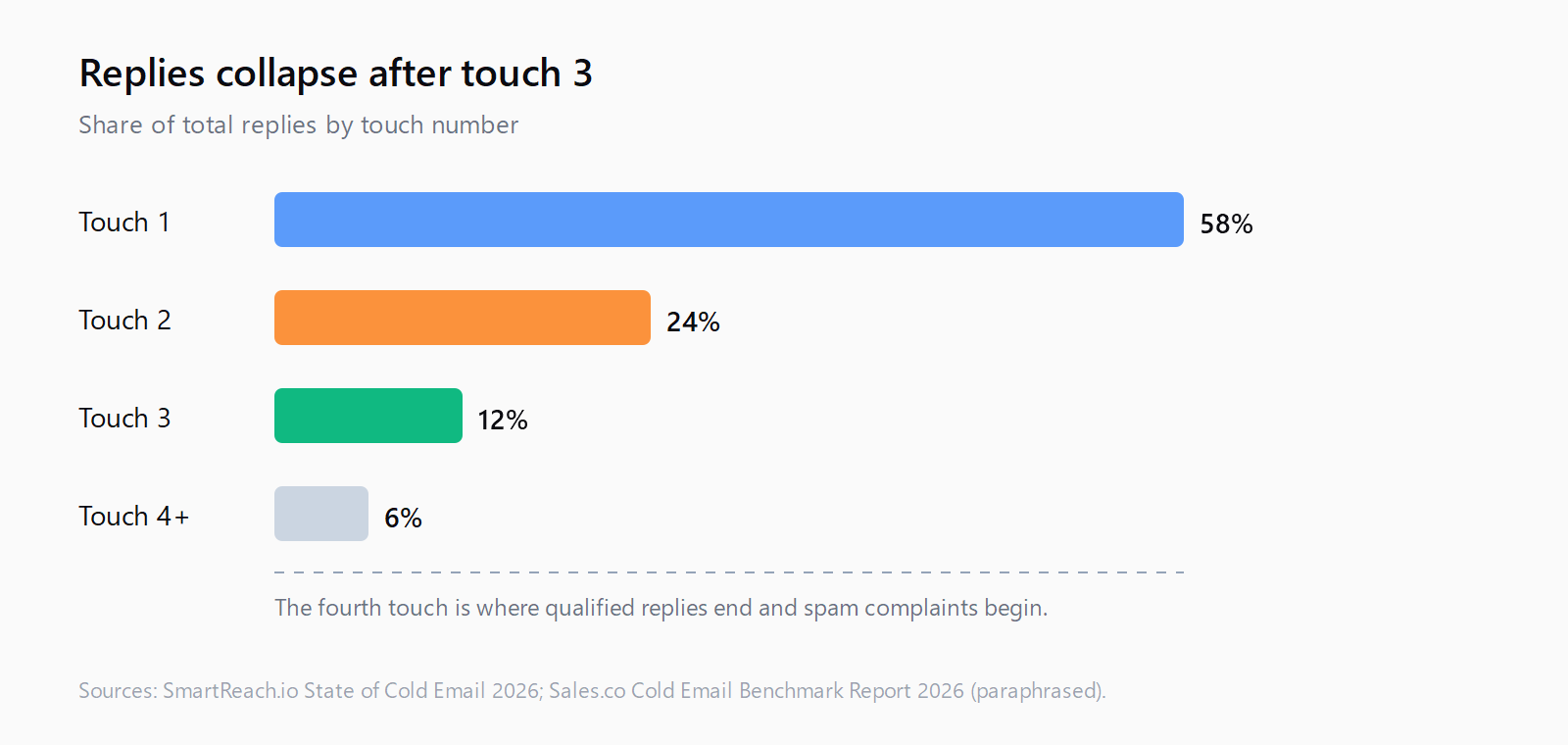
My one problem with the "just send fewer emails" moral is that it lets bad lists off the hook. A three-touch cap on a sloppy list still fails; it just fails faster and more quietly. The cap works when each touch earns its place, which is a list-quality problem before it is a copy problem. That is the part worth spelling out step by step.
How to audit reply rate by touch number
Export replies per sequence step for the last 90 days and split them into qualified replies (anything that advances a conversation: a meeting, a referral, a real question) versus total replies. OneAway's cut of 1,533,399 emails is the cautionary tale here: a 1.24% reply rate where only 13.4% of replies showed interest, roughly one interested reply per 600 sends. If you optimize for raw replies, their analysis concludes, you mostly optimize for people telling you no faster, since guilt-trip follow-ups lift reply counts while filling the inbox with rejections.
Plot qualified reply rate per touch alongside unsubscribes and spam complaints per touch. The pattern I expect (and the pattern in every dataset I have seen) is a steep drop after touch three with complaints rising from touch four on. If touch four shows near-zero qualified replies, delete it rather than rewriting it. RevOps teams that track this cut usually find the fourth touch was never earning its keep; it was just the default the sequencer shipped with. Rising opt-outs alongside flat replies is cadence fatigue, and the fix is subtraction. This is the same complaint math behind the Gmail spam complaint ceiling I wrote about earlier: Google wants spam rates under 0.10% and starts punishing at 0.30%.
How to write three touches that each add value
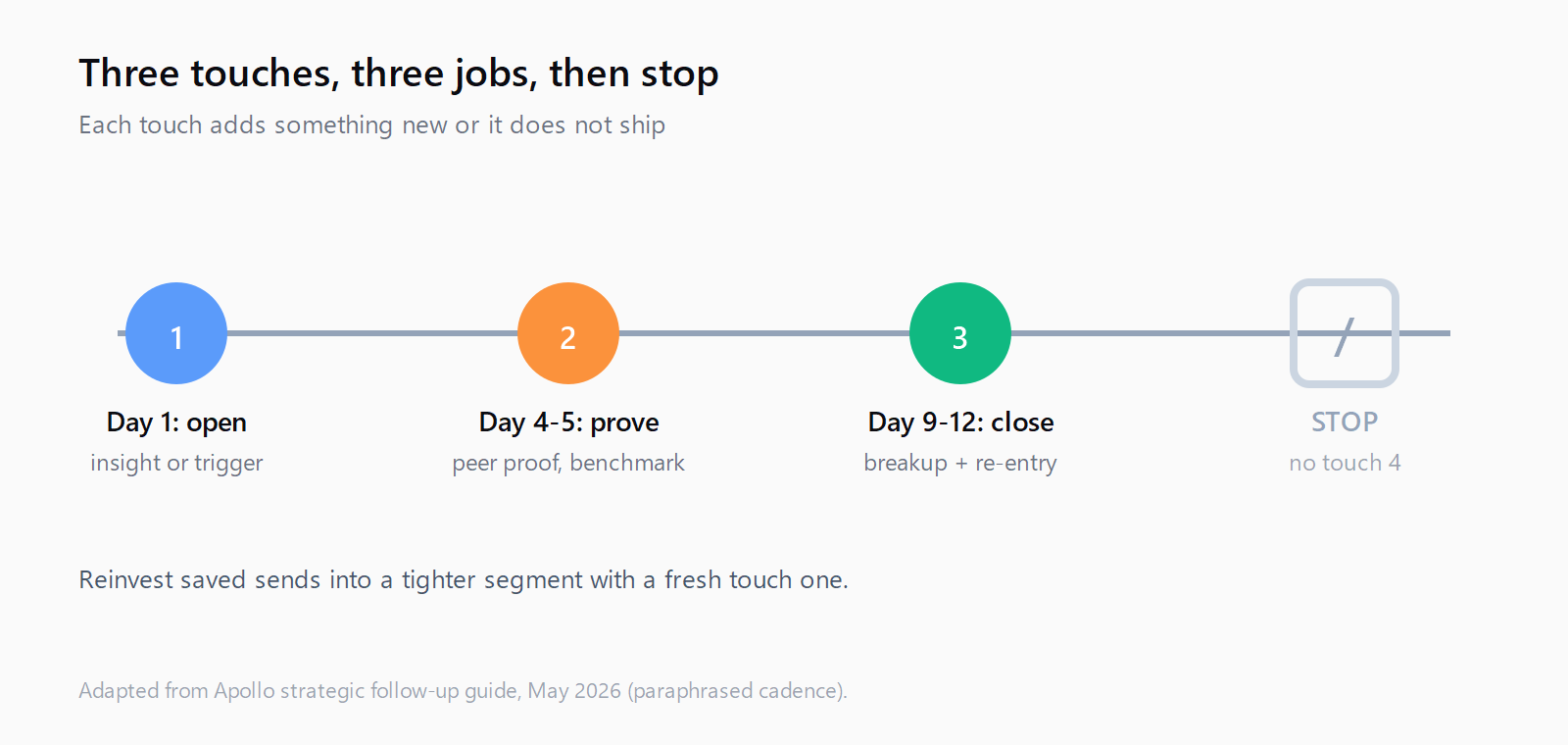
Touch one (day 4-5 after the opener) adds a proof point the first email did not contain: a peer result, a benchmark, a one-line customer story. Touch two (day 9-12) references something that changed since the opener: a funding round, a job post, a product launch, or a specific low-friction next step tied to that trigger. Touch three is the breakup: give explicit permission to disengage and offer a re-entry path ("if the timing is wrong I will not follow up again, happy to reconnect next quarter"). Keep each under 200 words; Sales.co found ultra-short and medium emails tie at roughly 8.8% positive rate while long ones sink to 6.42%.
The reason "just checking in" deserves its reputation is buyers, not deliverability. Gartner's June 2025 survey of 632 B2B buyers found 73% actively avoid suppliers who send irrelevant outreach. As Robert Blaisdell, VP Analyst in the Gartner Sales Practice, put it: "Many B2B buyers feel overwhelmed and frustrated by the outreach they receive from sellers and the seller's organization. Bad prospecting actively damages relationships with potential customers." Every touch has to justify its existence with something new, because the buyer is keeping score and the filter is keeping score too.
How to cut the fourth touch without losing pipeline
The objection writes itself: cumulative reply rate keeps climbing through touch five in most aggregate datasets, so cutting touches must cost meetings. (To be fair, I believed a version of this for years.) The error is counting every reply as progress. Aggregate curves count unsubscribes, "take me off your list," and auto-replies as replies; OneAway found 45.1% of replies in their corpus were auto-replies and 29.9% were negative. Strip those out and the fourth touch contributes almost nothing positive while contributing fully to complaint volume. Reinvest the saved sends into a tighter segment with a fresh touch one instead.
This is exactly the seam Leadex is built to close: follow-up discipline only pays when the list underneath it is tight enough that three touches suffice. Leadex does this same workflow from a single chat, describe the ICP, approve the plan, and semantic search returns up to 100 results per call per query so the segment earns its three touches instead of the sequence compensating for a weak list. One paragraph on the tie-in is enough; the point is that capping touches is a targeting decision first and a copy decision second.
How to fix deliverability before rewriting copy
A 10% open rate on hundreds of sends screams infrastructure, not subject lines. That is a paraphrase of a firsthand Reddit report from a struggling sender, and it matches the canonical demand signal for this whole topic: the "0.3% reply rate for months" thread where the actual fault turned out to be deliverability the sender had never audited. Google's sender guidelines, enforced since February 2024, require SPF and DKIM for bulk senders plus DMARC alignment, valid forward and reverse DNS, and one-click unsubscribe on marketing mail. Miss any of those and touches two through five land in spam while you A/B test subject lines against an audience of nobody.
The order of operations: authenticate everything, warm dedicated sending domains before launch, suppress bounces, cap daily volume per inbox, then audit the per-touch curve above. If reputation is already damaged, the recovery playbook is slow and unglamorous, pause volume, isolate the burned domain, rebuild on warmed infrastructure, which is the full sender reputation recovery procedure. Only then does rewriting touch two make sense. Copy changes on top of a burned domain are (I believe) the most common wasted effort in outbound.
The kicker for the next sequence review: count how many of your current touches introduce something the prospect has not already read. If the honest answer is one, you do not have a five-step sequence. You have one email and four reminders, and the reminders are the part the filters remember.
FAQ
How Many Follow-Up Emails Should SDRs Actually Send?
A maximum of three follow-ups after the opener, for four emails total. Sales.co recommends a maximum of 3 emails total per sequence, Apollo draws the damage line at the fourth touch, and SmartReach shows touches four and beyond contribute just 6% of replies. Longer sequences trade near-zero incremental positives for rising spam complaints.
What Should Each Follow-Up Email Say to Improve Reply Rates?
One new element per touch: proof on touch one, a trigger event or concrete next step on touch two, a graceful breakup on touch three. Generic "just checking in" messages repel buyers; 73% of B2B buyers avoid suppliers who send irrelevant outreach, per Gartner's 2025 survey. Keep each under 200 words.
Does Deliverability Affect Follow-Up Reply Rates?
Yes, before copy or cadence even matter. Missing SPF, DKIM, or DMARC alignment under Google's post-February-2024 rules routes follow-ups to spam regardless of wording. Audit authentication, domain reputation in Postmaster Tools, and bounce suppression first; keep spam rates under 0.10% and never near 0.30%.
What Should the Breakup Email Say on Touch 3?
Give explicit permission to disengage plus a dated re-entry path, such as reconnecting next quarter. The goal is a clean list and a memorable exit, not a guilt-trip reply. Breakups that offer a specific reason to re-engage later outperform open-ended "let me know" closes and protect the domain for the next sequence.