
Why Third-Party Email Verification Flags Apollo-Verified Emails as Invalid
Apollo's SMTP handshake passes catch-all domains where third-party verifiers flag them as unverifiable. Segment them into a separate campaign.
You export a list from Apollo, the email column shows "verified" or "good" in the verification badge, and you route it straight into the sequencer. Then you run the same list through a third-party email verification tool - ZeroBounce, NeverBounce, BriteVerify, MillionVerifier, whichever - and a significant chunk of those Apollo-verified addresses come back flagged as "catch-all" or "risky" or, in some cases, "invalid." The first time this happened to me I assumed the verification tool was wrong, because Apollo's badge is right there. It was not wrong. It was seeing something Apollo's verification pipeline was not designed to detect.
The gap is not a bug in either system. It is a structural limitation of SMTP-level verification against catch-all domains, and it is one of the most common reasons a cold-email program sees a higher bounce rate than the Apollo badge would suggest.
Why Apollo's SMTP verification passes catch-all domains
Apollo's email verification process - documented in their How Apollo Verifies Emails article - uses a multi-step pipeline that includes SMTP handshake verification. The engine connects to the receiving mail server, simulates the beginning of a mail delivery by sending a "MAIL FROM" and "RCPT TO" sequence, and checks whether the server accepts or rejects the recipient address. If the server responds with a code indicating the mailbox exists, Apollo marks the address as verified. This is a standard industry technique called SMTP tickling, and it works well for most domains.
For catch-all domains, it does not work at all. A catch-all mail server is configured to accept every address at the domain - valid or not - and respond with a "250 OK" to every RCPT TO command. The server does not distinguish between a real mailbox and a nonexistent one because the domain administrator chose to route all undeliverable mail into a single inbox. Apollo's SMTP handshake gets a green light for every address at that domain, and the verification pipeline has no way to tell the difference.
Catch-all domains are email domains that always return a "Valid" response from the SMTP service, whether the address is valid or invalid. [...] Because validating catch-all domains is impossible, ZeroBounce identifies and labels these domains accordingly. From there, it's up to you to decide if you want to risk emailing these domains.
- ZeroBounce Help Center, What Are Catch-All Domains?
This is not a limitation unique to Apollo. Every email verification system that relies on SMTP handshake as a primary signal will produce false positives on catch-all domains - the protocol itself is the problem, not the implementation. The difference is that Apollo's verification pipeline is optimized for speed and scale inside a bulk-export workflow, and it is not designed to run the additional detection layers that dedicated verification tools apply to catch-all domains.
What third-party verifiers do differently
Dedicated email verification tools like ZeroBounce, NeverBounce, and MillionVerifier add a second phase of analysis specifically for catch-all domains. ZeroBounce's Catch-All Email Validation, for example, triggers automatically when an initial validation pass identifies at least 10 catch-all addresses in a list. It runs deeper models and additional signals against those addresses, and according to the documentation, "processing may take up to 12 hours, depending on list size and domain behavior." The result reclassifies some catch-all addresses as valid or invalid, while the remainder stay categorized as catch-all - meaning the tool is honest about the uncertainty rather than pretending the address is clean.
These tools use a combination of techniques that Apollo's bulk-export pipeline does not typically employ: domain-level pattern analysis (checking whether the MX record is configured to accept all mail), bounce pattern matching against known catch-all signatures, greylisting detection, and real-time SMTP interrogation with timing analysis. A catch-all server accepts the RCPT TO command instantly regardless of the address; a non-catch-all server may reject an invalid address with a specific error code or a timing delay. ZeroBounce claims 99.6% accuracy in identifying these patterns - a figure that points to the complexity of the detection, not to a simple yes-no check.
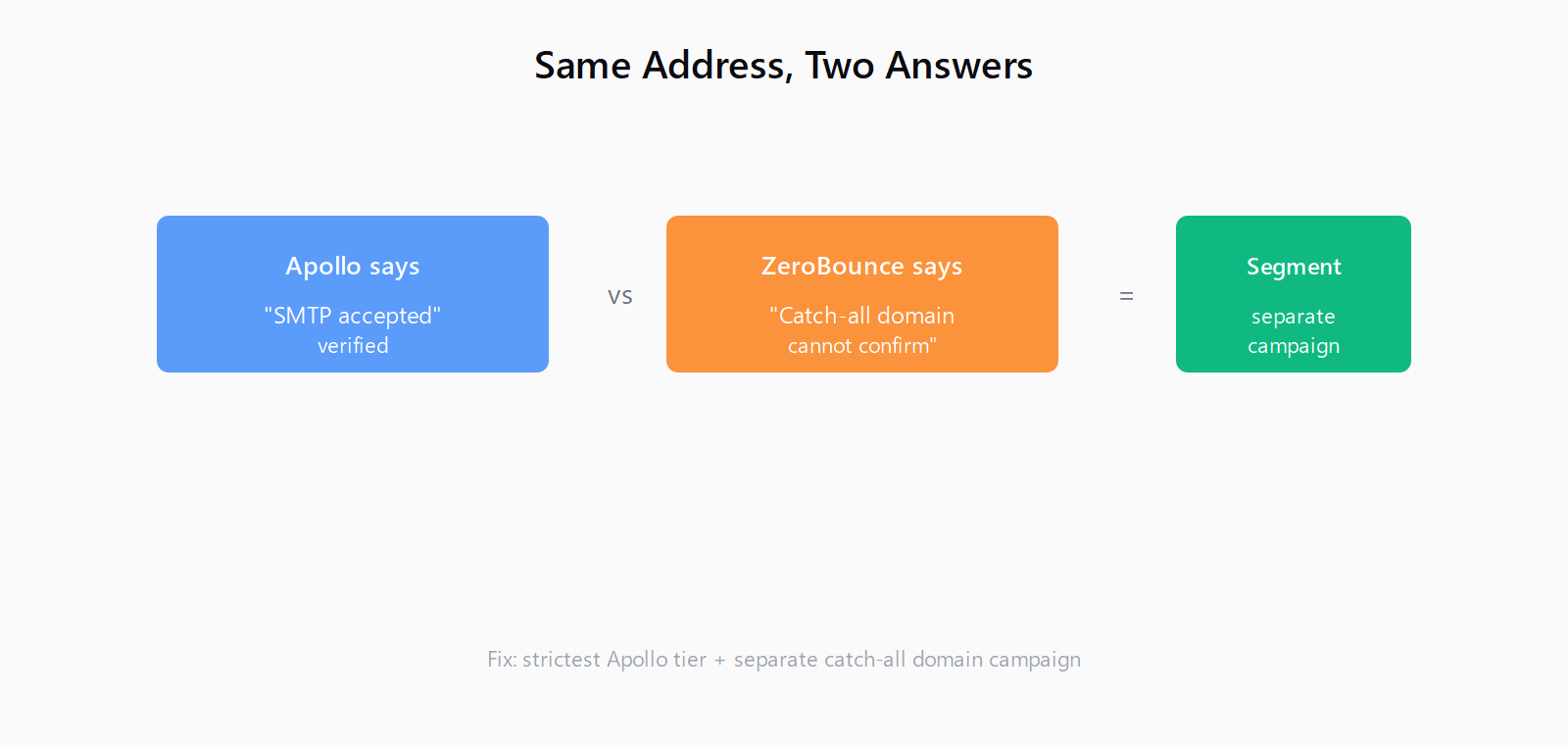
The result is a fundamental disagreement between two verification systems that are both technically correct. Apollo says "the SMTP server accepted this address" - true. ZeroBounce says "the SMTP server accepts every address at this domain, so we cannot confirm the specific mailbox exists" - also true. The question is which answer you should trust when building a sending list.
How to reconcile the two signals before you send
Treating the third-party flag as a veto is the safest default, but it has a cost. Some of those catch-all addresses are actually valid mailboxes, and by excluding them you lose reachable prospects. The workaround is not binary - include or exclude - it is operational: tag the catch-all addresses during enrichment and route them into a separate, lower-volume sending campaign.
Inside Apollo, the first step is to confirm that Apollo's email verification tiers are set to the strictest available level before export. The data validation toggle inside the waterfall enrichment settings, which Apollo ties to a 45% lower email bounce rate, is the same mechanism that reduces the share of soft-verified addresses in a pull. It does not eliminate catch-all false positives - no SMTP-level toggle can - but it shrinks the pool of unverifiable addresses that reach your list.
After export, run the email column through a dedicated verification tool that flags catch-all domains explicitly. Do not rely on the tool's "valid/invalid" binary - use the catch-all status field if it exposes one. Tag those contacts in your CRM or sequencer, and send them on a separate sending domain that can absorb a higher bounce rate without affecting your primary outbound reputation. This is the same principle I described in how to audit Apollo bounce logs - the most reliable deliverability signal is what actually happens when you send, not what the verification badge said before you hit send.
If you are building a cold email infrastructure from scratch, the catch-all question is a good reason to set up a secondary verification step before the CSV reaches the sequencer. A catch-all address that bounces costs the same reputation damage as a hard bounce on a bad address - the sending domain does not care about the distinction. ZeroBounce's own warning on the subject is worth treating as a rule: "Repeated bounces and lower engagement will hurt your email deliverability."
We think about this exact gap at Leadex because the pipeline between discovery and sending is where verification disagreements show up most often. Leadex routes researched contacts through your own connected enrichment providers - Apollo, HubSpot, or whichever you have configured - and the verification tier you set inside those providers is the same one Leadex's enrichment pass runs through. The catch-all ambiguity is not something Leadex adds or removes; it is inherited from whatever verification settings your enrichment provider has active. The value Leadex adds is the full audit trail - a URL and timestamp for every row in the CSV - so when a catch-all flagged address bounces, you can trace it back to the domain it came from and decide whether that domain belongs in the next run at all.
FAQ
Why does Apollo mark emails as verified if they are on a catch-all domain?
Apollo's verification uses SMTP handshake to check whether the receiving mail server accepts the address. Catch-all servers accept every address, valid or not, so the SMTP check passes for every address at that domain. Apollo's verification pipeline is not designed to run the additional detection layers that dedicated verification tools apply to catch-all domains.
Can I make Apollo detect catch-all domains during verification?
Not directly. Apollo does not expose a catch-all detection toggle in its verification settings. The practical workaround is to run the email column through a dedicated verification tool that flags catch-all domains, then segment those addresses into a separate sending campaign.
Should I delete all catch-all flagged addresses from my list?
No. Some catch-all addresses are valid mailboxes, and excluding them means losing reachable prospects. The better approach is to segment catch-all addresses into a lower-volume campaign on a separate sending domain, so you can test deliverability without risking your primary outbound reputation.
Does ZeroBounce's Verify+ feature reclassify catch-all Apollo-verified emails?
Yes. ZeroBounce's Catch-All Email Validation (Verify+) runs a second analysis phase on addresses initially identified as catch-all. It may reclassify some as valid or invalid based on deeper signals. The process can take up to 12 hours and is described in their documentation as a multi-phase approach to catch-all resolution.
What is the most reliable way to check if an email is on a catch-all domain?
No single check is reliable for catch-all domains - that is the defining characteristic of the problem. The most practical approach is to combine SMTP verification (which Apollo provides) with a dedicated verification tool that runs domain-pattern analysis and bounce signature matching, then route the uncertain addresses to a separate test campaign before mixing them into your main sequence.