
How to Use Apollo's Built-In Email Warmup Without Slowing Outbound
Apollo warmup costs 200 credits per mailbox per 30 days via Warmbox.ai, pauses when the pool runs dry, and can fail with error 53130 on start.
Two months ago I wrote about Smartlead silently disabling mailbox warmup after a pool bounce, and the response from readers was consistent: plenty of people had been burned by warmup quietly failing, almost nobody was checking. Apollo's built-in warmup has the opposite problem. It rarely fails silently, but it does fail loudly, and it is metered in a way that surprises people who assume warmup is a free in-plan extra. The two surprises are the recurring credit charge and the cryptic error 53130 that blocks warmup from starting.
Apollo's warmup is a genuine bundled feature. You turn it on from Settings > Email setup and health and it runs through a third-party network of inboxes that send, open, and reply to messages from your mailbox to build sender reputation. The engine behind it is Warmbox, which Apollo names plainly in the help docs. It sends system-generated test messages between a private network of inboxes; it does not touch your sequences or templates, which is why there is no "choose which sequences to warm up" setting - it does not work that way. The help article was updated July 29, 2026 and covers the whole setup flow.
How Apollo's built-in warmup works
Setting it up is short. Link the mailbox first - warmup only works on mailboxes connected to Apollo - then go to Settings > Email setup and health and toggle "Start warm up" beside the mailbox. Apollo recommends signing in with Google rather than pasting an app password; the OAuth connection is more stable and avoids the "connection dropped" failure class later. Office 365 mailboxes need SMTP AUTH enabled or warmup cannot run at all.
Then you pick a mode and a schedule. Progressive ramps volume up gradually and is the recommended default. Flat sends a constant volume and suits a mailbox that is already warm. Randomized does what it says. Apollo recommends a minimum two-week warmup window, a minimum of 10 emails per day, a recommended maximum of 40 (hard cap 50), and a 30% reply rate (hard cap 45%). Those caps matter if you are a high-volume sender - warmup is deliberately gentle, and it competes with your real outbound for the same daily quota at the mailbox provider.
What warmup actually costs in credits
Here is the part the marketing pages do not lead with: warmup is metered against your Apollo credit pool, and Apollo charges it when you start warmup and again at the top of every 30-day billing period. The help center spells out the tiers:
Apollo charges the applicable credits when you start warmup and again at the beginning of each 30-day billing period. If your team doesn't have enough credits when the next cycle is charged, Apollo automatically pauses warmup for the mailbox.
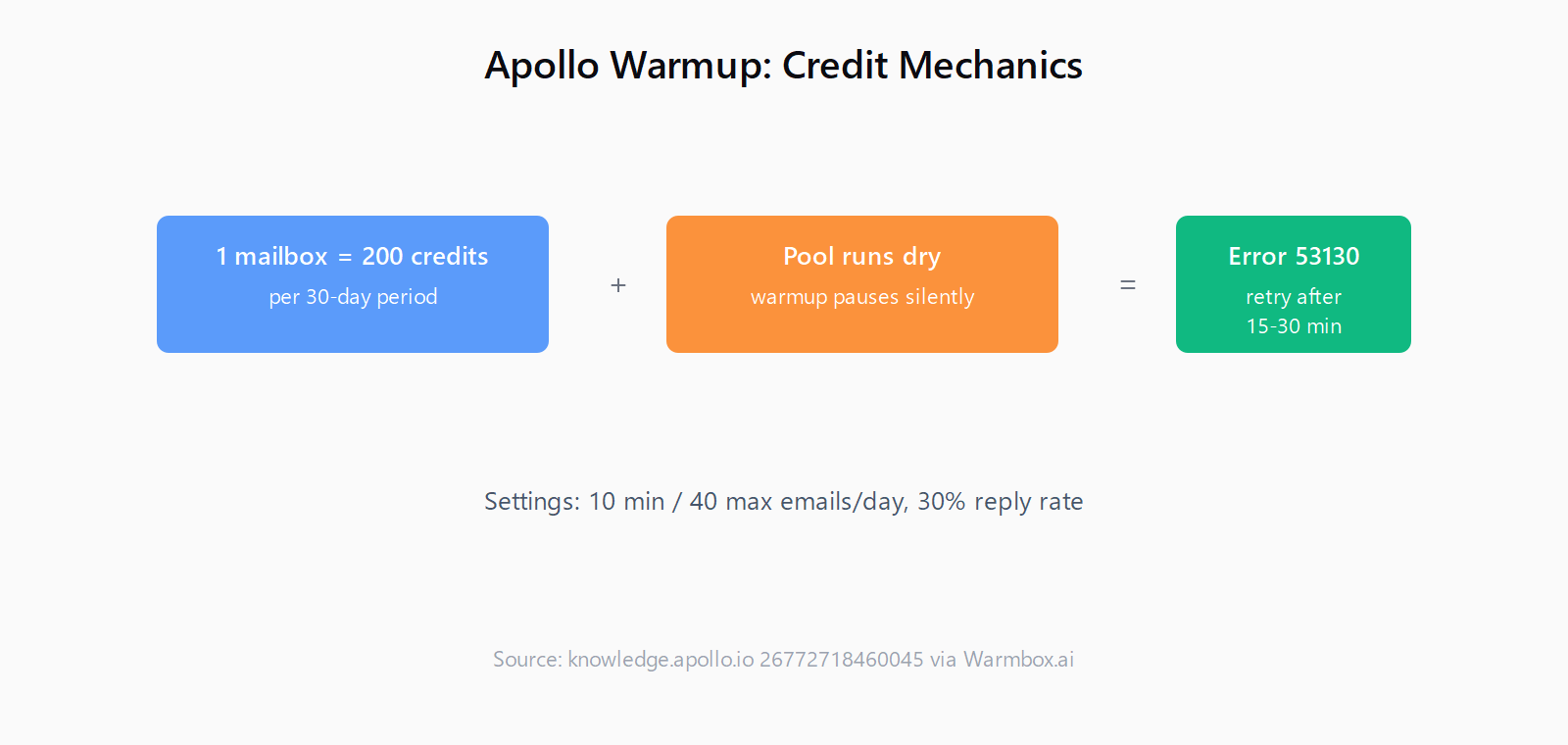
Paid plans typically include warmup for one mailbox per seat. Each additional mailbox costs 200 credits per 30-day billing period. Free plans also cost 200 credits per mailbox per 30 days. Export-credit plans use 40 export credits. If you run a team of three with two mailboxes each, that is a recurring 600-credit burn per month on top of exports and enrichment - real money if your credit pool is tight.
The failure mode is straightforward: when credits run out at cycle charge, Apollo pauses warmup. It does not cancel it and does not wipe progress. You top up credits and restart from mailbox settings and it resumes where it left off. The nuance to watch is the difference between pause and relink. Restarting after a credit top-up resumes warmup; relinking a mailbox restarts from zero. Those are different operations with different consequences for a domain that is mid-warmup.
How to set up warmup without slowing outbound
Warmup and outbound compete for the same mailbox. Apollo says explicitly: allow warmup to finish before sending automated or manual emails, and enrolling multiple mailboxes at once may slow your outbound volume. The practical reading is to sequence the rollout. Warm up a domain before you put volume on it, one mailbox at a time, and keep real campaigns off that mailbox during the window. This is the mailbox-level complement to the domain authentication work in any cold email infrastructure setup.
The "multiple mailboxes slow outbound" note is worth flagging for teams. It is easy to glance at the credit line, think "cheap, just pay it," and warm every mailbox simultaneously. The credit charge is real but small relative to the real cost, which is throttled sending while the network ramps. Staggering mailboxes a week apart keeps you from paying the slowdown across your whole pool at once.
If bounce rates start climbing during warmup - which can happen, especially for a new domain - the audit trail is in Apollo's deliverability suite, which now includes searchable, filterable bounce logs. The warmup period is exactly when you want those logs most, because a small bounce problem that goes unnoticed for a week can lock a domain into a reputation hole that warmup was supposed to prevent.
Why warmup stops, and what error 53130 means
Warmup can stop for three reasons, all of which Apollo documents. Credit exhaustion pauses it. OAuth revocation, a changed Gmail password, or a token problem stops it from sending until the connection is restored. And sometimes it never starts, which is where error 53130 shows up.
The error reads "Failure: Failed to parse response (Code: 53130)" and it appears when you try to start warmup. Apollo's explanation: the warmup provider, Warmbox, returned a temporary bad response. The fix is almost boring - wait 15 to 30 minutes and try again. This is usually temporary and warmup often starts cleanly on retry. If it keeps happening, unlink and relink the mailbox - and be aware that relinking restarts warmup from zero, so do not relink casually mid-warmup. The error is essentially a transient handshake failure between Apollo and Warmbox, and it resolves on its own more often than it does not.
There is also a limit to what warmup can fix, and Apollo states it plainly: if your sender reputation is already damaged, warmup may not be enough to recover it. The docs frame warmup as a reputation-builder for mailboxes that are new or neutral, not as a rescue tool for a domain that is already landing in spam. If you are trying to warm a mailbox that has been burning for months, the honest fix is usually a fresh domain or mailbox and a full deliverability review, not another warmup cycle.
The pattern is worth internalizing: Apollo warmup errors are mostly transient, and the dangerous failure is the quiet one. This is the mirror image of the Smartlead case - there it was a mailbox dropped from the pool with no alert. Here the network is contractually obliged to keep engaging, and when it stumbles it tells you, but the credit meter and the relink-resets-progress behavior can still bite you a month later.
This is the same credit economy our users live in. Leadex researches contacts and enriches them through your own provider keys - the Leadex brief is discovery, then your Apollo key does the enrichment, then deliverability happens downstream. So the credit math here is not abstract: a team that warms two extra mailboxes and runs enrichment through the same pool is managing one budget across both. It is exactly why we keep the enrichment layer bring-your-own-key - no per-contact markup, and the credit pool stays yours to budget.
If you are mid-warmup and 53130 shows up, the cheapest experiment is to wait half an hour - honestly, try the boring fix first. And before you enroll that second mailbox, run the credit math for three billing cycles, not one, because that is where the "free feature" stops being free. One genuinely useful detail from the docs: warmup test messages carry a "wbx" subject prefix, so you can set up a mailbox filter to route them out of your inbox. I set up that filter before I started warmup; it is the difference between a clean inbox and a folder full of replies you never sent.
FAQ
How much does Apollo email warmup cost in credits?
Paid plans include warmup for one mailbox per seat. Each additional mailbox costs 200 credits per 30-day billing period. Free plans also cost 200 credits per mailbox per 30 days. Export-credit plans use 40 export credits per mailbox. Credits are charged when you start warmup and again at the start of each 30-day billing cycle.
How many mailboxes can I enroll in Apollo email warmup?
The number depends on your plan. Paid plans include one mailbox per seat at no additional cost. Beyond that, each mailbox uses 200 credits per 30-day billing period. Enrolling multiple mailboxes at once may slow your outbound volume, so Apollo recommends staggering them.
Can I send emails while my mailbox is warming up?
Apollo recommends allowing warmup to finish before sending automated or manual emails. Warmup builds sender reputation through gradual, controlled volume. Sending campaigns during the warmup window competes with that process and can undermine the reputation gain.
What is error 53130 on Apollo warmup?
Error 53130 displays as "Failure: Failed to parse response (Code: 53130)" when starting warmup. It means Warmbox, Apollo's warmup provider, returned a temporary bad response. The fix is to wait 15 to 30 minutes and try again. If the error persists, unlink and relink the mailbox - though relinking resets warmup progress to zero.
Why did my Apollo email warmup stop?
Warmup stops automatically when your credit pool runs out at the next 30-day billing cycle charge. It also stops if the mailbox connection is broken - for example, OAuth revocation, a changed password, or a token issue. Credit exhaustion merely pauses warmup (progress is preserved); connection issues may require relinking, which resets progress.