
Why 11x Alice Emails Land in Spam and the 8-Cause Diagnosis Order
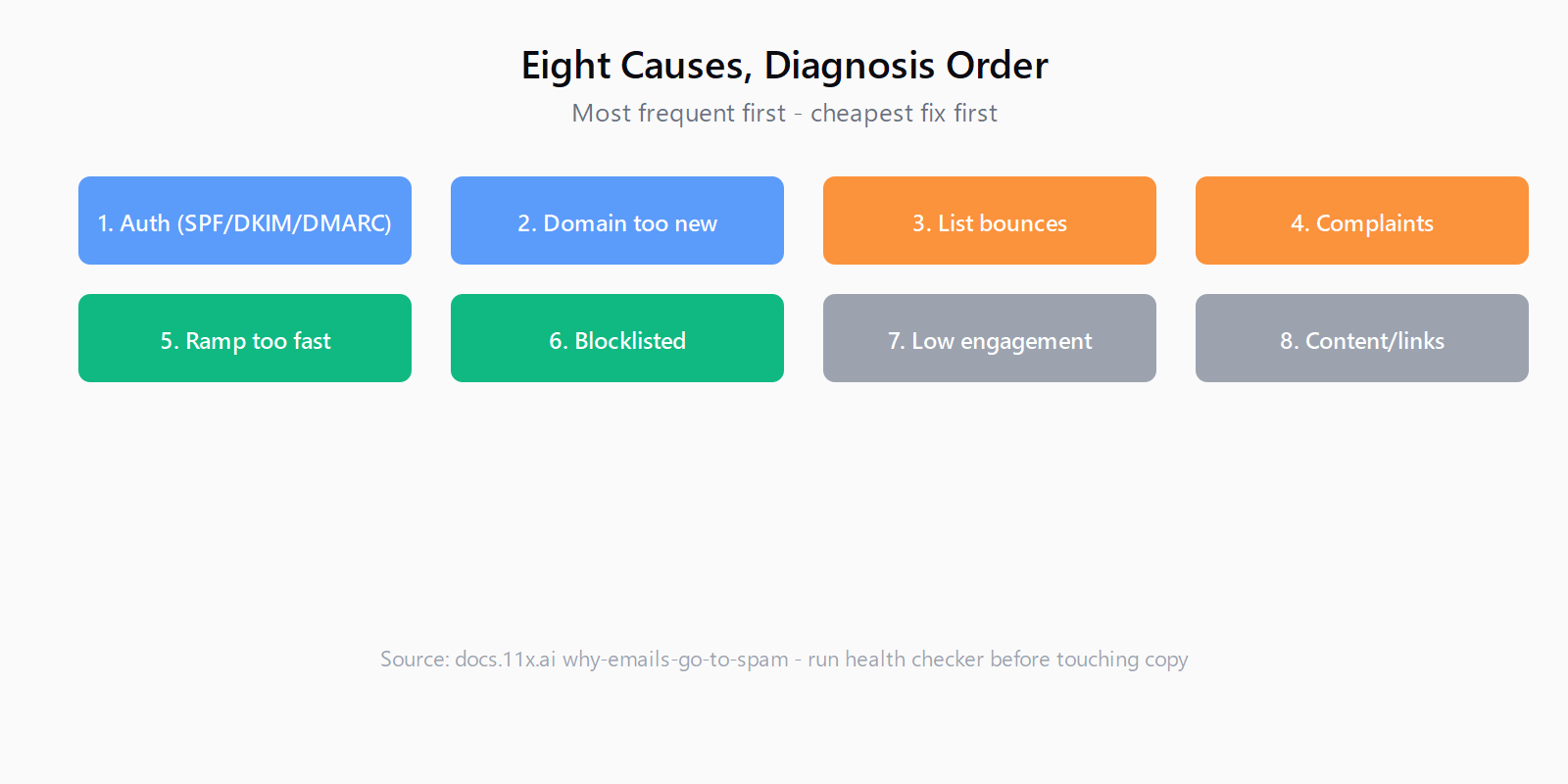
Eight reasons Alice emails land in spam, ranked by frequency: auth, domain age, list quality, complaints, ramp speed, blocklist, engagement, content.
There is a particular way an AI SDR's domain dies, and it starts quietly. Alice's delivery rate is fine for three weeks, then the analytics view shows a slow bleed - a few more spam placements each day - and one morning the inbox placement test comes back red. By the time a human notices, the domain has enough complaint history that recovery means weeks of low-volume sending, and in the worst case a blocklist entry that no warm-up schedule can rush.
11x documents the full list of causes on its why emails go to spam page, and the ordering is the useful part. Eight causes, ranked by how often they bite, with the fastest fixes first. From the page:
Emails go to spam for eight reasons, in order of frequency: email authentication is not resolving, the sending domain is too new, list quality is producing bounces, recipients are complaining, volume was ramped too fast, the domain or IP is blocklisted, engagement is too low, or content and link patterns look spammy.
I have now debugged Alice deliverability enough times to trust that order, and the pattern across every case is the same: teams jump to content and list-quality theories because those are the levers they can see in the campaign editor, when the actual cause in the majority of cases is the boring plumbing two steps up. This post walks the diagnosis in the order 11x gives it, because that order is also the rescue sequence - each step is cheap to check and the fixes compound.
Why Alice email authentication failing is the most common cause
Authentication is first for a reason: it is the cause most likely to be silently broken and the cheapest to verify. SPF, DKIM, and DMARC all have to resolve for the sending domain, and the failure mode that trips people up is that adding the DNS records is not the same as them working. Typos in the DKIM selector hostname, SPF records that exceed the ten-lookup limit, and DMARC policies stuck at p=none all pass the "did I add a record" test and fail the "is it actually authenticating" test.
11x's free domain health checker tests all three in a single pass, which is the right way to start any deliverability investigation. If it comes back clean, authentication was never the problem and you move down the list; if it flags a record, fixing that one thing usually restores normal placement faster than any other intervention on this page. This is the same wall I covered in setting up cold email infrastructure, and the same lesson applies to the AI-SDR version of the stack: the sending domain is the foundation, and nothing downstream compensates for a broken one.
How domain age and volume ramp interact
The second and fifth causes are really one story about reputation building. A brand-new domain has no sending history, so mailbox providers treat its first emails with suspicion until the domain earns trust through a gradual, engagement-positive ramp. The failure mode is skipping the ramp: pointing a fresh domain at a fully-loaded campaign and letting volume spike on day one, which reads to Gmail and Outlook as the signature of a compromised account rather than a legitimate cold sender.
11x's warm-up guide is explicit that the Deliverability Engine is meant to pace this for you, and that overriding it because early results look good is how a healthy domain becomes a blocklist entry. The counter-intuitive part is that a week of "quiet" sending during ramp is not a problem - it is the product protecting the domain. The same protective-default logic shows up in Instantly's bounce protection auto-pause, where a safety mechanism that looks like a fault is actually the thing keeping the sending domain alive.
Why list quality and recipient complaints compound
Causes three and four are the pair that quietly escalate. List quality produces bounces, and bounces at volume lower the domain's reputation; recipients who never wanted the email mark it as spam, and complaints are the heaviest negative signal a mailbox provider tracks. The compounding is the dangerous part - a bounce rate that creeps from 2% to 5% and a complaint rate that touches the ceiling will drag a domain down faster than any single fix can pull it back up.
The fix on the list side is the Qualification Agent. 11x's Alice setup filters prospects against your ICP before outreach, and keeping that filter honest is the difference between a list that produces replies and a list that produces bounces. If deliverability is slipping, the audit instinct should be: tighten the ICP and check who is actually getting disqualified, because a wrongly-included out-of-profile segment is often the invisible source of the complaints.
How to check for blocklisting, engagement, and content issues
Cause six, a blocklisted domain or IP, is the one that turns a deliverability problem into an infrastructure incident. The check is external: query the public blocklists the docs point to, and confirm whether the listing is on the domain or the shared IP. Domain listings come from complaint and content history and take weeks to clear; IP listings on a shared pool are usually the result of a neighbor's behavior and clear faster once the IP is rotated.
Causes seven and eight are the ones teams reach for first and should check last. Low engagement - opens and replies below the threshold that tells providers this mail is wanted - is a symptom of message-market fit more than plumbing, and fixing it means the copy and ICP work rather than the DNS work. Content and link patterns that look spammy, like a high ratio of link-heavy or attachment-heavy messages, round out the list. Both matter, but neither is where you should start a diagnosis, because neither explains a sudden change in a previously-healthy domain.
I keep coming back to a rule I first learned debugging a different kind of silent failure in why Alice stops sending: prove the plumbing before you rewrite the message. Deliverability is the same discipline applied to reputation. The health checker answers the authentication question in five minutes; the warm-up log answers the ramp question; the analytics view answers the complaint and bounce questions. Only after all four are clean should you touch the copy.
That diagnosis order is also the mental model worth keeping for the whole AI-SDR category. The agent is not a magic sender - it is software sitting on the same deliverability physics as every other cold email tool, which means the same DNS records, the same ramp discipline, and the same complaint-rate ceilings. When Alice's emails land in spam, the eight-cause list on the docs page is the fastest path out, and most of the time the answer is in the first two entries. We built Leadex to sit on the research side of that same stack - the list quality that determines whether your sends produce replies or complaints is exactly the input we help you get right before it ever reaches the sending tool.
The test I would run tomorrow if my domain placement were slipping: health checker first, warm-up log second, complaint analytics third, and only then a single ICP tightening. Diagnose in the order the platform documents, because that order is the reputation rescue sequence in disguise.
FAQ
Why did my Alice emails start going to spam after weeks of good delivery?
The most likely causes are cumulative - a complaint rate that crept past the ceiling, a domain that hit a blocklist after repeated complaints, or volume ramped faster than engagement could support. Run the health checker first to rule out authentication, then check complaint analytics and blocklist status.
How long does it take a blocklisted domain to recover?
Domain listings from complaint history typically take weeks of low-volume, high-engagement sending to clear. IP listings on a shared pool can clear faster once the IP is rotated. There is no shortcut that a warm-up schedule can rush.
Is authentication really the most common spam cause for AI SDRs?
Yes, per 11x's own ordering. SPF, DKIM, and DMARC records that were added but never verified as resolving correctly are routine, and the domain health checker tests all three in one pass.
Can I send at full volume while Alice warms up a new domain?
No. The Deliverability Engine paces volume during ramp, and overriding it because early results look good is the fastest way to earn a blocklist entry. A quiet ramp week is the product protecting the domain.
Do spam complaints or bounces matter more for an AI SDR domain?
Complaints carry the heavier negative weight. Bounces signal list quality problems; complaints signal that recipients did not want the mail at all, which mailbox providers weight most heavily when deciding placement.