What Apollo's Pocus Acquisition Means for Signal Buyers
Apollo bought signal-intelligence platform Pocus on 2026-03-19, bolting account prioritization onto its execution stack. What it changes for teams buying standalone signal tools.
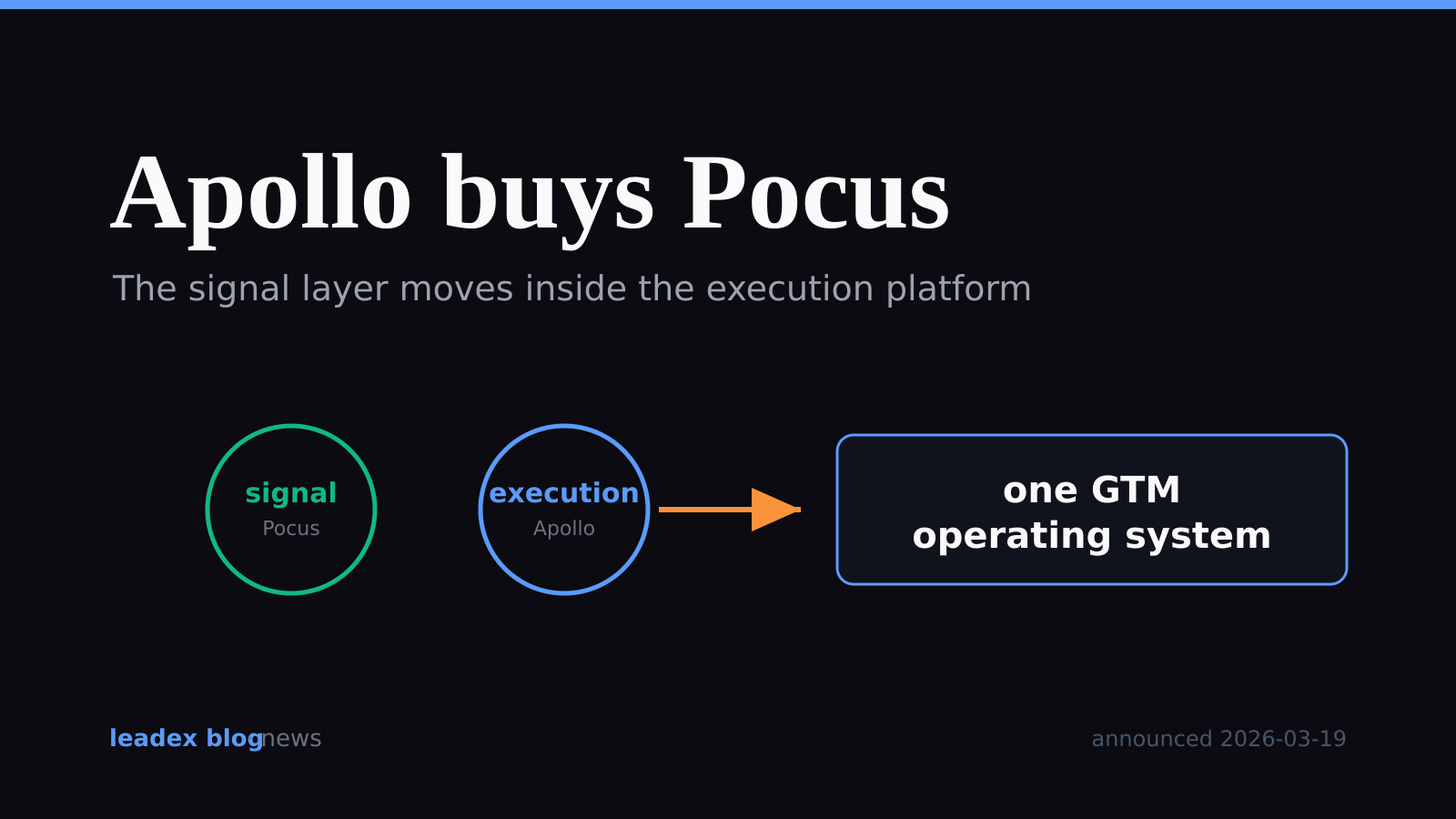
The first thing worth saying about Apollo buying Pocus is that it happened at all. Apollo spent years as the cheap, high-volume execution layer - a contact database with a sequencer bolted on - and signal intelligence was the thing other vendors sold on top of it. On 2026-03-19 that line moved. Apollo announced its acquisition of Pocus, an enterprise revenue-intelligence platform whose job is to read buying signals and tell a rep which account to touch first. Terms were not disclosed.
If you have been mapping the difference between intent, signal, and context data, this is the moment a pure-play signal vendor got absorbed into an execution platform. Pocus did the upstream part - watch CRM activity, behavioral data, and product usage, then rank accounts by how likely they are to buy. Apollo did the downstream part - the 230M+ contact database, the sequencer, the dialer, the deal management. The pitch is that one company now owns both ends. Apollo CEO Matt Curl, who took the job in February 2026 and for whom this is the first M&A move, frames it as building "the leading AI-native operating system for go-to-market teams from SMB to enterprise." Pocus brings the customers to match the register: Asana, Canva, and Monday.com were on its book.
Pocus CEO Alexa Grabell put the rationale plainly in the announcement:
We started Pocus to solve a simple but critical problem: revenue teams were drowning in data but starving for direction. Apollo has built the execution layer modern GTM teams trust. By joining Apollo, we can scale our mission in delivering signal-powered clarity and helping teams focus on the opportunities that matter most.
"Drowning in data but starving for direction" is the honest version of why signal tools exist, and it is also the honest version of why they are hard to keep as standalone purchases. A signal layer that does not connect to the system where reps actually work tends to become another dashboard nobody opens. So the strategic logic is sound: the place a signal is most useful is one click from the place you act on it. (I believe that is the real prize here, more than any single piece of Pocus technology.)
The number Apollo wants you to read this through is enterprise growth. The company says enterprise accounts grew over 400% in the past 12 months, and that revenue is up more than 5x since its Series D. Pocus is the proof point for moving up-market - you do not buy an enterprise-grade intelligence layer to serve a solo founder running 50 sends a day. That is the part SMB buyers should sit with. Apollo today powers more than 600,000 companies and 2 million users globally, with over 100,000 paying customers, and the company is explicit that nothing changes near-term: same pricing, same core features, the dialer and webforms and conversational intelligence all stay. Near-term is the load-bearing phrase. Roadmap attention follows the accounts that grew 400%, _not_ the long tail.
The other number Apollo is leaning on is AI adoption, and it is the more interesting one. Since the AI Assistant launched in beta in October, the company says credit consumption has doubled in under six months, AI adoption by customers has climbed from 35% to 75%, and weekly active users are up 94% since the assistant went generally available. Read charitably, that is a platform that has taught its users to expect the software to do the deciding, not just the storing - which is exactly the muscle a signal layer needs. Read skeptically, "credit consumption doubled" is also a sentence about a usage-based pricing model getting more expensive to run, and a signal engine is not free to operate. Whoever ends up paying for the inference behind "AI-native" is a question the press release does not answer.
It is worth being precise about what an "operating system for go-to-market" actually has to be, because the phrase is doing a lot of work. An operating system is the thing everything else runs on top of - it implies you stop shopping for the layers it covers. That is a genuinely large claim for a company that, two years ago, most people filed under "affordable Apollo alternative to ZoomInfo." The detection-to-execution loop Apollo is describing - see a signal, rank the account, sequence the rep, dial the number, all in one place - is the right loop. The open question is whether owning every step of it produces better outbound or just stickier billing. Those are not the same thing, and the difference only shows up in reply rates a few months after the integration ships.
Here is the skeptic read on consolidation. "Native signals" do not exist for most Apollo customers yet - they are a roadmap, not a feature you can switch on the morning after a press release. Until the Pocus engine is generally available inside Apollo and tuned for Apollo-scale data, the build-vs-buy math on a standalone signal tool has not actually changed. And consolidating your discovery, your signals, and your execution onto one vendor is exactly the lock-in trade Apollo is betting you will make - convenient until the day a roadmap decision or a price change lands somewhere you cannot route around. This is the same gravitational pull behind Clays own consolidation story, where one platform absorbs the workflow that used to be five tools. One-vendor GTM is a real efficiency and a real dependency at the same time.
The piece a single signal score quietly skips is the one that decides whether the signal is worth anything: do you actually have the right contacts at the account it just lit up? A platform can tell you Acme Corp is in-market and still hand you a stale VP who left eight months ago. We think about this a lot because Leadex lives at the seam between discovery and enrichment - you describe the account in plain English, approve a plan, and the agent browses the open web and enriches contacts through your own connected providers, with "up to 100 results per call" on its semantic search. A signal points; discovery and enrichment turn the point into a list you can send to. Apollo owning the signal does not remove that step - it just decides whose database fills it. And if your ICP is the kind of thing a filter UI cannot express - a niche segment, an unusual trigger, an account list assembled from sources outside any single vendor's index - then the database doing the filling matters more than the signal that pointed at it, because a 230M-contact index is only useful for the accounts it happens to cover.
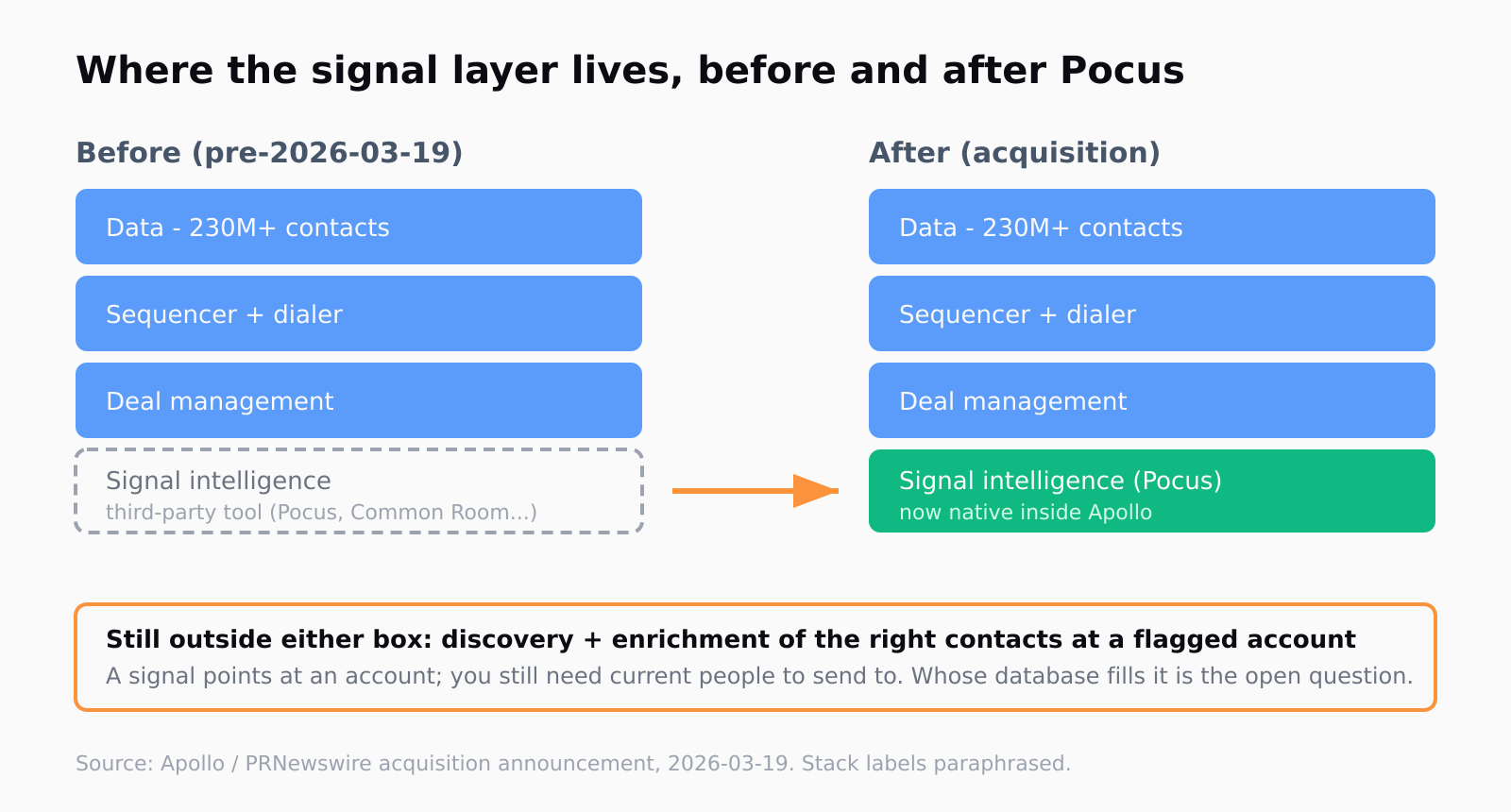
If you run signal-based outbound today, the move is not to cancel anything this quarter. It is to watch what ships. A signal score is only as good as the stack it sits in, which is why the taxonomy of buying signals matters more than any one vendor owning it - the taxonomy of buying signals outlives whichever platform is hosting them this year, and the signals worth stacking are the ones you can act on inside a day. Watch for the GA date, watch whether SMB pricing holds once the enterprise tail is doing the growing, and watch whether "AI-native operating system" turns into shipped product or stays a slide. The acquisition is real and the logic is clean. Whether it makes your standalone signal tool redundant is a question you get to answer in about two quarters, not today - and the answer will depend less on what Apollo bought than on whether the combined product actually puts the right account in front of the right rep at the right moment, which is a much harder thing to ship than a press release.