
Why 11x Meetings Aren't Booking: Calendar, Routing, Qualification, and Buffer Fixes
Four reasons 11x meetings fail to book: disconnected calendar, routing not resolving, qualification too strict, and missing buffer.
The send counter is the failure you can see. I wrote last week about the six reasons 11x's Alice stops sending email entirely, and that list front-loads the checks that cost nothing. The quieter version of the same dashboard sits one stage downstream: replies are coming back, inbound is interested, and the meeting count will not move off zero. When a prospect says yes and no meeting appears on any calendar, the leak is not in the outreach - it is in the plumbing between a conversation and a booked slot.
11x documents this failure mode directly. The troubleshooting page for meetings that are not booking opens with a four-part diagnosis:
Meetings fail to book for four reasons: no connected calendar, routing not resolving to a rep, qualification too strict, or missing buffers creating conflicts. Calendar connection is by far the most common, and it is a per-rep action that is easy to miss when someone joins.
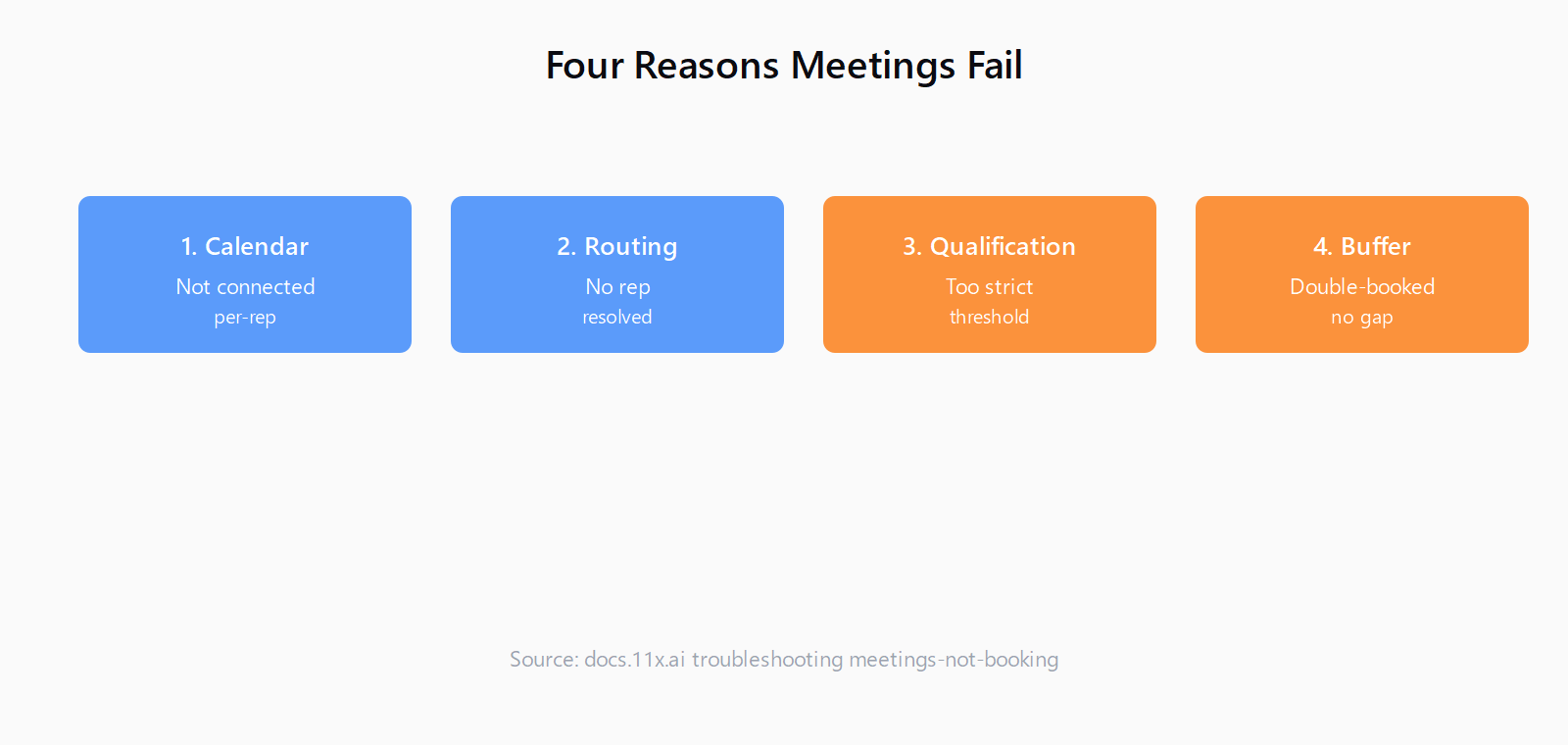
That last sentence is doing the work. The failure is per-rep, it is configuration rather than a bug, and it is easy to miss when someone joins. It also crosses both of 11x's workers - Alice books from replies to outbound, Julian books inside inbound conversations - so the same four causes repeat across two products. Work through them in order, calendar first.
Why meetings are not appearing on a rep's calendar
The most common cause is the least interesting one: the receiving rep's calendar was never connected. Booking runs against real availability in Google Calendar or Outlook, so an unconnected calendar means the agent has nothing to confirm a time against. The lead routing documentation states the consequence plainly: routing to a rep without a connected calendar produces a booking failure, and every receiving rep needs one. Calendar connection is a per-rep, per-user action rather than a workspace-wide toggle, which is why it is trivially easy to miss when someone joins mid-rollout - the exact case the troubleshooting page calls out.
This one cause explains two symptoms that look unrelated. If a prospect agrees to a meeting and nothing gets booked, the first thing to check is not the copy - it is whether the rep the lead routed to has a connected calendar at all. And if Julian seems to offer times a rep cannot keep, the same cause is usually behind it: the agent checks availability against the rep's connected calendar, and with no calendar there is no availability signal for it to anchor to. The fix is one action per rep, and it is the first thing to audit whenever a new person joins the team.
Why routing resolves to no rep at all
Calendar connected and meetings still missing? Routing is the next suspect. Routing decides which rep owns a qualified lead, and in 11x it happens during the conversation rather than after it. The routing rules cover ownership, territory, round-robin, deal size, and custom logic, with one emphatic ordering instruction: account ownership takes precedence over everything else, because a lead from an account a rep already works must reach that rep rather than the next name in a rotation. Get that wrong and the failure is a trust problem, not a configuration one.
Here is the detail I would not have guessed, and it is the one most likely to burn you: 11x does not publish its fallback behavior for a lead that matches no routing rule. The docs tell you to define an explicit catch-all rule yourself rather than assume a sensible default exists. A round-robin with no catch-all, or an ownership rule with no fallback, can silently resolve to nobody - the prospect agrees, routing has no destination, and the meeting evaporates without an error anywhere. The second trap is running two routers. If you already use a router your team trusts and you also enable routing inside 11x, you are duplicating logic, and duplicated routing is how leads end up assigned twice or not at all. Pick one source of truth.
And the handoff matters as much as the destination. A booked meeting is supposed to arrive with context - the transcript, the qualification reasoning, the discovery answers, a recommended next step, engagement context - so the rep does not re-ask what the prospect already answered. A rep who receives only a calendar invite has lost the entire value of the qualification, and re-asking answered questions is a worse first impression than a cold call. If you are not sure the payload survives, the test is cheap: ask a receiving rep whether they had enough to run the meeting. This is the same distinction I drew when I mapped what 11x's Alice actually automates - the agent is only as good as the context it hands off, and none of that context survives if routing drops it.
Why qualification is silently killing good leads
Third cause, and the most subtle: qualification thresholds set too strict. Julian scores inbound leads during the conversation, on conversation context, company data, and engagement signals, and the score decides whether to book a meeting, route to nurture, or disqualify. The ICP scoring documentation argues for starting slightly permissive and tightening over time, and the reason is an asymmetry in how failures get reported.
An unqualified meeting costs a rep 30 minutes and generates a complaint you'll hear about. A wrongly disqualified good lead costs you the deal and generates no complaint at all - nobody reports the lead that was quietly turned away.
That asymmetry is why a too-strict threshold is so dangerous: it is a silent leak in the exact place where a permissive one makes noise. The docs' tuning loop is the practical part. Ask reps to flag unqualified meetings formally rather than in passing, because an unflagged bad meeting means the threshold stays wrong and reps quietly lose trust. Read a weekly sample of disqualified transcripts, since the reasoning is logged and that is the only way to catch the failure that does not self-report. Change one criterion at a time so you can attribute the effect. And re-tune before you scale, because a threshold that is a rounding error at 100 leads is a serious problem at 10,000.
The other guardrail is escalation: a named strategic account, an existing customer, a question outside the agent's knowledge boundaries, and an explicit request to speak to a person should all reach a human regardless of score. Scoring also inherits whatever is true of the data feeding it - a lead disqualified for a missing attribute that the company actually has is a data problem, not a criteria problem, and no threshold tuning fixes dirty firmographics. That is the failure class I keep circling in where autonomous AI SDRs still hit their limits: the scoring and routing layers are sound, and the output is garbage because the inputs are. It is why I built Leadex as a research agent that verifies accounts before they ever reach a sequence or a scoring model - the qualification gate downstream is only as honest as the list you feed it.
Why you get double-bookings and rep conflicts
Fourth cause: missing buffers. The meeting scheduling documentation lists setting meeting duration and buffers among its setup requirements, so that back-to-back bookings do not leave reps without preparation time. Skip that step and the agent will happily stack two interested prospects back to back, and the conflict surfaces as a double-booking or a rep walking into a meeting cold. The calendar side matters here too: the docs are blunt that booking works against real availability, and that an unconnected calendar means failures or double-bookings. If you see a rep with two simultaneous invites, check both their calendar connection and the buffer configuration before you blame the agent.
Once meetings are landing, the leak moves to what happens after the booking. Julian can send reminders, offer to reschedule when a prospect cancels, and re-book no-shows, and the docs call no-show recovery the largest silent leak in an inbound funnel: the lead was qualified, the meeting was booked, and the pipeline dies to a scheduling gap nobody owns. My read is that most teams never check what their current process does with a no-show, and that is precisely the assumption the docs are warning about. The scheduling philosophy underneath all of this is worth stealing even if you are not on 11x: book inside the conversation, because every handoff to "I'll send you a link" is an avoidable step where a qualified prospect goes cold.
If I were walking into a cold 11x workspace with a frozen meeting counter, I would run one test end to end before touching anything else: connect a calendar for every receiving rep, define an explicit catch-all routing rule, send a test lead through, and confirm the invite lands on the right rep's calendar with its context attached. Then cancel it and watch whether the reschedule behavior works. That single test exercises calendar, routing, qualification, and handoff at once, and it tells you which of the four documented causes you are actually fighting - instead of guessing by looking at the copy.
FAQ
Why are meetings not appearing on a rep's calendar?
The receiving rep's calendar is not connected. Calendar connection is a per-rep action, and booking works against real availability, so an unconnected calendar means nothing can be booked onto it. Connect Google Calendar or Outlook for every rep who receives routed leads.
Why do prospects agree to a meeting but nothing gets booked?
Work the four documented causes in order: no connected calendar, routing that does not resolve to a rep, qualification thresholds too strict, and missing buffers. Calendar connection is by far the most common, so audit it first, then confirm routing has a catch-all rule.
Why does Julian offer times the rep is not available?
Julian checks availability against the rep's connected calendar. If the calendar is not connected there is no availability signal to anchor to, so the times offered have nothing to reflect. Connect the calendar and confirm the rep's working hours are accurate.
Why am I getting double-bookings?
Two causes dominate: routing logic duplicated between 11x and an external router assigns the same lead twice, or missing meeting buffers let back-to-back bookings stack. Pick one routing source of truth and set meeting duration plus buffers in the scheduling setup.
Why are no-shows not being re-booked?
No-show recovery needs to be configured rather than assumed. Julian can send reminders, offer to reschedule, and re-book no-shows, and the docs treat no-show recovery as the largest silent leak in an inbound funnel. Check what your process does with a no-show before assuming it is marginal.