What Salesforce's Qualified Acquisition Means for Agentforce Pipeline Buyers
Salesforce closed the Qualified deal April 1, 2026. Here's what changes for B2B teams evaluating Agentforce for pipeline generation - and what doesn't.
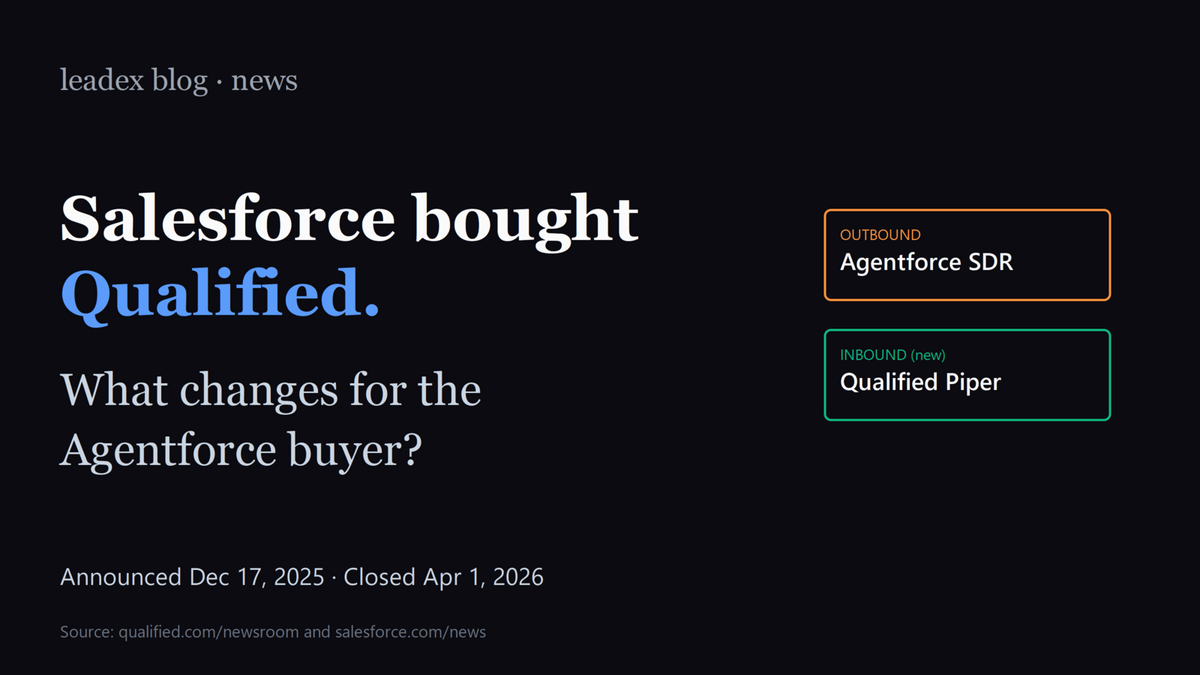
Salesforce announced its acquisition of Qualified on December 17, 2025, and closed the deal on April 1, 2026 - which means that as of today, a B2B sales team evaluating Agentforce for pipeline generation is no longer evaluating an outbound-only stack with a third-party AI website agent bolted on top, but a Salesforce-owned roundtrip from anonymous website visitor to qualified inbound conversation to outbound follow-up. That changes the comparison in ways the press releases don't quite say out loud, so it's worth unpacking what each side actually brings before the integration messaging takes over and the picture gets harder to read.
Qualified's product is, in plain English, an AI agent that sits on your website, identifies the company behind anonymous traffic, opens a chat tailored to that company's industry and apparent intent, qualifies the visitor with a conversation, and routes the qualified ones to a sales rep with a meeting already scheduled. The marketing name for the agent is Piper. Pre-acquisition it competed with Drift (acquired by Salesloft in 2024), Intercom Fin, and a handful of "AI SDR" products that worked the outbound side of the same problem - though Qualified always insisted, accurately, that what it was doing was inbound qualification, not outbound prospecting, and the distinction mattered. Agentforce SDR Agent, by contrast, was launched by Salesforce in late 2024 to handle the outbound side: pull leads from the CRM, draft personalized emails, sequence them, log replies. The two never fully overlapped, which is why the acquisition reads as roll-up rather than consolidation.
The official framing is in the press release:
"The agentification of the enterprise continues to accelerate. By integrating Qualified's agentic marketing expertise into Agentforce, we will enhance our ability to offer autonomous pipeline generation." [...] "We founded Qualified to revolutionize how B2B companies generate pipeline, and today, that vision takes a massive leap forward. Joining forces with Salesforce is a natural evolution."
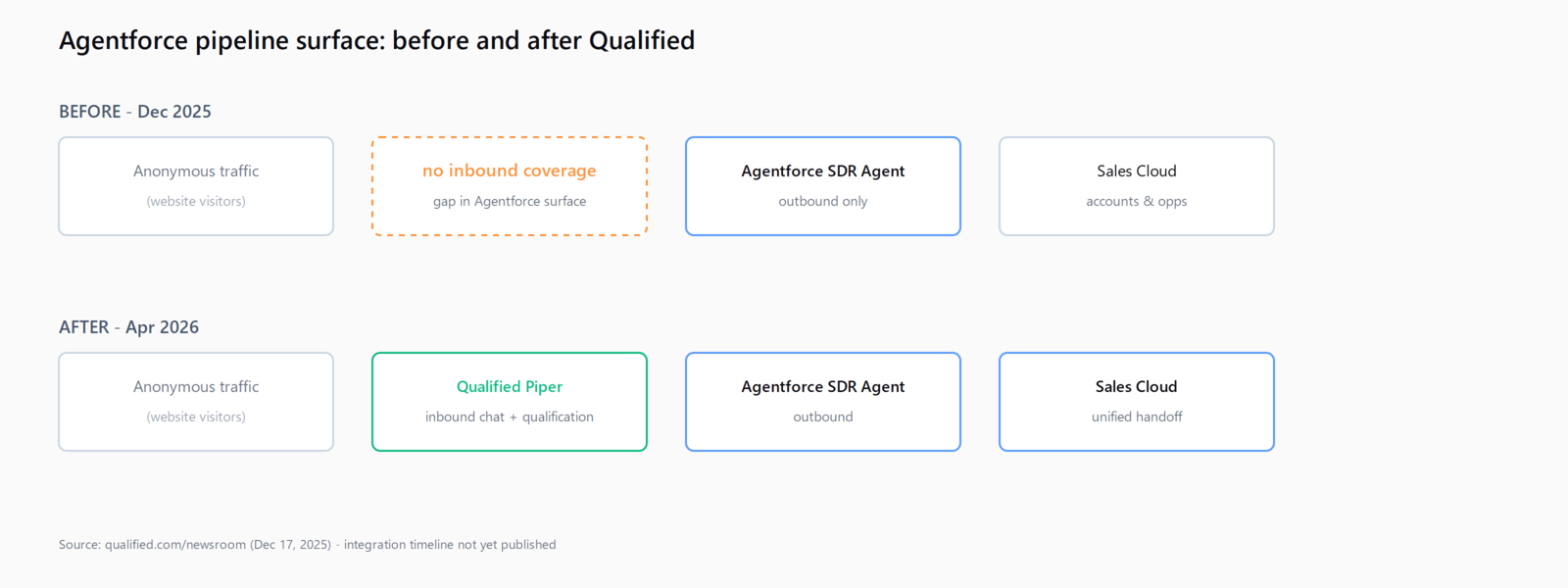
Steve Fisher (President and Chief Product Officer at Salesforce) and Kraig Swensrud (CEO and Co-Founder of Qualified) saying what they have to say, but the structural read is more interesting than the quotes. Salesforce had an outbound SDR agent and no inbound coverage; Qualified had a great inbound agent and no outbound product; Qualified was already an AppExchange partner and a Salesforce Ventures portfolio company. The deal closes a known gap in the Agentforce surface area for less than it would have cost Salesforce to build Qualified's intent-data and conversation-routing stack from scratch, and it removes a competitor that could have hypothetically been picked up by HubSpot, Microsoft, or even Google Cloud.
What changes for B2B teams already in the Agentforce evaluation cycle: the answer to "does Agentforce cover the whole pipeline-generation surface or only outbound?" flips from "only outbound, you'll need Qualified or Drift on top" to "both sides, once the integration ships." That phrase - "once the integration ships" - is doing a lot of work. The press release is careful not to commit to a timeline beyond "the transaction is expected to close in the first quarter of Salesforce's fiscal year 2027," which has now happened. Product integration, in the sense of Piper showing up inside Agentforce Marketing with a unified routing surface, is not yet announced. I believe any team buying Agentforce today should assume Qualified continues to run as a standalone product for at least the next two quarters, and budget the integration risk accordingly: the meeting-scheduling handoff between inbound chat and outbound SDR follow-up will be the seam where data quality gets lost.
The interesting counter-take is the one Qualified competitors are quietly making, which is that Salesforce's track record on acquired-product integrations is uneven. Slack still feels bolted on six years later. Tableau is a separate world. MuleSoft is a separate world. The acquisitions that worked best were ones where the acquired product became a primitive (Heroku for runtime, ExactTarget for marketing email) rather than staying a peer product with its own UI. Qualified's UI is its product - the website chat surface, the rep-side conversation cockpit - so the integration question is whether Piper ends up as a primitive that Agentforce Marketing calls into, or whether the Qualified UI persists and only the data flow gets unified. I think the former is more likely and the latter is more useful to existing Qualified customers; those two preferences will tension against each other through 2026.
The buying decision is also harder to defer than it looks. Salesforce's Agentforce pricing is consumption-based ("Flex Credits" in the current rate sheet), and the company has been clear that pipeline-generation agents are a strategic priority - meaning Qualified's existing per-seat or per-conversation pricing is likely to migrate to that consumption envelope within a renewal cycle. Teams on Qualified contracts that come up for renewal in late 2026 or 2027 should expect the renegotiation to be in Flex Credits, not the old seat-and-conversation pricing. That's not a price hike in itself - Flex Credits often work out cheaper for the inbound case, where conversation volume is bursty - but it's a different shape of bill, and procurement teams should model both scenarios.
This is also the kind of vendor-consolidation arc Leadex's customers ask us about constantly, because the choices on the discovery side mirror the choices on the conversation side. The traditional outbound stack was list provider (ZoomInfo / Apollo / Cognism) + sequencer (Outreach / Salesloft) + CRM, and the temptation is always to collapse the stack into the CRM's native tooling. We've written about that tradeoff in Cognism Diamond Data vs ZoomInfo for EMEA-first outbound and Apollo alternatives compared: native consolidation wins on integration depth and loses on best-of-breed flexibility, and the right answer depends on whether your ICP fits the consolidator's database. Leadex exists to handle the cases where the ICP doesn't fit - niche, unstructured, founder-shaped briefs that no filter UI on a consolidator product can express - and that's a complement to the Agentforce/Qualified pipeline, not a competitor with it.
The most underrated piece of context is the Qualified intent-data layer. Pre-acquisition, Qualified was building first-party intent signals from the website chat sessions themselves - which pages a company viewed before opening a chat, which questions were asked, how often the same company came back. That data has now become Salesforce data, which means Sales Cloud accounts gain a column of "intent activity observed on our website" that previously lived in Qualified's standalone dashboard. The signal-stacking analysis we ran in signal stacking: why one trigger is never enough applies directly: web-engagement intent on its own is a weak signal (mid-market companies have hundreds of monthly anonymous visitors, the conversion-to-pipeline rate from chat alone is in low single digits), but combined with funding-round or hiring-spike signals it sharpens considerably. Salesforce now owns that web-engagement layer; the question for buyers is whether Sales Cloud's signal-fusion logic will improve fast enough to make the combined intent stack worth the consumption credits.
If you're evaluating Agentforce for pipeline generation in mid-2026, the practical move is to treat the Qualified acquisition as a reason to extend evaluation by a quarter, not shorten it. The combined surface is the right shape on paper, the integration is unannounced, and the migration path for existing Qualified customers is the most concrete signal of how serious Salesforce is about preserving the inbound product's strengths. Watch for two things: a published Piper-to-Agentforce data-flow architecture diagram (which would mean the integration is being treated as a roadmap item, not a UI cleanup), and a Flex Credits rate sheet for Qualified workloads (which would tell you what consumption looks like before you sign). Until both exist, the acquisition is news, not yet a product.