Outreach Launches Omni AI Agent: What It Means for Sales Engagement Platform Buyers in 2026
Outreach Omni is a conversational AI agent embedded in the platform's action layer - not a copilot, but an interface where you ask a question and execute the follow-through without switching tools. Here's what the April 2026 launch means for buyers evaluating renewal.
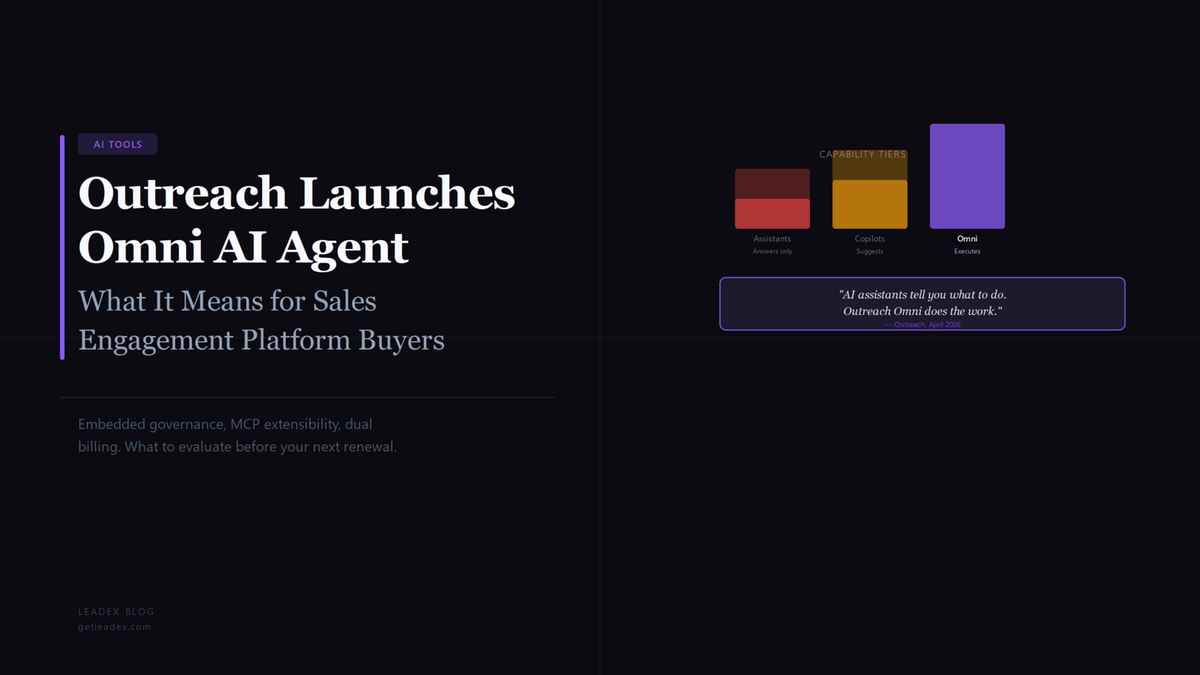
Outreach has been calling itself an "agentic AI platform for revenue teams" since early 2026, but the April 27 Spring release was the first time that positioning had a centerpiece. Outreach Omni is a conversational AI agent embedded in the platform's action layer - not a sidebar copilot that suggests the next step, but an interface where you ask a question, dig into the answer, and execute the follow-through without leaving the conversation. The launch matters because it changes who Outreach is competing against: no longer just Salesloft for sequence workflows, but standalone AI SDR tools, Gong for conversation intelligence, and the general-purpose copilots enterprise buyers are already piloting separately.
The strategic signal is in the rebranding. Outreach moved its domain to outreach.ai alongside the release and restructured its packaging from four old tiers (Standard/Professional/Enterprise/Unlimited) into three Amplify plans with dual billing: per-seat access fees plus consumption-based AI credit charges. For teams coming up on Outreach renewals in 2026, the timing is deliberate - Omni is Outreach's answer to the CFO question of why the company pays separately for a SEP, a conversation intelligence platform, and an AI prospecting layer.
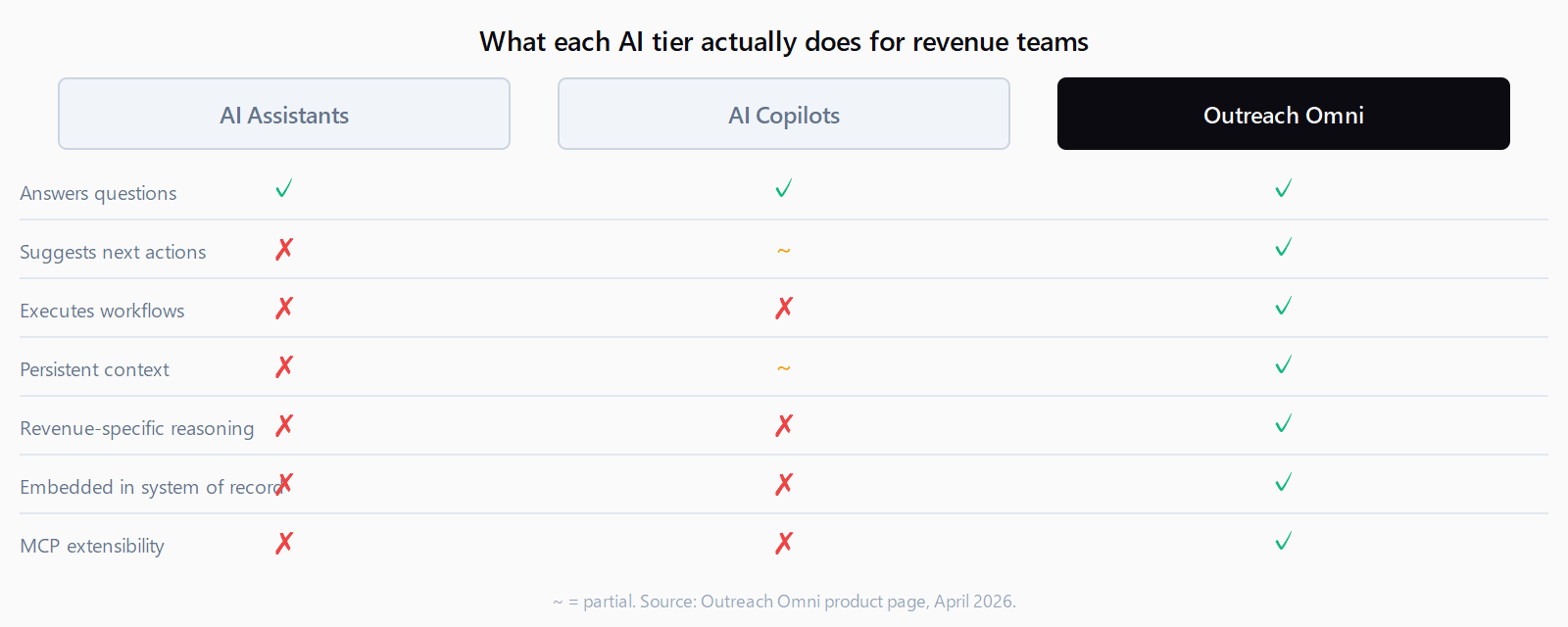
AI assistants tell you what to do. AI copilots suggest the next step. Outreach Omni does the work.
That is from Outreach's Omni product page, published the day after the BusinessWire announcement. The framing captures the positioning precisely. First-generation AI copilots surfaced insights but left the execution to the human - you got the answer, switched to email, drafted the follow-up, logged the task. Omni's claim is that it collapses those steps: ask which enterprise deals have gone quiet for two weeks, get the answer, draft the re-engagement email to the executive sponsor, and send it from the same interface. Every action is logged and governed through the same access controls as a human action in the platform.
What Outreach Omni adds to the platform
Omni is available in the Outreach web app, mobile app, and Slack, and it maintains conversation history across all three. A thread started on desktop continues on mobile without losing context - relevant for AEs who do account prep before an onsite and want to pick up the same thread from their phone. The governance layer is the part that distinguishes it from a general LLM wrapper: every email Omni sends goes through Outreach, is logged against the engagement record, and is subject to the same sending rules a human rep would face. Omni cannot bypass the engagement frequency limits or channel restrictions your revenue ops team has configured.
The April release also shipped Agent Studio - a visual canvas for revenue ops to deploy pre-built AI workflows without writing code. The initial templates cover inbound lead engagement, closed-lost reactivation, and deal alert routing. The Meeting Prep Agent moved from beta to general availability: it assembles a structured brief before each scheduled call, pulling attendee profiles, account context, open deal fields, and recommended talking points. Deal Alerts flag risk signals and auto-generate action items when deals stall, with customization by opportunity type.
The infrastructure decision with the longest tail is MCP Client support. The February 2026 release had shipped an MCP Server, making Outreach data available to external AI systems like Claude. The April release adds the client side: Omni can now pull data from external tools - CRM records, data warehouses, third-party enrichment signals - through the MCP protocol without requiring custom integration work. This makes Outreach a node in a broader MCP network rather than just an endpoint. For teams already building Outreach API deprecation migration paths in 2026, this is the relevant architectural shift to track.
The renewal math for current Outreach customers
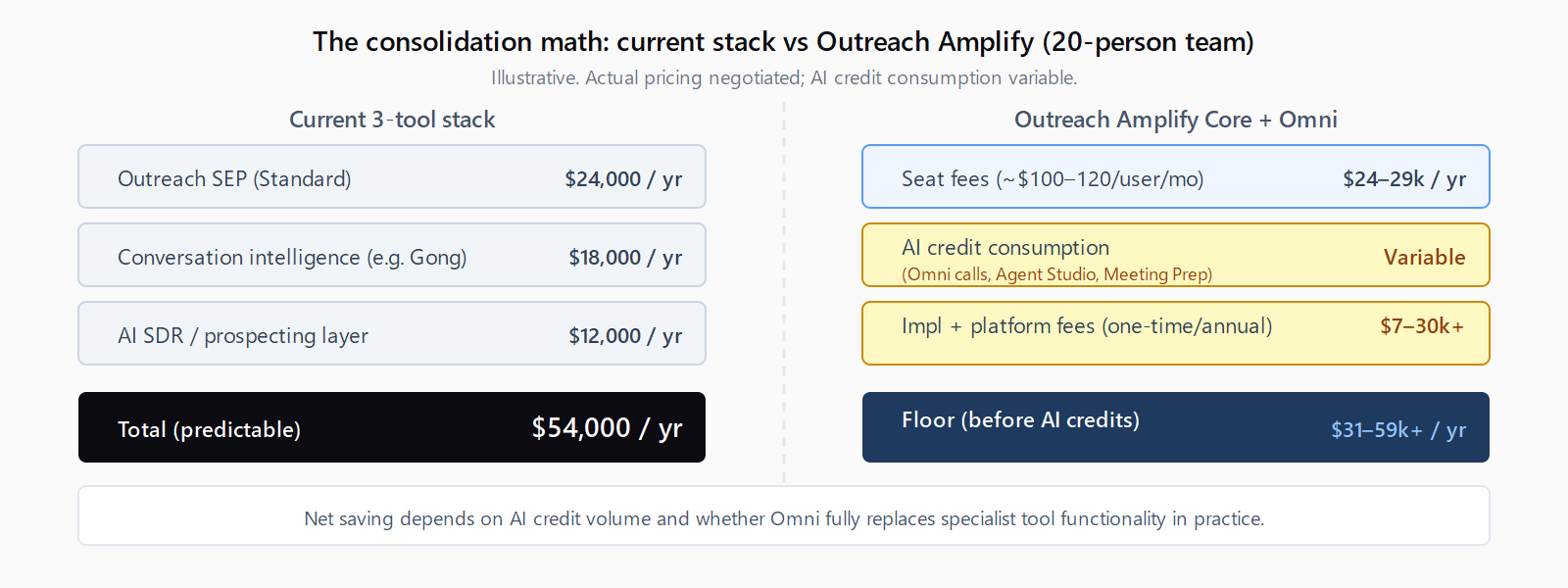
Amplify Core runs roughly $100-120 per user per month in seat fees before AI credit consumption - $24,000 to $29,000 per year for a 20-person team, plus implementation fees of $5,000-25,000 and platform fees of $2,000-5,000 annually. The AI credit layer is variable and depends on how heavily the team uses Omni, Agent Studio runs, and Meeting Prep Agent briefs. That variable component is what makes the renewal negotiation different from the old four-tier model: the seat fee is predictable, but actual spend at scale requires usage modeling before committing.
The consolidation argument is straightforward to sketch: if a team currently pays for Outreach plus a standalone conversation intelligence tool plus a separate AI prospecting layer, Omni absorbs meaningful functionality from both. The autonomous AI SDR limitations that have become clearer in 2026 - hallucinated contact context, disconnection from the system of record, difficulty auditing what the agent actually sent - are exactly the gaps Outreach is positioning Omni to fix through embeddedness. Whether the consolidation math works in practice depends on how deeply a team relies on the specialist tools versus how much it needs basic versions of each capability.
Salesloft is running a parallel playbook with Rhythm's AI queue. On the CRM side, the HubSpot Breeze Agents tier comparison tells the same story: incumbents are all making the bet that native, governed, embedded AI wins over best-of-breed point solutions at renewal time. Outreach's structural advantage over HubSpot here is that it sits closer to the execution layer - sequences, dials, meeting cadences - rather than primarily in the CRM record.
What to pressure-test before signing
Three questions worth answering before the renewal conversation.
First: which AI tools in the current stack are actually being used? Usage data from Gong, your AI SDR tool, or your existing copilot will show what the team reaches for versus what got licensed in optimism. The Omni consolidation argument only holds where the team was actually using the specialist tools it would be replacing.
Second: what does AI credit consumption look like at your team's usage patterns? Outreach's pricing page is the starting point, but the consumption model means the contract floor is not the ceiling. Run a projected usage model against your current call volume, deal count, and sequence activity before committing to the Amplify tier structure.
Third: what is the enrichment data feeding Omni? Outreach Omni reasons over your CRM data, conversation history, and enrichment signals. The answer to "which accounts should I prioritize today?" is only as good as the contact records, firmographic data, and engagement signals underneath the question. If company data is stale, contact coverage is sparse, or engagement signals are missing for key accounts in the segment Omni is supposed to reason about, the output degrades accordingly - and the degradation is invisible until a rep acts on a bad recommendation. Outreach ships Smart Data Enrichment integrations with LeadIQ and ZoomInfo in the February 2026 release; for teams that want to bring their own provider data without routing lookups through platform credit metering, Leadex handles BYOK enrichment at the provider level, keeping that cost outside the Outreach consumption model.
The Omni launch is a concrete answer to the question of whether traditional SEPs survive the AI-native wave or absorb it. Outreach is betting on absorption. The real test arrives in mid-2026 NRR figures - whether enterprise teams on renewal pay the new consumption-based pricing for embedded governance, or whether specialist AI-SDR and conversation intelligence tools hold their ground as line items. The bet is not unreasonable. The governance and embeddedness argument is real. But the execution layer only works at the quality of the data layer underneath it.