What HubSpot's Frame AI Acquisition Means for Teams Paying for Gong or Chorus
HubSpot closed Frame AI in Dec 2024 and Breeze CI has been rolling out ever since. Here's the real Gong/Chorus drop-or-keep calculus for a 30-rep team.
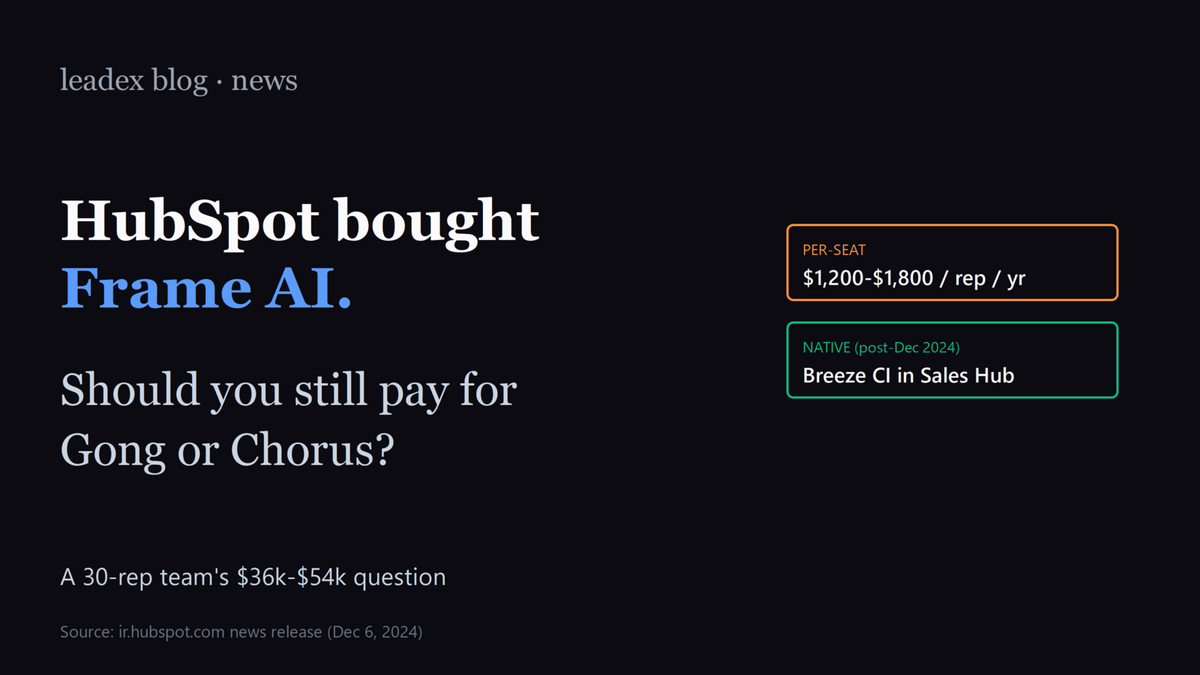
HubSpot announced its acquisition of Frame AI on December 6, 2024, and the deal closed a few weeks later. Frame's product was conversation intelligence: a pipeline that turned unstructured customer touch points - emails, call recordings, meeting transcripts - into structured signals about sentiment, intent, churn risk, and deal stage. Eighteen months after the close, HubSpot's native conversation intelligence has been rolling into Breeze, the company's AI surface, in successive Spotlight releases. The buying question that's now sharp for any HubSpot-CRM customer paying Gong or Chorus seat licenses is whether the native capability is good enough to drop the third-party seat at renewal. The answer is more nuanced than either vendor's slide deck suggests, and worth unpacking before the next procurement cycle.
The structural change is that conversation intelligence stops being a separate product you buy and starts being a default property on the Contact and Deal records. For HubSpot-only shops, that's the simplest "consolidate the bill" story since the Marketing Hub-to-Sales Hub bundle - one less vendor invoice, one less SSO integration, one less GDPR data-processor agreement, and one less integration to maintain between a conversation tool and a CRM. For shops that also use a separate dialer, a separate scheduler, or a separate meeting-recording tool, the gain is smaller and depends on whether Breeze's native CI hooks into those products with the same fidelity that a Gong integration provides.
The official framing in the press release:
"AI is only as powerful as the data behind it. While structured data has long been the foundation of CRM, unstructured data - like conversations - holds the key to deeper insights into customer sentiment, behavior, and intent." [...] "Whether it's helping to optimize campaigns, close deals faster, or prevent churn, we're excited to bring our experience in conversational intelligence to help HubSpot customers grow."
Yamini Rangan (CEO of HubSpot) and George Davis (co-founder and CEO of Frame AI) - the standard acquisition-announcement choreography, but the words "deeper insights into customer sentiment, behavior, and intent" are doing the strategic work. Sentiment and intent are exactly the two columns Gong has historically been strongest at and that HubSpot's native CRM has historically been weakest at. Frame AI was the cheapest credible path to closing that gap, and the December 2024 timing - just before HubSpot's INBOUND product cycle - was a deliberate setup for the 2025-2026 Breeze releases that have since landed.
What Gong and Chorus do that the native HubSpot Breeze conversation intelligence still doesn't (as of mid-2026): the deep-call-coaching surface. Gong's strength has always been the call-by-call rep-development workflow - the "you spent 60% of this call talking, the customer mentioned competitor X four times, your follow-up email didn't address two of their objections" feedback loop that sales managers actually use in weekly 1:1s. Frame AI's standalone product was a horizontal sentiment/intent layer, not a vertical sales-coaching tool, and HubSpot's Breeze CI inherited that horizontal posture. I believe the coaching gap will narrow over the next two product cycles - HubSpot has the data and the AI budget - but it's not closed today, and any team whose Gong usage is genuinely about rep development should not drop Gong on the assumption that Breeze covers the same workflow.
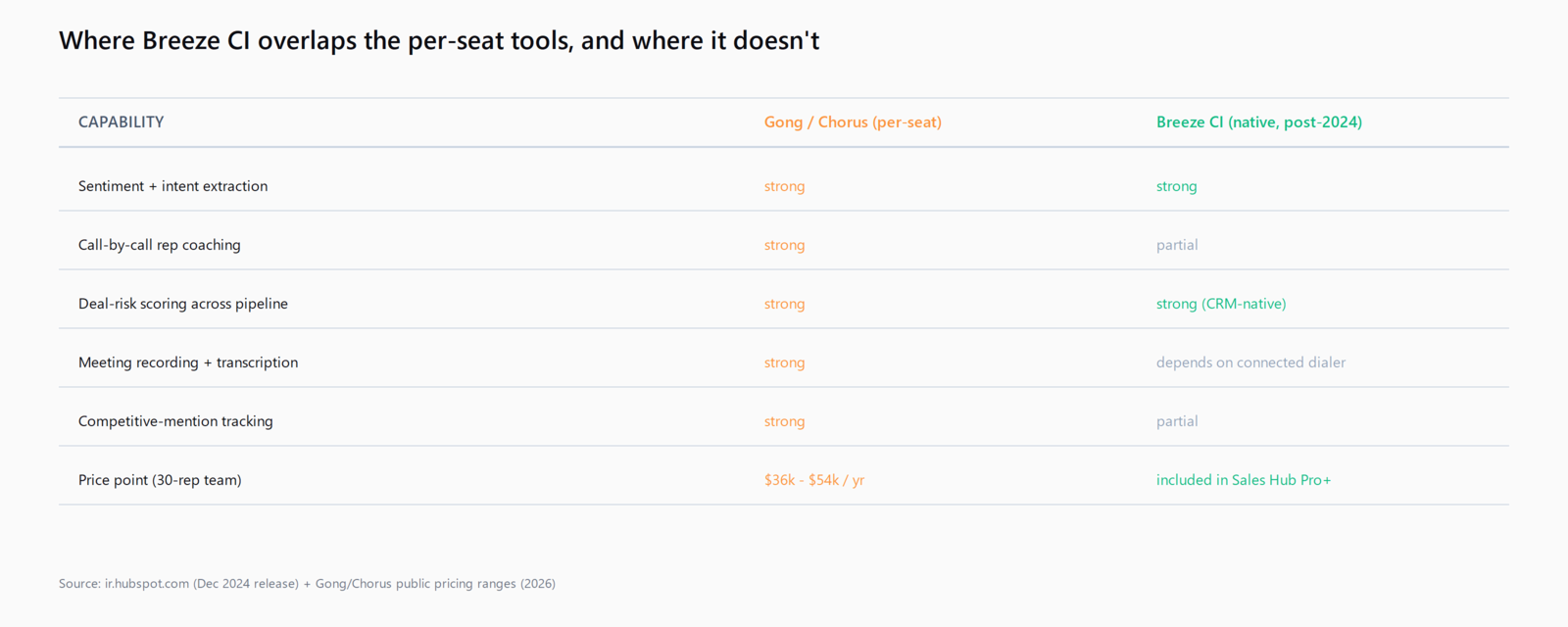
What HubSpot's native Breeze CI does that Gong and Chorus don't (or do worse): tight integration with the CRM record itself. Frame AI's signals land on the Contact, Deal, and Company records as structured properties - "sentiment trend over the last 30 days," "competitive mentions count," "champion-departure flag" - and become first-class filter criteria for Lists, Workflows, and Reports. That's a different value than Gong's standalone analytics; it means a Workflow can fire "deal sentiment dropped below threshold last week, alert the AE" without a Zapier-style middle layer. For shops where the workflow automation is the actual product (most mid-market HubSpot installations), this is a real upgrade and the kind of capability the per-seat tools struggle to match because their data lives outside the CRM.
The pricing math is the part most teams will actually decide on. Gong's published pricing in 2026 is roughly $1,200-$1,800 per rep per year for the standard sales seat, with enterprise tiers higher; Chorus (now part of ZoomInfo) is similar. A 30-rep sales team is spending $36,000-$54,000/year on conversation intelligence as a line item. HubSpot's Breeze CI features ride on the Sales Hub Pro / Enterprise tier, which a HubSpot-CRM team is already paying for - the marginal cost is effectively zero. For a 30-rep team, dropping Gong is a $36k-$54k/year savings if the native tooling covers the use case, and that's the budget item that gets a procurement reviewer's attention at renewal.
The case against dropping the per-seat tool is harder than the dollars-saved math suggests. Gong's call library, the historical archive of every call ever recorded with the searchable transcript and the playback UI, is something a sales org genuinely uses - for onboarding new reps, for resolving deal-specific disputes, for win-loss analysis. Migrating that library to Breeze isn't a feature HubSpot has shipped (and may never ship); switching means leaving the historical archive behind. Some teams treat that as a sunk cost and switch anyway; others treat the archive as the actual product and keep paying.
This is also the kind of vendor-consolidation arc Leadex's customers think through end-to-end, because the discovery side of outbound mirrors the same buy-vs-bundle tradeoff. The traditional outbound stack is a discovery tool plus a scraper plus an enrichment provider plus a CRM importer; the temptation is always to consolidate into whatever your CRM ships natively, and the right answer depends on whether your ICP fits the consolidator's database shape. We've written about exactly this calculus in Apollo alternatives compared and in the Cognism vs ZoomInfo for EMEA piece - native consolidation is the right call for teams whose use case fits the bundle, best-of-breed wins for teams whose use case doesn't. Leadex exists to handle the discovery cases the bundles can't express; the same logic applies to whether Gong's per-seat product covers a coaching use case that Breeze's native CI doesn't.
The most underrated piece of this story is what happens to Chorus specifically. Chorus is owned by ZoomInfo, and ZoomInfo's strategic position has been weakening in the mid-market for two years - declining seat retention, competitive pressure from Cognism in EMEA, a heavily-discounted enterprise pricing motion. If a meaningful slice of HubSpot-using Chorus customers drops the seat at renewal in 2026 because Breeze CI covers the workflow, that's a direct revenue hit to ZoomInfo at a moment when ZoomInfo is least equipped to absorb it. Gong is privately held and better positioned to compete on differentiation; Chorus is the more exposed product, and the Frame AI acquisition's downstream effect on ZoomInfo's CI line is one of the underreported stories of the 2026 GTM-tooling cycle.
For the team actually making the call in the next 90 days: run a 30-day pilot where one squad uses only Breeze CI and the other keeps Gong; compare what each set of AEs and managers actually opens, what gets cited in pipeline reviews, what surfaces in deal-debrief writeups. If the Breeze cohort doesn't notice Gong is gone, the renewal answer writes itself. If they do notice - and specifically miss the call library, the coaching workflow, or the competitive-mention tracking - the per-seat tool is paying for itself and the consolidation story is wrong for your team. Either answer is defensible; running the pilot is what makes it defensible, and a 30-day window is the smallest that produces a real signal.