What Gong's Mission Andromeda Means for AI Coaching Buyers
Gong's February launch keeps rolling out through July 2026 - what Gong Enable, Gong Assistant, and MCP support actually change for RevOps teams evaluating an AI coaching platform.
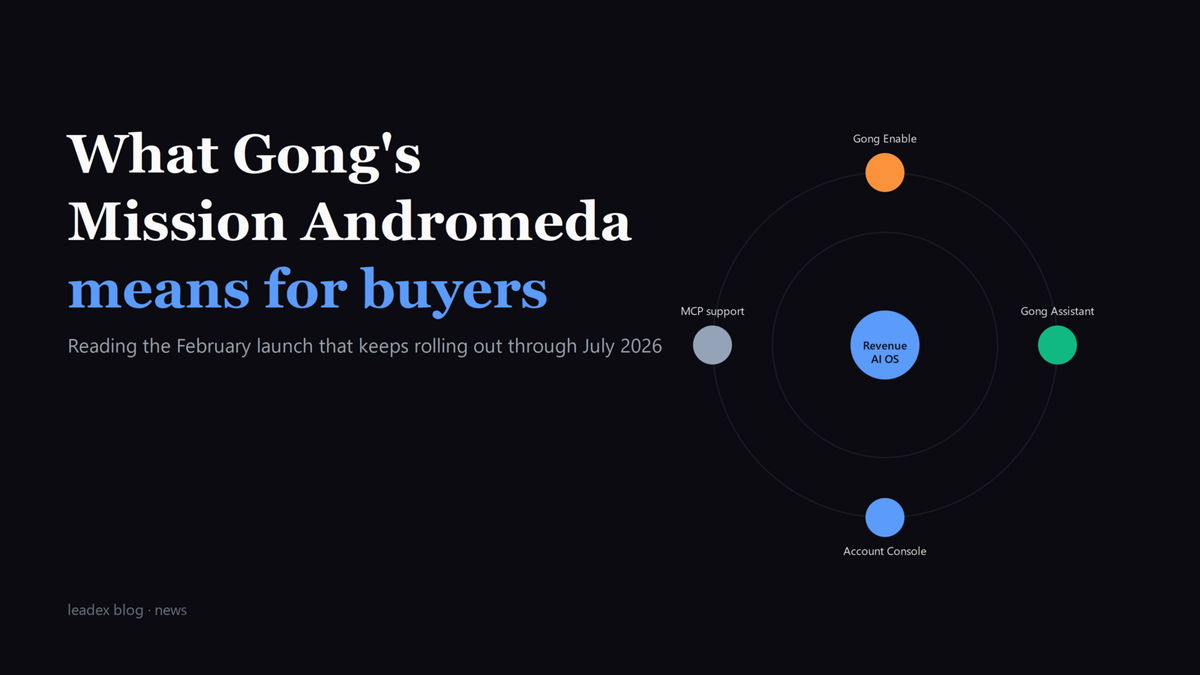
Back in June I wrote about what teams already paying for Gong or Chorus seats should make of HubSpot buying Frame AI. The subtext of that post was that conversation intelligence was consolidating fast, with every vendor racing to bundle more AI on top of a recorded call. Gong answered that subtext directly on February 25, 2026, when it launched "Mission Andromeda," the first release in a new named-launch cadence the company says will keep shipping grouped capabilities under galactic names going forward - and confirmed several of Andromeda's remaining pieces are only reaching general availability this month - July 2026 - which is why this is worth a second look now rather than in February.
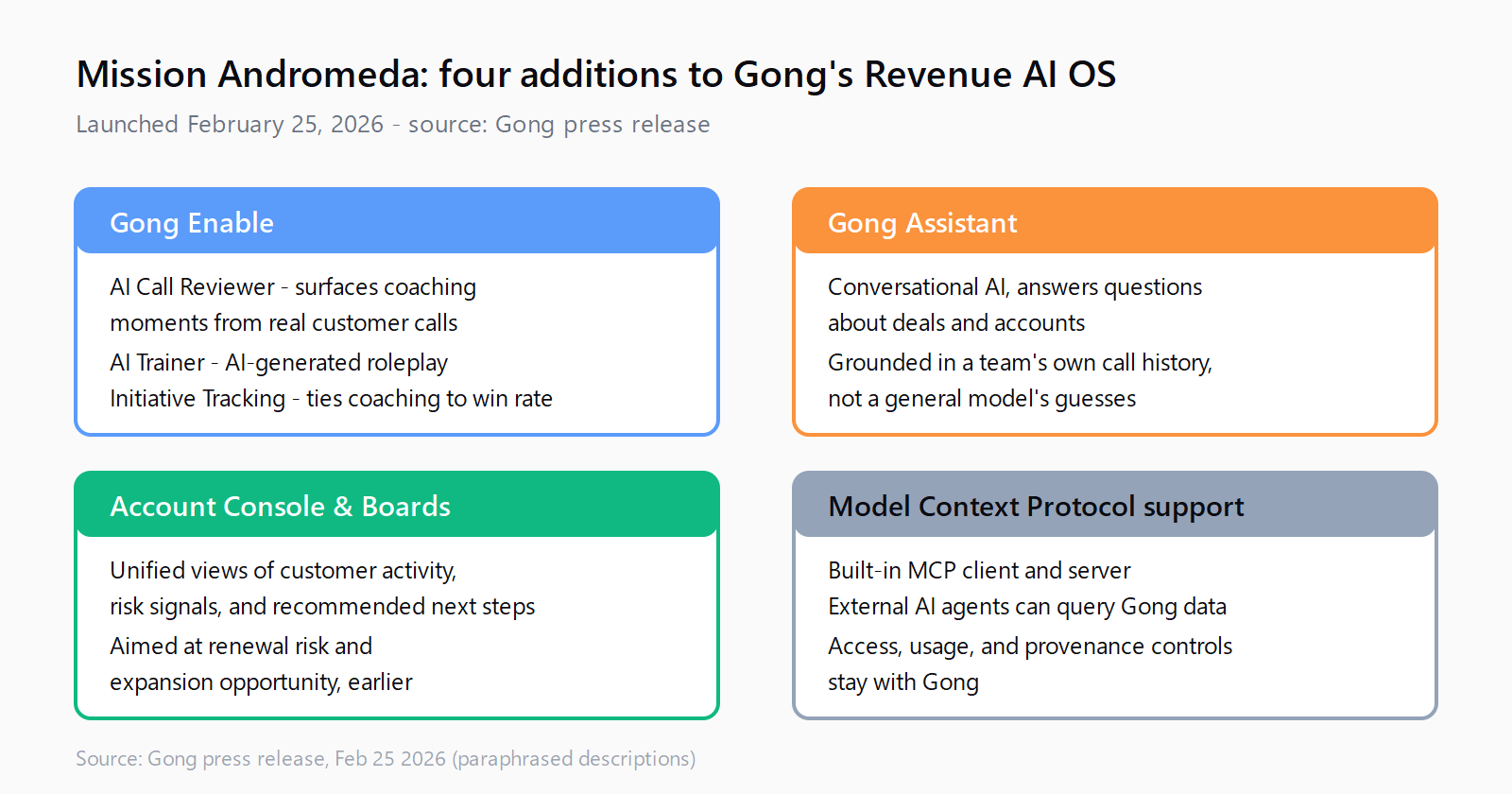
The concrete additions, according to Gong's own announcement: Gong Enable, a new AI-powered enablement product built around AI Call Reviewer (surfaces coaching moments from real calls), AI Trainer (AI-generated roleplay scenarios), and Initiative Tracking (ties coaching programs to win rate, deal size, and ramp time); Gong Assistant, a conversational layer that answers questions about deals and accounts grounded in a team's actual call history instead of a general model's guesses; Account Console and Account Boards, unified views of customer risk and expansion signals that read a lot like what used to require a separate customer-success tool; and built-in support for Model Context Protocol, letting external AI agents query Gong data under access controls Gong still administers. Four products, one release name, one press cycle - Gong's stated goal with the new cadence is to stop customers discovering each capability piecemeal, the way earlier Gong features often shipped as a changelog line nobody in RevOps noticed until a rep asked why a new tab appeared in the app.
Gong frames all of this as extending intelligence into "daily decisions," not just producing more dashboards. Chief Product Officer and co-founder Eilon Reshef put it this way in the announcement: "Revenue teams have more insights than ever before, but applying those to drive outcomes remains a challenge." The one customer quote in the release comes from Rae Cheney, Director of Sales Enablement Technology at Morningstar, who said Gong Enable "lets us turn real customer conversations into practical coaching and tighter deal execution" (I'd note Morningstar is the launch's cited reference account, which is useful context but not the same thing as broad customer outcome data).
The specific gap Gong cites in that same release, from a Gartner survey of sales leaders:
Enablement teams face growing demands with limited capacity. According to Gartner Inc., 65% of CSOs and senior sales leaders say their enablement function is stretched thin, while frontline managers spend just 9% of their time coaching.
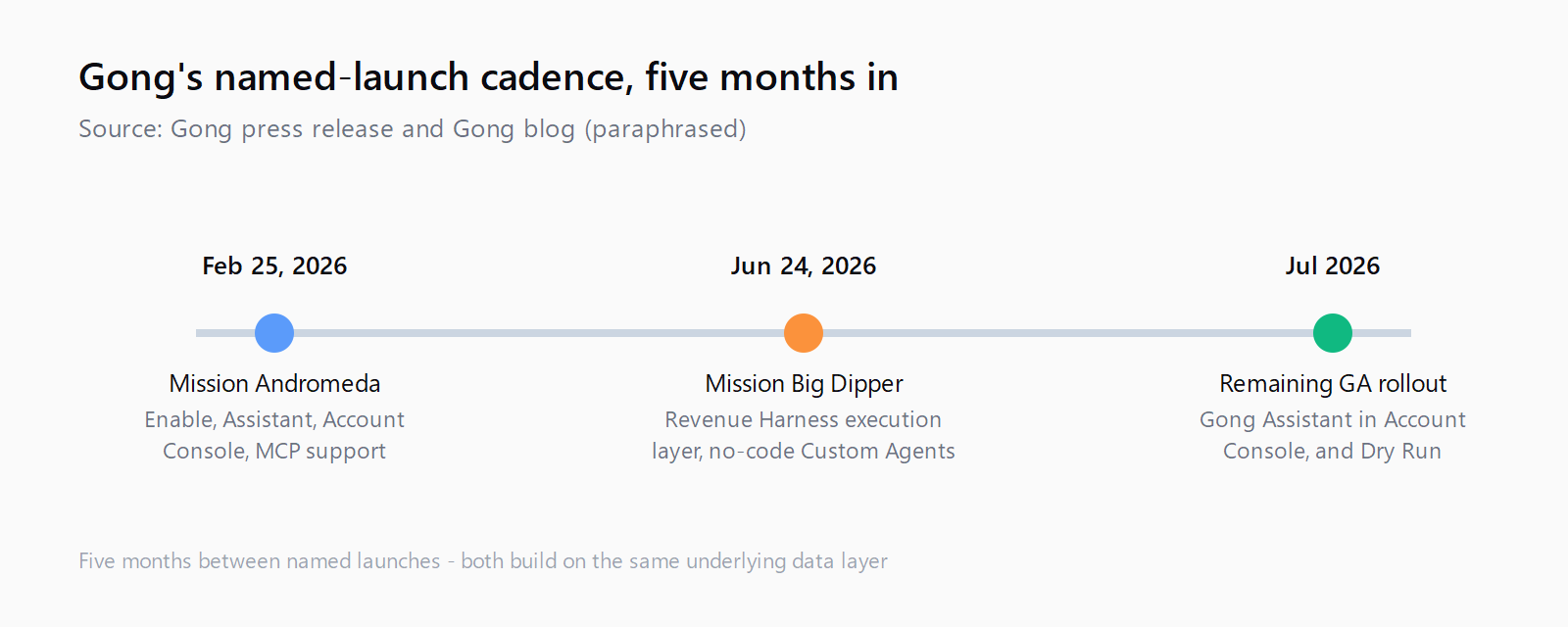
That's the stat Gong is building Gong Enable against, and it's a real gap - I've heard some version of "managers don't have time to coach" from enough RevOps people that I believe the 9% figure more than most vendor-cited research. What's newer is the interoperability move: MCP support means a Gong customer's other AI tooling (a forecasting agent, a QBR generator, whatever gets built next) can pull grounded call data through a standard protocol instead of a bespoke API integration per vendor. Gong's follow-up launch in June, Mission Big Dipper, leans into exactly this by adding a no-code "Custom Agents" builder on the same data layer - Gong's own example is a RevOps leader describing an agent that "monitors every account over $100K, flags risk signals, and generates a structured summary" without touching code, which is a considerably more ambitious pitch than the enablement-focused messaging Andromeda shipped with five months earlier. Andromeda's MCP bet, in hindsight, reads less like a one-off feature and more like the foundation Gong is now actively building on - two named launches, five months apart, is a fast enough cadence that treating either one as a finished product feels like the wrong frame. Better to read Andromeda as the data-and-coaching layer and Big Dipper as the layer that acts on it, with more named launches presumably coming.
This is exactly the kind of platform-consolidation moment we think about a lot at Leadex, because it's happening one layer downstream from where we sit. Gong is bundling coaching, account visibility, and now agent interoperability around calls that have already happened; Leadex's job is upstream of that, building the account and contact list a rep gets a chance to call in the first place. The MCP detail is the one worth watching if you're evaluating this stack, since "let other agents query our data under controlled access" is the same seam Leadex already lives at - our research agent composes data from the open web and your connected providers into one deduped export rather than owning a walled garden of its own.
The part I'd push back on: Gong Enable ships as its own paid tier, not a bundled upgrade, and Gong's existing customer reviews already flag price as the top complaint - "way too expensive when there are more affordable tools that work" is a common enough line on review sites (I paraphrase the sentiment from Sybill's rundown of Gong reviews, which independently reaches the same conclusion). Buying AI-generated roleplay and call-grounded coaching on top of an already five-figure conversation-intelligence contract is a different budget conversation than buying the base product was two years ago, and it's worth asking a Gong rep directly whether Enable is priced per seat or per team before assuming it slots into an existing renewal. Gong isn't alone in making this move, either - Outreach's own Omni AI agent push shipped this year with a similar logic, an AI layer embedded in the execution surface rather than sold as a bolt-on. Every RevOps team evaluating one of these launches this year is really evaluating whether their existing platform vendor should also become their AI vendor, and whether that's a consolidation worth paying a premium for.
The skepticism worth sitting with (I think) isn't whether Gong Enable can generate roleplay transcripts - it obviously can - it's whether AI-generated coaching changes what a rep actually does on the next call, or just produces another dashboard a manager glances at once a quarter. Conversation intelligence has been promising behavior change since the category existed; Initiative Tracking is Gong's attempt to make that promise measurable by tying it to win rate and ramp time instead of leaving it as a vibe. There's also a quieter risk worth naming: AI Call Reviewer and AI Trainer both run on a rep's own recorded calls, so the coaching-versus-surveillance line depends entirely on how a manager chooses to use the output, not on anything the product itself enforces. Whether the win-rate correlation holds up with a full year of real customer data, as opposed to the single Morningstar case study Gong is running in its own launch materials, is the thing to actually ask a Gong rep before signing an Enable contract, not after. Ask specifically for win-rate or ramp-time deltas from customers who've run Initiative Tracking for at least two full quarters, not the launch-week case study - a coaching product's real evidence takes longer to accumulate than a press cycle does.
What actually changes for a RevOps buyer this month: Gong Assistant inside Account Console and a feature called "Dry Run" are the two pieces still marked as rolling out to general availability in July, so if you're mid-evaluation, ask which parts of the demo you saw are shipped versus roadmap. Account Console pulling risk signals alongside whatever's already flowing through Gong's Salesforce sync is the part I'd actually pilot first - it's the one piece of Mission Andromeda that doesn't require trusting a new AI coaching workflow, just a better view of data Gong already had.